


A flashing headlight from an oncoming truck in Thailand isn’t a polite invitation to go first; it’s a bold warning that they’re claiming the right of way. If you’re planning to get behind the wheel, understanding the specific Pattaya road rules for tourists is the difference between a scenic coastal drive and an expensive afternoon at a police station. we know that the thought of aggressive traffic flow and confusing IDP legality can feel overwhelming when you just want to explore the Land of Smiles on your own terms.
You’re right to be cautious, as 2026 has brought much stricter enforcement and higher fines for simple mistakes. This guide promises to turn that anxiety into confidence by helping you master both the legal requirements and the local driving culture for a safe, fine-free journey. We’ll walk you through the mandatory 1949 or 1968 IDP conventions, explain why the fine for using a mobile phone has reached 4,000 THB, and show you how to join the traffic flow safely without attracting unwanted attention at police checkpoints.
Key Takeaways
- Ensure your International Driving Permit (IDP) matches your specific vehicle category, as a standard car license is legally insufficient for operating motorbikes in Thailand.
- Navigate busy intersections with confidence by mastering the Pattaya road rules for tourists, including how to identify “no parking” zones marked by red and white striped curbs.
- Learn to use the unique Thai U-turn system on divided highways and understand why following the natural traffic flow is often safer than relying strictly on western-style right-of-way.
- Protect yourself legally and financially by verifying your rental vehicle has a valid “Por Ror Bor” compulsory insurance sticker and a documented pre-rental inspection.
- Stay alert for local hazards such as stray animals during dawn or dusk and recognize that larger vehicles generally expect smaller ones to yield in the local hierarchy of the road.
Legal Driving Requirements: What You Need Before You Start
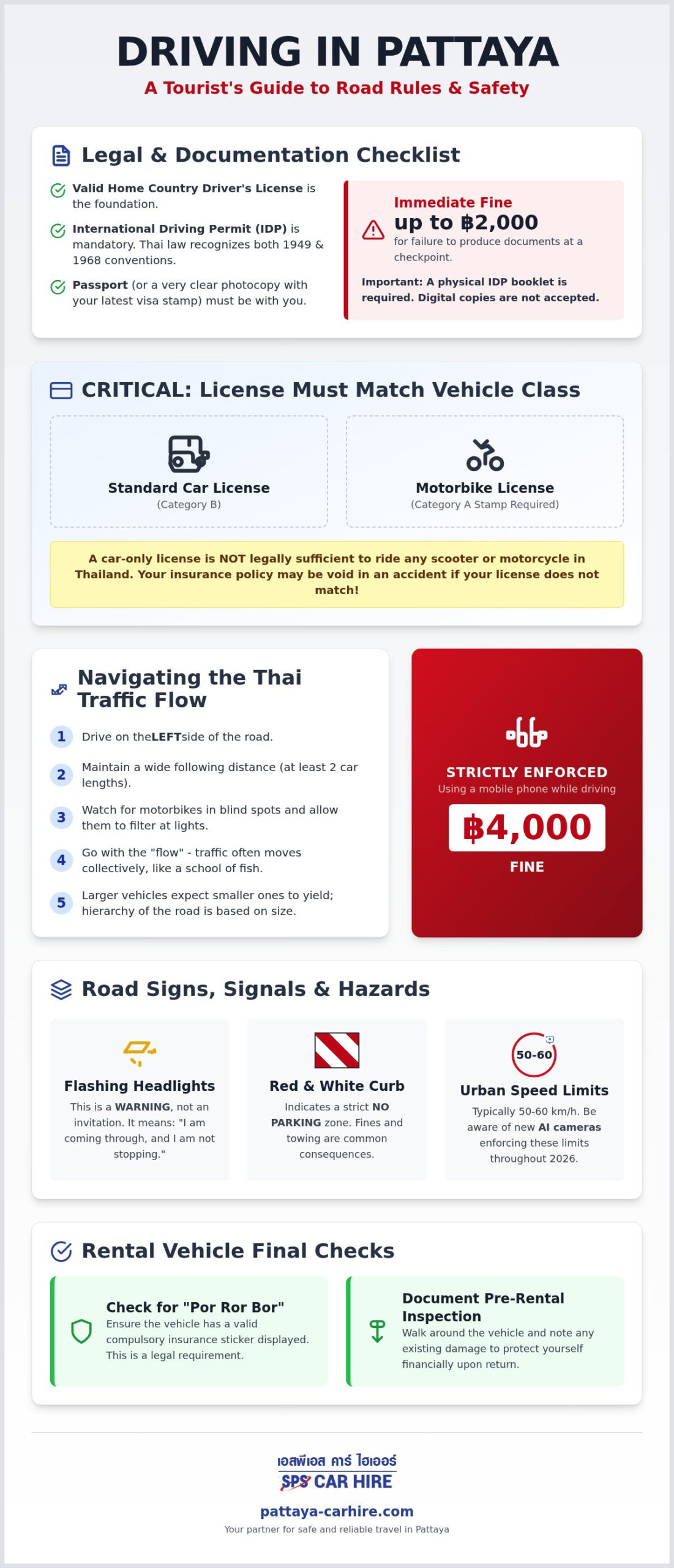
Driving through the vibrant streets of Chonburi is the ultimate way to see the sights, but you need to be legally “bulletproof” before you turn the key. While your home country license is a valid proof of your driving ability, Thai law requires tourists to carry an International Driving Permit (IDP) at all times. This isn’t just a suggestion; it’s a core part of the Pattaya road rules for tourists that keeps you out of trouble at local checkpoints. You’ll also need to keep your passport, or a very clear photocopy with your latest visa entry stamp, handy. If a police officer asks for your papers and you can’t produce them, you’re looking at an immediate fine of up to 2,000 THB.
The 1949 vs. 1968 IDP Convention
Thailand currently recognizes IDPs issued under both the 1949 and 1968 conventions. It’s a common point of confusion, but as long as your permit is valid and matches the format of your home country’s issuing body, you’re usually fine. Always check the expiration date before you fly, as these permits typically only last for twelve months. we’ve seen many travelers try to show a digital version on their smartphone, but this rarely works. Thai authorities want to see the physical booklet. Given the complex nature of Transport in Thailand, having the correct physical documentation ensures there’s no room for misinterpretation during a roadside check.
Vehicle Class Matching
You must ensure your license category matches the vehicle you’re operating. This is where most tourists get caught out. If you’re planning to enjoy a best price motorbike rental, your IDP must have the “Category A” stamp. A standard car license doesn’t legally allow you to ride a scooter or motorcycle in Thailand, regardless of the engine size. The same rule applies if you’re opting for a truck rental; make sure your home license covers that weight class. This detail is vital because your insurance validity hinges on it. Even the best “First Class” insurance policy won’t pay out if you’re unlicensed for the vehicle you’re driving. We prioritize your safety and peace of mind, so we always verify your documentation to make sure your coverage remains 100% valid throughout your trip.
Staying legal isn’t just about avoiding fines; it’s about making sure you’re protected if the unexpected happens. When you have the right paperwork, you can focus on the road ahead rather than worrying about the next police checkpoint. It’s the first step toward a smooth, stress-free journey across the country.
Driving Tips for Navigating the Thai Traffic Flow
Adapting to the local movement is the secret to a stress-free trip. In Thailand, we drive on the left side of the road. While that sounds simple, the actual Pattaya road rules for tourists involve a fluid “flow” that might feel chaotic at first. You’ll quickly notice that traffic moves like a school of fish. If everyone is shifting slightly to one side to avoid an obstacle, you should too. Don’t just stare at the signs; watch the vehicles around you. This collective movement often dictates the pace more than the posted limits, though you should still respect the 50-60 km/h urban speed limits to avoid the new AI cameras that are active throughout 2026.
Maintaining a wide following distance is your best defense against local surprises. Public transport vehicles like “baht buses” or songthaews are notorious for stopping without warning to pick up passengers. If you’re tailgating, you won’t have time to react. We always recommend keeping at least two car lengths of space, especially on busy stretches like Beach Road or Second Road. This gap gives you the visibility needed to spot motorbikes that might be darting into your lane from a side soi. It’s much easier to enjoy the scenery when you aren’t constantly slamming on the brakes.
Interacting with Motorbikes Safely
Motorbikes are the lifeblood of Thai traffic. You must assume a bike is in your blind spot every time you turn or change lanes. Use your indicators early and move predictably so riders can adjust their path around you. It’s common practice to leave space at the front of a traffic light queue for motorbikes to filter through. Don’t take it personally; it’s just how the system works. According to the U.S. Embassy guidance on driving in Thailand, being aware of these smaller vehicles is crucial for avoiding accidents. If you’re looking for the most flexible way to get around, our budget car and truck rental options provide a much safer “bubble” than a scooter.
The Unwritten Rules of Right-of-Way
The hierarchy of the road is real. In practice, larger vehicles like buses and trucks often assume they have the right of way regardless of what the signs say. It’s safer to yield than to insist on your legal right. A headlight flash from an oncoming car doesn’t mean “go ahead.” It actually means “get out of the way, I’m coming through.” Also, be extremely careful at pedestrian crossings. While you’re legally required to stop, the driver behind you might not expect it. Check your mirrors before braking for a pedestrian to ensure you aren’t about to get rear-ended. By merging these unwritten habits with formal rules, you’ll navigate the city like a seasoned local.
Deciphering Road Signs and Traffic Signals
Understanding the visual language of the streets is your best defense against accidental fines. Most major directional signs use both Thai script and English translations, making it surprisingly easy to find your way. However, you need to pay closer attention to the curbside markings than the overhead signs. Red and white striped curbs indicate a strict “No Parking” zone at any time. If you ignore this, you’re looking at a 2,000 THB fine plus towing fees. Yellow and white stripes are for temporary loading or bus stops. You can drop someone off here, but don’t leave your vehicle unattended.
One of the most helpful Pattaya road rules for tourists is the “Left Turn on Red” policy. At many intersections, you’re permitted to turn left even when the light is red. You must come to a complete stop and yield to oncoming traffic before moving. Look for a small sign at the intersection that explicitly allows or forbids this move. If there’s no sign, it’s generally accepted, but always proceed with extreme caution to avoid the flow of motorbikes filtering through the front.
Traffic Light Nuances
Patience is a virtue at Thai intersections. Large urban centers often feature traffic lights with countdown timers that can stretch for several minutes. While you wait, stay alert for specific directional arrows. Don’t move just because the car next to you does; wait for your specific green arrow. AI-powered red light cameras are now standard in 2026, automatically issuing digital fines for those who try to beat the light. Whether you’re exploring the city or following a Thailand road trip guide through the countryside, these systems are strictly enforced to improve road safety.
Police Checkpoints and Fines
You’ll likely encounter police checkpoints during your stay. These are routine measures used to check for licenses and sobriety. When stopped, remain polite and show your IDP along with your rental agreement. If you are issued a fine for a violation, such as using a mobile phone which costs 4,000 THB in 2026, always insist on a formal ticket. Most fines are now processed digitally, allowing you to pay via a banking app or at the local station. We recommend avoiding any “informal” settlements to ensure your records remain clear and your journey stays on track. Staying calm and transparent is the fastest way to get back on the road.
Navigating Common Hazards and Rural Roads
Stepping outside the city center introduces a new set of challenges that aren’t always covered in a standard manual. One of the most critical Pattaya road rules for tourists to remember is to watch for “ghost riders.” These are local motorbikes that drive against the flow of traffic on the shoulder to save time. It’s a common sight, so don’t let it startle you; just maintain your lane and avoid drifting too far to the left. You should also be wary of the monsoon season between May and October. Roads can become incredibly slippery in seconds, and deep standing water can hide potholes or debris. If the rain starts, reduce your speed immediately to maintain control.
If you’re planning a trip outside the city, choosing a reliable best price car and truck rental ensures you have a vehicle capable of handling these varied conditions safely. Rural roads often lack the streetlights and safety barriers found on major highways, so we advise against driving at night whenever possible. Stray animals, particularly dogs and cattle, frequently wander onto the tarmac during dusk and dawn. Their behavior is unpredictable, and a collision can be devastating at high speeds.
Mastering the Highway U-Turn
Thai highways often lack traditional exits, relying instead on a system of U-turn slots to change direction. This can be intimidating on a six-lane road. Merge into the far right lane well before you reach the slot. Wait for your gap. You must wait for a clear gap in oncoming high-speed traffic before committing to the turn. Once you move, accelerate quickly to match the speed of the vehicles in your new lane. Mastering this maneuver is a vital part of understanding the Pattaya road rules for tourists who want to explore beyond the main beaches. Don’t hesitate; the key is to be decisive so other drivers can predict your movement.
Rural and Mountain Driving
Heading toward the hills requires a shift in your driving technique. Always use lower gears for steep descents to prevent your brakes from overheating and fading. Many mountain passes are narrow and lack shoulders, meaning there’s very little room for error. We recommend sounding your horn gently when approaching blind curves. This alerts oncoming drivers of your presence in areas where the road might be too narrow for two vehicles to pass comfortably. It’s a simple local habit that significantly reduces the risk of a head-on collision on winding rural routes.
Ensuring Safety with Your Rental Vehicle
Your journey starts long before you merge into traffic. Before you sign any rental agreement, perform a meticulous walk-around inspection of the vehicle. Take photos or a quick video of every scratch, dent, and wheel rim. This simple step protects your deposit and ensures there are no disputes when you return the keys. We pride ourselves on transparency, so we always encourage our clients to be thorough. You must also verify that the vehicle displays a valid “Por Ror Bor” sticker on the windshield. This is the compulsory third-party insurance required by law. Without it, you’re technically violating Pattaya road rules for tourists, which can lead to immediate complications at any police checkpoint.
While the “Por Ror Bor” is mandatory, it offers very limited coverage. For true peace of mind, always choose a rental agency that provides comprehensive “First Class” insurance. In Thai rental terms, First Class coverage is the gold standard. It protects you against theft, fire, and damage to your own vehicle regardless of who is at fault. It’s the only way to drive with total confidence. Learn more about car rental insurance in Thailand to understand exactly how these policies shield your wallet from unexpected costs. Finally, save your rental company’s emergency contact number and the tourist police hotline (1155) into your phone before leaving the lot.
What to Do in the Event of an Accident
If the unexpected happens, stay calm and keep the vehicles exactly where they are. In many Western countries, you’re told to move to the shoulder, but in Thailand, moving the car before the insurance surveyor or police arrive can be seen as an admission of guilt. Contact your rental company immediately to trigger the insurance process. They’ll send a surveyor to the scene to handle the paperwork and coordinate with the other party. Following this protocol is a vital part of navigating Pattaya road rules for tourists safely and ensures your insurance claim remains valid. For a comprehensive breakdown of every step you need to take, review the full rental car accident procedure Thailand requires in 2026, including who to call and how to protect your deposit.
Choosing the Right Vehicle for Your Trip
The right vehicle makes all the difference for your specific itinerary. If you’re planning to explore the rugged rural roads we discussed earlier, a sturdy truck provides the ground clearance and power you need. For those sticking to urban centers, a compact car is much easier to maneuver through narrow sois and tight parking spots. If your stay exceeds two weeks, our long term car hire packages offer significant savings over daily rates. Always prioritize vehicles equipped with modern safety features like ABS and multiple airbags. We focus on providing high-quality, well-maintained vehicles so you can focus on the adventure ahead.
Hit the Road with Total Confidence and Ease
Mastering the local driving culture is the ultimate way to unlock the freedom of Thailand on your own terms. By securing the correct IDP category and learning to navigate the natural “flow” of traffic, you’ve already cleared the biggest hurdles to a successful trip. Staying alert for unwritten habits like the highway U-turn system and adhering to the Pattaya road rules for tourists ensures your journey remains smooth, safe, and entirely fine-free. Driving yourself offers a level of flexibility that taxis simply can’t match, allowing you to discover hidden coastal spots at your own pace.
We’re dedicated to making your self-drive experience as simple as possible from the moment you arrive. Book your budget-friendly rental car today and benefit from our Best Price Guarantee on all vehicles. Every booking features First-Class Insurance included and 24/7 Roadside Support, providing you with a reliable safety net wherever your adventure leads. We’ve taken care of the logistics so you can focus on the incredible views ahead. Enjoy the drive and stay safe out there!
Frequently Asked Questions
Can I drive in Thailand with a UK or US driving license?
You can use a UK or US license, but it’s only legally valid when accompanied by an International Driving Permit (IDP). For car rentals, you must carry either the 1949 or 1968 convention IDP booklet. If you’re planning on a motorbike rental, your IDP must specifically have the Category A stamp. Driving without the correct permit can result in a police fine between 1,000 and 2,000 THB.
What side of the road do they drive on in Thailand?
Traffic moves on the left-hand side of the road in Thailand, and all vehicles are right-hand drive. This is the same system used in the UK and Australia. If you’re used to driving on the right, pay extra attention when turning at intersections or exiting parking lots. It’s easy to instinctively drift into the wrong lane when the roads are quiet.
Is it safe for tourists to drive a car in Thailand?
It’s safe for tourists to drive if they stay alert and adapt to the Pattaya road rules for tourists. While the traffic flow is often aggressive, driving a car offers much better protection and flexibility than a scooter or a taxi. We recommend staying within the 50-60 km/h urban speed limits to navigate busy areas like Beach Road with confidence.
What does it mean when a driver flashes their lights at me?
A headlight flash from an oncoming vehicle means “I am coming through” and serves as a warning for you to yield. This is the opposite of the “after you” signal used in many Western countries. If someone flashes their lights, don’t pull out or change lanes. They’re asserting their right of way and expect you to wait until they’ve passed.
How do I handle a police checkpoint as a foreigner?
Stay calm, be polite, and have your physical documents ready to present to the officer. You’ll need to show your passport, your home driving license, and your IDP. If you’ve committed a minor violation, the officer will issue a formal ticket. Most fines in 2026 are processed digitally, allowing you to pay at the nearest station or via a mobile banking app.
What are the parking rules and curb markings I should know?
Curb colors tell you exactly where you can and cannot stop. Red and white stripes indicate a strict no-parking zone where you’ll face a 2,000 THB fine and potential towing. Yellow and white stripes are reserved for bus stops or temporary loading zones. You can generally park next to black and white or plain curbs unless a specific sign forbids it.
Are there toll roads in Thailand and how do I pay?
Toll roads are common on major routes like Motorway 7, and you can pay using cash or electronic tags like M-Pass. Toll fees typically range from 30 to 120 THB depending on how far you travel. We suggest keeping a small stack of 20 and 50 THB notes in your rental vehicle to make passing through the manual toll booths quick and easy.
What should I do if I get into a minor car accident?
Do not move your vehicle until the insurance surveyor or police have arrived at the scene. Moving the car can be interpreted as an admission of fault and may void your insurance coverage. Contact our rental office immediately so we can dispatch a surveyor to handle the paperwork and liaise with the other driver on your behalf.
 -
- -
- -
- -
- -
- -
- -
-