


Did you know that the “cheapest” monthly rental quote you just found might actually be an illegal trap that leaves you personally liable for millions of Baht? It’s a common fear for many expats and long-stay travelers who worry that a minor scratch or a confusing road incident could lead to a massive bill or legal trouble in a foreign land. Understanding long term car rental insurance Thailand is the only way to protect your wallet and your peace of mind while you explore the Land of Smiles.
I know you just want a reliable car without the anxiety of hidden fees or “Third Party” policies that offer almost zero protection. This guide will help you master the complexities of the 2026 insurance landscape, including the new 20 million Baht liability minimums and the mandatory e-policy system. I’ll show you exactly how to spot genuine “First Class” coverage that includes a bail bond, ensuring you stay legally compliant and financially safe. We’re going to break down the entire claim process and explain how to secure premium protection on a budget-friendly rental package.
Key Takeaways
- Identify the critical differences between Thailand’s tiered insurance classes to avoid the legal and financial traps of insufficient coverage.
- Learn why First-Class protection is the only viable option for long term car rental insurance Thailand to ensure you’re covered for theft, fire, and no-fault collisions.
- Navigate the updated 2026 regulations, including the shift to mandatory e-policies and the significantly increased 20 million Baht liability limits.
- Understand how to manage and minimize your “excess” or deductible to keep your financial liability low in the event of an accident.
- Discover how to secure transparent, budget-friendly rental packages that combine local expertise with premium insurance standards.
Understanding Long-Term Car Rental Insurance in Thailand
Thailand’s vehicle insurance system isn’t a guessing game; it’s a structured, numerical hierarchy that ranges from Class 1 down to Class 3. While a basic understanding of vehicle insurance from your home country provides a foundation, the local market has specific quirks that can trip up even the most seasoned traveler. When you’re investigating long term car rental insurance Thailand, you’ve got to realize that a six-month contract isn’t just an extended holiday hire. You’re effectively a local road user now, and your exposure to daily traffic risks is significantly higher than a weekend tourist visiting a resort. First-Class insurance is the highest level of comprehensive vehicle protection in Thailand.
Choosing the right coverage means looking past the monthly price tag. A three-day rental might let you get away with basic protection, but for long-term stays, you need a policy that handles the heavy lifting of legal liability and property damage. You don’t want to be the person stuck in a police station because your “budget” rental didn’t include the right paperwork for an extended hire.
The Risk of Private vs. Commercial Insurance
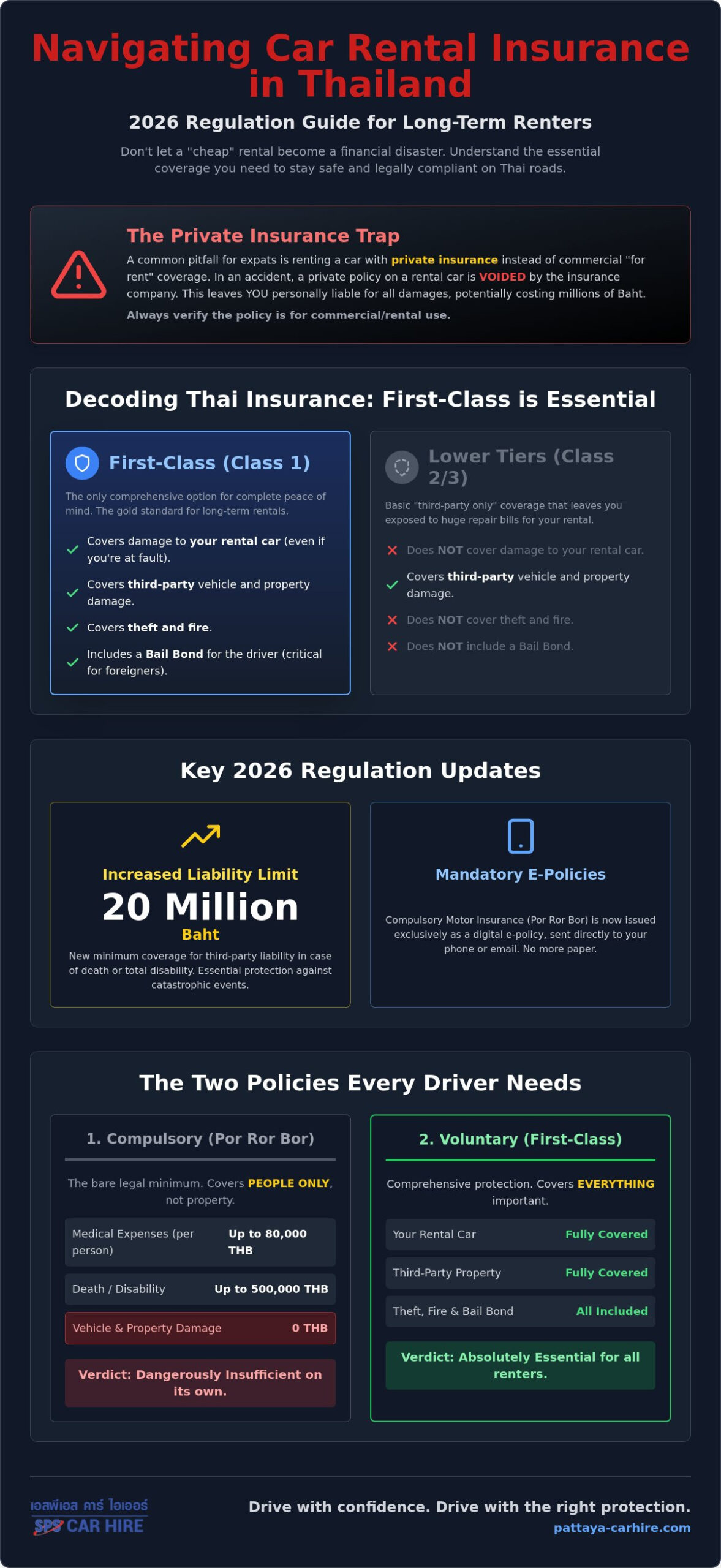
I see this mistake all the time: expats renting from a small, independent owner who uses a standard private insurance policy. This is a massive trap. In Thailand, if a vehicle is used for commercial hire but is only covered by a private policy, the insurance company will legally void any claim the moment an accident occurs. You’ll be left personally liable for every Baht of damage to the car and any third-party property.
You can identify a legally insured rental by checking the registration documents provided with the car. If the policy doesn’t explicitly state it’s for commercial use or “rent-a-car” purposes, you’re driving without real protection. The financial consequences of an accident in an improperly insured vehicle can reach into the millions, especially with the 2026 minimum liability requirements now in effect. Don’t risk your savings just to save a few hundred Baht on a monthly rate.
Compulsory Motor Insurance (Por Ror Bor)
Every vehicle on a Thai road must carry “Por Ror Bor,” the government-mandated compulsory insurance. As of January 1, 2026, these are issued exclusively as digital e-policies, so you should receive a copy on your phone or via email immediately. Many people confuse the square tax sticker on the windshield with the insurance itself. While they’re linked, that sticker is actually your annual road tax, which can only be paid once the compulsory insurance is active.
This coverage is strictly for people, not metal. It pays for medical expenses up to 80,000 Baht per person and provides up to 500,000 Baht in the event of death or permanent disability. It doesn’t cover a single satang of damage to your rental truck or the Mercedes you just bumped into. For long-term residents, relying on Por Ror Bor alone is incredibly dangerous. It’s the bare legal minimum, but it won’t protect your wallet from the actual costs of a road incident.
What Exactly is First-Class Insurance for Car Rentals?
First-Class insurance, often called Class 1, is the absolute gold standard for anyone looking into long term car rental insurance Thailand. It provides the most comprehensive protection available, covering theft, fire, and collision damage. Unlike lower tiers that only cover the other party, this policy protects your rental vehicle regardless of who caused the accident. If you’re involved in a scrape with a motorbike or a stationary object, you won’t be left footing the entire repair bill. First-Class insurance is the only tier that covers “own-vehicle” damage in a single-vehicle accident.
Third-party property damage limits are a major part of this coverage that you cannot afford to ignore. As of January 1, 2026, new voluntary policies are required to provide a minimum of 20 million Baht for third-party liability in cases of death or total disability. This high limit is essential because Thai roads can be unpredictable; having a policy that meets these modern standards is non-negotiable for long-term peace of mind. You must ensure your policy is backed by official licensing requirements, as driving without a valid IDP or Thai license can void these protections instantly.
The Bail Bond: A Critical Foreigner Protection
One of the most overlooked features of Class 1 insurance is the Bail Bond clause. In Thailand, if an accident involves serious injury or death, the police have the authority to detain the drivers involved during the investigation. For a foreigner, this is a terrifying prospect. A Bail Bond acts as a financial guarantee to the court, allowing you to remain free while the legal process unfolds. It’s a standard part of our long-term car rental packages because we know that your freedom is just as important as your financial safety.
Personal Accident Insurance (PAI)
While the vehicle is covered, Personal Accident Insurance ensures the people inside are protected too. This component provides medical coverage for the driver and all passengers for injuries sustained during an accident. It’s designed to complement your existing health insurance, acting as an immediate financial cushion for hospital stays or emergency treatments. For budget-friendly rentals, these limits are typically robust enough to handle initial stabilization and minor surgeries. It’s about creating a safety net so you can focus on recovery rather than hospital bills.
Comparing Insurance Options for Extended Vehicle Hire
When you’re looking at monthly rates, I’ll tell you straight: the gap between a “cheap” quote and a “safe” quote usually comes down to the insurance class. For long term car rental insurance Thailand, you’ll mostly encounter Class 1, Class 2, and Class 3. While Class 3 covers the other driver’s car, it leaves you completely exposed for your own vehicle’s repairs. Over a six-month or year-long hire, the statistical likelihood of a minor bump increases, making that initial saving a massive financial gamble. You can find more details on these tiers in this guide to rental car insurance, which highlights why comprehensive coverage is the standard for reputable agencies.
You’ll also see terms like “Collision Damage Waiver” (CDW) used frequently. In Western markets, CDW is a specific legal waiver, but in Thailand, it’s often just a marketing label for Class 1 insurance. Don’t assume CDW means zero liability. Always ask if it’s “Full” or if there’s a hidden list of exclusions. A stripped-back policy might exclude glass, tires, or undercarriage damage. These are the most common issues on Thai roads and can quickly drain your security deposit. If you’re based in the area and want a full breakdown of how these policies work locally, our car rental insurance Pattaya guide for 2026 covers every detail of the updated digital-policy landscape.
First-Class vs. Third-Party Only
Budget rental companies often highlight Third-Party only rates to lure you in with a low headline price. This covers the medical costs of others and damage to their property, but if your rental truck is stolen or catches fire, you’re responsible for the full replacement value. It’s a massive liability gap that most expats can’t afford. Consider these differences:
- Class 1: Covers your car, their car, theft, fire, and no-fault accidents.
- Class 3: Covers only the other person’s property and medical bills; zero coverage for your rental.
At SPS Car Hire, we refuse to play that game. We include First-Class insurance in our long-term packages because we believe true value means protecting our customers from life-changing debt, not just offering the lowest price on a spreadsheet.
The “No Opposing Party” Clause
Thai roads are full of surprises, from stray dogs to poorly marked concrete barriers. If you swerve to miss a dog and hit a pole, that’s a single-vehicle accident. Under Class 2 or 3 insurance, the claim will be rejected immediately because there’s no “opposing party” (another vehicle) to identify. First-Class insurance is the only tier that handles these common scenarios. It ensures that a moment of bad luck doesn’t turn into a multi-thousand Baht repair bill that you have to pay out of pocket before you can return the keys. Before you hit the road, it’s also worth reviewing the Pattaya road rules for tourists to understand local traffic behaviour and the 2026 enforcement changes that could affect your journey.
Managing the Excess: What Long-Term Renters Need to Know
In the world of long term car rental insurance Thailand, the “excess” is your maximum financial liability for a claim. Think of it as the skin you have in the game. It prevents drivers from filing a claim for every tiny pebble chip. For budget-friendly cars and trucks in 2026, the standard excess range for a First-Class policy typically sits between 5,000 and 10,000 THB. This amount is usually pre-authorized on your credit card or held as a cash deposit when you start your multi-month hire.
You need to distinguish between “Damage Excess” and “Theft Excess.” While they are often the same amount, some predatory contracts might sneak in a higher deductible if the vehicle is stolen. Before you drive away, take a high-quality video walk-around of the vehicle. Focus on the wheels, the roof, and the interior upholstery. For a long-term hire, these time-stamped records are your best defense against unfair charges when it’s time to return the keys.
How Deductibles Work in a Claim Scenario
If you’re involved in an accident and it’s your fault, you’ll pay the agreed excess amount to cover the repairs. However, if the accident is clearly not your fault and the “opposing party” is identified at the scene, you shouldn’t have to pay a satang. This is where the insurance surveyor comes in. In Thailand, insurance companies send a representative on a motorbike to the scene of every accident. This surveyor is the judge and jury; they document the damage and issue the claim forms on the spot. Don’t move your vehicle until they arrive and provide you with the official paperwork.
Savvy Local Checklist: Verifying Your Policy
Don’t just trust the sticker on the windshield. That square paper is actually your road tax, not your insurance policy. To verify your protection, you must look at the actual insurance schedule, which should be kept in the glove box or provided as a digital e-policy. I recommend looking for specific Thai phrases to ensure you aren’t being scammed. A legal rental must be registered for “Commercial Use” (เพื่อการพาณิชย์). If the document says “Personal Use” (ส่วนบุคคล), the insurance is technically void for a rental, and you’ll be left unprotected in a major crash.
I’ve built my reputation on being straightforward about these details. If you want a contract that is 100% transparent and legally compliant, check out our long-term car rental packages today. We ensure every vehicle is correctly registered so you can focus on the road, not the fine print.
Securing Your Long-Term Rental with SPS Car Hire
Choosing a vehicle for an extended stay shouldn’t feel like a legal gamble. At SPS Car Hire, we operate as a locally owned independent agency, which gives us a massive advantage over the detached corporate giants. We know the Thai roads, the local police protocols, and exactly how long term car rental insurance Thailand should be structured to keep you safe. Our commitment is simple: every long-term package we offer includes full First-Class insurance by default. We don’t believe in “optional” safety, so we’ve built our budget-friendly rates to include the premium protection that expats and long-stay travelers actually need to stay legal and stress-free.
When you rent for more than six months, the logistics can get messy. Most people forget about insurance renewals or annual road tax payments until they see a flashing light in the rearview mirror. We take that burden off your shoulders entirely. Our team manages all insurance renewals and scheduled maintenance for the duration of your contract. We keep our fleet in top mechanical condition, ensuring your self-drive experience remains reliable from the first month to the last. You get the benefit of a premium-service experience without the premium price tag.
Transparent Long-Term Car and Truck Packages
We’ve built our business on a “No Hidden Costs” promise. When you receive a quote from us for a car or truck, the price you see is the total price you pay. There are no surprise insurance surcharges or hidden tax fees waiting for you at the counter. We offer flexible terms on a wide range of vehicles, from fuel-efficient hatchbacks to rugged pickup trucks. By exploring our long term car hire benefits, you’ll see how we prioritize transparency and value for the international community. Whether you’re based in Pattaya or exploring further afield, our packages are designed to fit your specific lifestyle and budget.
24/7 Support and Replacement Guarantee
Road incidents don’t follow a schedule, so our support doesn’t either. If your rental vehicle requires mechanical attention or you’re involved in a collision, you won’t be left stranded on the side of a highway. We provide a replacement vehicle guarantee to ensure your life doesn’t stop just because your car needs a repair. You’ll have direct access to local experts who speak your language and can guide you through the insurance surveyor process we discussed earlier. It’s much safer to rent car instead of taxi for long stays, as it gives you total control over your mobility and ensures you’re always protected by a valid, commercial-grade insurance policy. We’re here to remove the friction from your journey, providing a one-stop solution that combines local knowledge with world-class protection.
Drive with Total Confidence on Thai Roads
Now you have the inside track on how the vehicle insurance system works in the Land of Smiles. You know that settling for anything less than First-Class coverage is a gamble that isn’t worth taking, especially when your legal freedom and savings are on the line. By ensuring your vehicle carries proper commercial registration and a bail bond clause, you’ve removed the biggest hurdles that trip up most expats. Just remember to document your vehicle’s condition thoroughly and always confirm your excess limits before you drive away.
At SPS Car Hire, we don’t just rent vehicles; we provide the peace of mind you need for a successful long stay. As a locally owned and operated agency, we stand by our best price guarantee and include full First-Class insurance with every single package. We’ve simplified the complexities of long term car rental insurance Thailand so you can skip the confusing fine print and start exploring. Your journey should be about the destination, not the paperwork.
View Our Long-Term Rental Packages with Full Insurance and secure a reliable, protected vehicle today. Thailand is a beautiful place to explore; let’s make sure you do it with the right safety net in place.
Frequently Asked Questions
Is First-Class insurance mandatory for car rentals in Thailand?
Compulsory Motor Insurance (Por Ror Bor) is the only legal requirement, but it only covers medical costs for injured persons. First-Class insurance isn’t mandated by the government, but it’s a standard requirement for any professional rental agency. We include it in every package because driving a long-term rental with only basic coverage is a massive financial risk that we won’t let our customers take.
What is the “excess” on a long-term car rental and how much is it?
The excess, or deductible, is the capped amount you’re responsible for paying if the car is damaged and you’re at fault. For budget cars and trucks in 2026, you’ll usually see this set between 5,000 and 10,000 THB. If the accident isn’t your fault and the other party is identified at the scene, you won’t have to pay anything at all.
Does my credit card car rental insurance work for long-term hires in Thailand?
It’s highly unlikely that a credit card policy will provide adequate protection for a multi-month hire in this region. Most cards limit coverage to 28 or 30 days and often exclude Southeast Asian countries from their benefits entirely. Securing dedicated long term car rental insurance Thailand ensures you have local support and a surveyor who can visit the accident scene in person to handle the paperwork.
What should I do if I have an accident in my rental car?
Stay with the vehicle and call your rental agency’s emergency hotline right away. You must wait for the insurance surveyor to arrive so they can assess the damage and identify who is at fault for the incident. Make sure you have your passport, driving license, and the insurance documents from the glove box ready for the surveyor to inspect.
Does long-term rental insurance cover multiple drivers?
Coverage is typically limited to the drivers named on your rental agreement. If you want a spouse or colleague to drive, they must be officially registered with the rental agency to keep the insurance valid. We can add additional drivers to your contract easily, provided they meet the local licensing requirements and have a valid International Driving Permit.
What happens if my rental car is stolen during a long-term hire?
Your First-Class policy covers the total loss of the vehicle through theft, as long as you followed basic security measures like locking the doors. You’ll need to file a formal police report immediately and notify the rental company to start the claim process. Your financial liability will be limited to the theft excess amount specified in your long-term rental contract.
Does the insurance cover damage to the tyres or windshield?
Windshield damage is usually covered under Class 1 policies, but tyres are often treated differently by insurance providers. Most insurers only cover tyre replacement if it’s the result of a larger accident involving another vehicle. If you simply get a puncture or hit a curb, the cost of the repair or replacement is typically your responsibility as the renter.
Can I take my rental car to neighbouring countries like Laos or Cambodia?
No, your insurance policy and rental agreement are only valid for use within the borders of Thailand. Driving into Laos, Cambodia, or Malaysia would immediately void your insurance and leave you personally liable for the car’s full value. Our vehicles are not permitted to cross international borders under any circumstances due to these strict insurance and registration limitations.
 -
- -
- -
- -
- -
- -
- -
-