


What if the insurance policy you just signed for your holiday drive is actually just a digital receipt that leaves you liable for thousands of dollars in “excess” fees? It’s a common fear for anyone looking into car rental insurance Pattaya, especially when you’re caught between confusing acronyms and the worry of being scammed after a minor fender bender. We know that the last thing you want on your vacation is to feel vulnerable or overcharged because of a document you didn’t fully understand. Most travelers feel that same knot in their stomach when handed a rental agreement, but it doesn’t have to be that way.
We’re here to help you master the complexities of Thai vehicle coverage so you can hit the road with total peace of mind and zero hidden costs. Since the 2026 shift to mandatory digital-only policies, the landscape has changed, but the goal remains the same: protecting your wallet. This guide breaks down the three-layered shield of Thai insurance, from Compulsory Third Party (CTP) to Super Collision Damage Waiver (SCDW). You’ll learn exactly what to check on your rental agreement, how to distinguish between mandatory and commercial layers, and how to avoid paying for duplicate coverage you don’t actually need.
Key Takeaways
- Learn to distinguish between mandatory CTP and voluntary commercial layers to ensure you aren’t driving with only the bare legal minimum.
- Master the difference between CDW and SCDW to effectively eliminate your financial liability and achieve “Zero Excess” peace of mind.
- Use our 2026 pre-drive checklist to verify essential car rental insurance Pattaya details, including the critical and often overlooked “Bail Bond” coverage.
- Discover how to secure the best price on budget-friendly rentals while maintaining high-quality, transparent protection that covers you against hidden costs.
Car Rental Insurance Explained: Mandatory vs. Voluntary Coverage
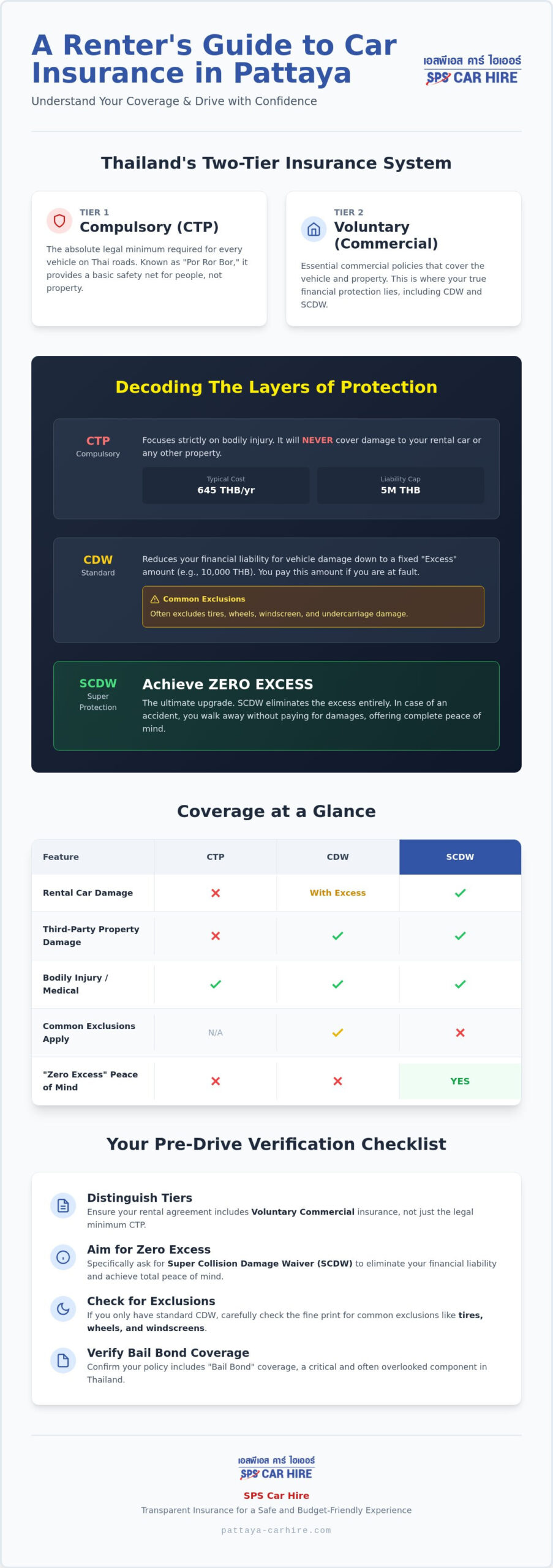
Understanding car rental insurance Pattaya starts with realizing that coverage in Thailand isn’t a single policy. It’s a two-tier system designed to protect different things. You have the “Compulsory” layer, which is the legal floor, and the “Voluntary” commercial layer, which provides the actual ceiling of protection for your wallet. We’ve seen many travelers assume that because a car is “insured,” they’re fully protected. In reality, the type of insurance you carry determines whether a minor accident is a small hiccup or a financial catastrophe.
Every single vehicle on Thai roads must carry Compulsory Third Party (CTP) insurance, often referred to locally as “Por Ror Bor.” This is mandated by the Motor Victim Protection Act, also known as the Road Protection Act. Since January 1, 2026, all these policies must be issued in a digital format to increase transparency and allow for faster verification during transportation in Thailand. While CTP is the absolute bare minimum required by law, it leaves massive gaps that only voluntary commercial insurance can fill.
The Role of Compulsory Third Party (CTP) Insurance
CTP is the statutory medical coverage required for all Thai-registered vehicles to ensure victims of road accidents receive immediate care. It focuses entirely on bodily injury and death for third parties and passengers. For a standard sedan or 4-door pickup, the annual rate is fixed by the government at 645 Baht. The total limit of liability per accident for a vehicle with seven seats or fewer is currently capped at 5,000,000 THB. However, CTP strictly excludes any damage to your rental vehicle or the other party’s property. If you scrape a luxury car or dent your rental bumper, CTP won’t pay a single satang toward those repairs.
Why Voluntary Insurance is Essential for Renters
Driving with “Compulsory Only” coverage in a foreign country is a recipe for financial disaster. If an accident occurs, you’re personally on the hook for the full value of the rental car and any property you’ve damaged. Commercial policies like Collision Damage Waiver (CDW) fill this gap by covering the “metal” rather than just the “medical.” We always advise our clients to look beyond the legal minimum. Having this extra layer protects your personal assets and ensures you don’t face life-altering bills after a simple mistake. It provides the peace of mind that comes from knowing property damage is fully covered, allowing you to enjoy your trip without constant worry. This is the savvy way to handle car rental insurance Pattaya, securing a budget-friendly rate while ensuring your protection is premium-grade.
The Layers of Thai Vehicle Protection: CDW and SCDW
Once you’ve secured the legal basics, it’s time to build your real defense. For most visitors, car rental insurance Pattaya actually refers to these voluntary layers that protect you from paying for a new car if things go wrong. While CTP covers the people, Collision Damage Waiver (CDW) and its “Super” counterpart protect the vehicle itself. These aren’t just optional extras; they’re the difference between a minor scrape being a non-event or a massive drain on your holiday budget. The same principles apply whether you’re renting a car or exploring on two wheels — travelers considering a budget scooter rental Pattaya should understand these coverage layers before hitting the road.
Standard Collision Damage Waiver (CDW)
Standard Collision Damage Waiver is the most common layer you’ll encounter. It isn’t technically insurance in the traditional sense. Instead, it’s a contractual waiver where the rental company agrees to limit your financial responsibility to a set “excess” amount. If the car is worth 600,000 Baht and you have CDW with a 10,000 Baht excess, your liability stops at that lower figure. However, there’s a catch that many agencies hide in the fine print. Standard CDW often excludes the most vulnerable parts of the vehicle. You’ll often find that tires and wheels damaged by potholes, windscreens cracked by flying stones, and undercarriage damage from rough roads are completely excluded. Liability also hinges on the “Fault” factor. If you’re found to be the party at fault in an accident, you’ll definitely be paying that excess fee.
Upgrading to Super Collision Damage Waiver (SCDW)
Upgrading to Super Collision Damage Waiver (SCDW) is the smartest move for anyone who wants a stress-free holiday. This “Zero Excess” protection removes the deductible entirely, meaning you walk away from a dented bumper without a bill. It’s particularly valuable in high-traffic areas where minor scrapes are common. For those staying longer, see our long term car rental insurance Thailand for specific package details that keep monthly costs low while maintaining full protection. This level of car rental insurance Pattaya ensures that your only job is to enjoy the drive.
You should also look for Theft Protection (TP) and Personal Accident Insurance (PAI). TP is usually bundled, but remember that it doesn’t cover negligence; if you leave the keys in the ignition and the car vanishes, you aren’t covered. PAI provides an extra layer of medical coverage for everyone inside your rental. Before you drive, ensure your license is valid according to UK government travel advice, as an invalid license can void these voluntary protections. If you’re looking for a reliable ride, you can find low cost car and truck rental options that include these essential layers as standard.
Understanding the ‘Excess’: Managing Your Financial Liability
Understanding “excess” is the most critical step in managing your car rental insurance Pattaya. In simple terms, the excess, also known as a deductible, is the maximum amount you’re responsible for paying out of your own pocket before the insurance company covers the rest. It represents the boundary between your personal savings and the insurer’s vault. If you have an accident with a 10,000 THB excess and the repairs cost 50,000 THB, you pay the first 10,000 and the insurer handles the remaining 40,000. In the current 2026 Thai market, standard excess amounts for budget car and truck rentals typically range from 5,000 to 20,000 THB, depending on the vehicle class and the specific agency.
Most rental companies handle this liability through a credit card pre-authorization. This means the funds are “frozen” but not actually deducted unless damage occurs. Some local agencies may still accept cash deposits, but this is becoming less common as digital systems take over. You should also be aware of the “No-Fault” rule. If someone hits your rental car and they are clearly at fault and identified, you shouldn’t lose your deposit. However, if you return to find a fresh dent in a parking lot and no culprit in sight, that damage will likely be deducted from your excess because there’s no third party to claim against. Knowing the correct rental car accident procedure Thailand requires can make all the difference in protecting your deposit when an incident does occur.
How Deductibles Impact Your Rental Cost
There is a direct trade-off between your daily rental rate and your insurance excess. Many agencies lure drivers in with incredibly low daily prices, but these “cheap” rentals often hide a massive excess of 20,000 THB or more. If you don’t manage this correctly, a small mistake could end up costing you more than the entire rental fee. A high excess is essentially a form of self-insurance. While it saves you a few hundred Baht per day on the front end, it places a significant financial burden on you if anything goes wrong on the road. Understanding the Pattaya road rules for tourists is equally important, since stricter 2026 enforcement means traffic violations can directly affect your fault status in an accident and trigger that excess payment.
Reducing Excess to Zero
The most effective way to protect your holiday budget is to purchase an “Excess Waiver” or SCDW at the start of your rental. This mechanics of this are simple: you pay a slightly higher daily rate to move your liability from 10,000 THB down to zero. We strongly recommend full coverage for those unfamiliar with local driving customs or the unique flow of traffic in Pattaya. To protect your deposit even further, always use the “Before Photo” strategy. Walk around the vehicle and take high-resolution photos or a video of every existing scratch, wheel scuff, and glass chip before you leave the lot. This documentation is your best defense against being charged for damage you didn’t cause, ensuring your car rental insurance Pattaya experience remains transparent and fair.
Verifying Your Coverage: A 2026 Pre-Drive Checklist
Before you drive off into the Pattaya sun, you need to be certain that the protection you paid for is actually active. Verification is your final safety net. Many travelers rush through the paperwork because they’re eager to start their holiday, but five minutes of diligence at the counter can save you hours of stress later. Since all mandatory policies are now digital in 2026, you should ask to see the electronic confirmation or a clear summary of tiers on your rental agreement. Don’t just take a verbal “you’re covered” as a guarantee.
The Essential Document Check
Your first priority is ensuring the policy is “First Class Insurance,” often referred to as Type 1. This is the most comprehensive tier available in Thailand. It covers your vehicle, third-party property, and medical expenses. While reviewing the tiers, pay close attention to the “Bail Bond” coverage. This is a unique and critical feature of car rental insurance Pattaya for foreign drivers. If you’re involved in a serious accident that results in injury, Thai law may require a bail payment to prevent detention during the investigation. A quality policy includes a bail bond where the insurer provides these funds on your behalf, acting as a crucial legal safeguard. Being prepared also means knowing the exact steps to follow after a collision — our guide on the rental car accident procedure Thailand enforces in 2026 walks you through who to call and what not to do at the scene.
You should also confirm the territorial limits of your policy. While most allow you to drive anywhere in Thailand, some budget agencies might restrict coverage to specific provinces. If you’re debating the logistics of driving yourself versus other options, our car rental vs taxi Pattaya guide offers a great comparison of the freedom versus the costs. Check for exclusions regarding flooded streets as well. Pattaya can experience heavy rain, and driving through deep water is often considered negligence, which can void your entire policy.
Physical Inspection Best Practices
Never let a rental agent rush you through the damage diagram. If you see a scratch, chip, or scuff that isn’t marked, point it out and ensure it’s added to the document. We always recommend recording a 30-second walkaround video of the car’s exterior and interior before you leave the lot. This video is your best insurance against false claims because it provides a timestamped record of the vehicle’s condition. It’s much harder for an agency to argue about a pre-existing dent when you have high-definition proof.
Pay special attention to the tires and the spare. Tires are frequently excluded from standard car rental insurance Pattaya packages, so ensuring they are in good condition at the start is vital. Look for bulges or low tread that could cause issues later. For a transparent experience with no hidden surprises and clearly defined terms, check out our best price car and truck rental options today.
Why SPS Car Hire Provides the Safest Budget Rental Experience
We’ve spent this guide breaking down the complexities of car rental insurance Pattaya, from the 2026 shift to digital mandatory policies to the hidden nuances of excess waivers. Now, it’s time to choose the right partner for your journey. Choosing an independent, locally owned agency like SPS Car Hire means you get the “inside track” on local road conditions without the corporate coldness of a global chain. We believe that budget-friendly shouldn’t mean high-risk. That’s why we offer a Best Price Guarantee on our rentals, ensuring you get the most value for your money while maintaining the highest insurance standards. We prioritize your safety and your wallet.
Transparent Insurance Policies
Our commitment to transparency is absolute. We prioritize “First-Class” coverage (Type 1) across our fleet to ensure our customers are never left stranded with only the bare legal minimum. For expats and visitors staying for a month or more, our specialized long-term car rental packages incorporate premium insurance tiers that keep your daily costs low and your protection high. If you ever have a question or need to make a claim, you won’t be stuck in a frustrating call center loop. Instead, you’ll speak directly with a local expert who understands your policy and the specific driving environment of Pattaya. This direct contact builds immediate trust and ensures any issues are resolved quickly.
Getting Started with Your Rental
Booking your vehicle and selecting the right insurance tier is fast and simple on our website. We’ve streamlined our requirements for tourists and foreigners to get you on the road without unnecessary delays. To get started, you’ll generally need a valid passport, your home country’s driver’s license, and an International Driving Permit. We’ve removed the friction from the process so you can focus on enjoying your trip. Our budget car and truck rental options prove that you don’t have to sacrifice quality for a great price. We handle the fine print of car rental insurance Pattaya so you can drive with total peace of mind.
Our team is dedicated to providing a high-value choice that doesn’t compromise on quality or service. We take pride in our local roots and our role as your savvy guide to the region. Whether you need a short-term solution or a long-term package, we are here to ensure your journey is smooth and secure. Secure your budget-friendly rental with full insurance here
Drive with Total Confidence in 2026
You now have the “inside track” on how to navigate the complexities of car rental insurance Pattaya without falling for common traps. By understanding the three-layered shield of Thai coverage and mastering the digital verification process, you’ve removed the friction from your journey. We are dedicated to being your reliable community fixture, offering transparent “First-Class” insurance options that leave no room for hidden surprises. Whether you need a short-term car for a weekend getaway or specialized long-term rental packages for expats, we ensure you never compromise on safety. Our Best Price Guarantee means you get premium protection at a budget-friendly rate every single time. It’s time to stop worrying about the “what-ifs” and start enjoying the freedom of the coast. Book Your Fully Insured Budget Rental Today and experience the peace of mind that comes with local expertise. We’ll see you on the road!
Frequently Asked Questions
Is car rental insurance mandatory in Thailand?
Yes, Compulsory Third Party (CTP) insurance is legally required for all vehicles under the Motor Victim Protection Act. This policy covers basic medical expenses for third parties involved in an accident. It doesn’t protect the rental vehicle itself. For real protection against damage to the car, you must have a voluntary commercial policy in place before you drive.
What is the difference between CDW and SCDW in a rental agreement?
CDW limits your financial liability to a set excess amount, whereas SCDW typically removes that liability entirely. With CDW, you still pay a deductible if the car is damaged. SCDW is often marketed as “Zero Excess” protection. It’s the best way to ensure you don’t face unexpected repair bills after your trip is over.
Does my credit card insurance work for rentals in Thailand?
While some premium cards offer rental protection, they are rarely accepted as primary coverage by local agencies. Most car rental insurance Pattaya providers require you to use their own policies to ensure immediate claims processing. If you rely on your card, you’ll likely have to pay for all damages out of pocket first and then seek reimbursement from your bank.
What happens if I have an accident in a rental car without a police report?
Your insurance claim will almost certainly be denied if you fail to provide a police report. Insurance companies in Thailand require official documentation to verify the circumstances of an accident. If you have a collision, don’t move the vehicle. Call the police and your car rental insurance Pattaya provider immediately to ensure a report is filed at the scene.
Does rental insurance cover theft of personal belongings from the car?
No, vehicle insurance policies strictly cover the car and its parts, not your personal property. Items like smartphones, cameras, or luggage are not protected if they are stolen from the vehicle. We recommend checking your personal travel insurance policy for this type of coverage. Always lock your doors and keep valuables out of sight when parked.
What is ‘Bail Bond’ coverage and why do I need it in Thailand?
Bail Bond coverage is a legal safeguard that pays for your release if you’re detained following a serious road accident. In Thailand, police can hold drivers involved in accidents causing injury or death. A “First Class” insurance policy includes this bond so the insurer handles the bail for you. It’s an essential protection for any foreign driver.
Are tires and windshields covered by standard rental insurance?
Standard policies typically exclude tires, glass, and undercarriage damage. These parts are highly susceptible to damage from road debris and potholes. If you want these items covered, you should look for a “Full Protection” or SCDW package. Always check the exclusions list on your rental agreement to see exactly what is left out of the basic coverage.
Can I drive my rental car to another country like Cambodia or Laos?
You cannot drive a rental car across the border into Cambodia, Laos, or Malaysia. Rental agreements and insurance policies are strictly limited to the territorial boundaries of Thailand. Taking the car across a border voids your insurance and is often treated as a breach of contract. If you plan to visit neighboring countries, use local transport instead.
 -
- -
- -
- -
- -
- -
- -
-