


A search for holiday car rental deals can bring up headline prices that are difficult to compare. The real value of a self-drive rental depends on whether the vehicle suits your group and luggage, how long you need it, and what the rental terms say.
Start with your holiday plans. A car may suit a group travelling with everyday luggage, while a truck may be more practical for carrying larger items. A motorbike suits a different kind of journey. SPS Car Hire offers budget-friendly self-drive car, truck, and motorbike rentals across Thailand, as well as long-term car and truck packages for extended stays.
This guide explains how to compare offers using consistent criteria, assess vehicle fit, and review rental terms before booking. The aim is to help you weigh practical value, not just choose the lowest displayed price.
Key Takeaways
- Assess a rental by vehicle fit, clear terms, and value across the full rental period, not just the headline rate.
- Compare offers using the same dates, rental duration, vehicle category, terms, and stated inclusions.
- Match the vehicle to your passengers, luggage, and plans by considering the practical differences between cars, trucks, and motorbikes.
- Use a booking checklist to organise your travel needs and review rental conditions before committing.
- Explore SPS Car Hire’s self-drive options, including long-term car and truck packages for extended stays in Thailand.
What makes a holiday car rental deal genuinely worthwhile?
A worthwhile holiday car rental deal pairs a vehicle suited to your passengers, luggage, and plans with clear terms and useful value for the rental period. The lowest advertised rate is only one part of the decision. Before choosing, make sure you understand what you’re booking and that the vehicle category fits the trip.
A promotion may look attractive but cover different dates, a different rental duration, or another vehicle category than the offer you’re comparing it with. The Car rental industry overview provides general background on rental arrangements. For your own comparison, focus on the terms of the specific offers. Separate details stated in the offer from assumptions, then compare like with like.
Why the lowest advertised price may not be the best fit
A headline rate doesn’t tell you whether the vehicle suits your group or whether the quoted rental period matches your itinerary. Compare the same vehicle category and rental duration, then read the terms and stated inclusions together. This gives you a more useful comparison than placing different offers side by side based on their first displayed price.
Consider whether each stated feature serves a real need on your trip. An inclusion can be useful if it supports your plans, but a long list of promotional details doesn’t automatically make an offer better. Focus on the requirements that matter to you and the conditions clearly described in the offer.
Start with your holiday plans, not the deal banner
Before comparing holiday car rental deals, write down how many people will travel, how much luggage you expect to bring, and what you plan to carry. Think about whether you’ll make short trips, travel between several stops, or need to transport larger items. These details help narrow down the vehicle category that makes sense for your holiday.
A car may suit travel with passengers and everyday luggage. A truck is worth considering when your plans involve carrying larger items. A motorbike may fit a different kind of journey, particularly when your transport needs are simpler. Think about passengers and luggage together rather than choosing by vehicle label alone.
Rental length matters, too. A short holiday may call for a rental period that matches specific travel dates, while an extended stay can make a longer-term package more relevant. SPS Car Hire offers self-drive car, truck, and motorbike rentals, along with long-term car and truck packages. Start with your itinerary, then compare the category and terms that fit it. That’s a more practical way to assess value than choosing by a deal banner.
How to compare holiday car rental deals before booking
For a fair comparison, line up the dates, rental duration, and vehicle category first. Then compare the written terms and stated inclusions. This makes it easier to assess holiday car rental deals Pattaya search results without relying on a promotional headline.
Offers can look similar while covering different vehicles or rental periods, so compare their details in the same order. Count only information clearly stated in the offer. Don’t assume a feature or condition applies because you’ve seen it elsewhere.
Compare rental terms and inclusions consistently
Start with the basics: use the same pick-up and return dates, compare the same length of rental, and look at the same vehicle category. A short rental and an extended rental aren’t direct comparisons, nor are different vehicle types. If an offer lists an inclusion, note exactly what it says. Keep optional features and general promotional wording separate from details presented as part of the rental.
- Vehicle category: Compare like with like rather than treating different vehicle types as equivalent.
- Rental dates and duration: Use the dates and total rental period that match your itinerary.
- Terms: Read the rental terms so you understand the conditions attached to the offer before committing.
- Stated inclusions: Record what the offer explicitly says is included, and distinguish it from optional features or general advertising.
Don’t fill in missing details yourself. If an offer doesn’t clearly state something, don’t count it as an inclusion or assume a particular policy applies. This keeps the comparison grounded in what’s presented, rather than assumptions about fees, deposits, insurance, mileage, or cancellations.
Match the vehicle category to the group and itinerary
Once the terms are side by side, check whether each option suits the people and belongings travelling with you. Consider passenger numbers, luggage, and anything else you plan to carry. A car may work for passengers and everyday bags. A truck may better fit a plan involving larger loads. A motorbike is a distinct option, not a substitute for a vehicle needed to carry a group or luggage.
Think about how you’ll use the vehicle throughout the rental period. A category that works for one person making short journeys may not suit a group with several bags. Remove options that don’t meet your practical needs before comparing the remaining terms and value. This keeps the decision focused on fit as well as price.
With your comparison criteria in hand, explore SPS Car Hire’s self-drive options across car, truck, and motorbike rentals. Compare each category with your itinerary in mind.
Car, truck, or motorbike: which rental suits your holiday?
The right category depends on how you plan to travel, not just which offer catches your eye. Consider your group, luggage, and intended use before comparing options. SPS Car Hire offers self-drive cars, trucks, and motorbikes for different transport needs. Use the guide below to narrow down the category that fits your plans.
| Vehicle category | Passenger and luggage needs | Intended use |
|---|---|---|
| Car | Consider it for enclosed transport with passengers and everyday luggage. Check that the specific vehicle suits your group and bags. | Flexible self-drive travel involving passengers and personal belongings. |
| Truck | Consider what you need to carry and whether a truck category fits your planned load. | Trips where the intended use calls for a truck rather than a car or motorbike. |
| Motorbike | Consider passenger and luggage needs carefully. This category differs from a car or truck. | Self-drive travel where a motorbike suits the journey and transport requirements. |
When a self-drive car is the practical holiday choice
A car may suit you if you want enclosed, flexible transport for travelling with other people or carrying bags. Before choosing, count your passengers and consider the size and amount of your luggage. These practical details matter more than assumptions based on a broad category label. The right fit depends on the specific vehicle and your group’s needs.
For example, if you’re travelling with companions and several bags, think about passenger space and luggage together rather than focusing only on the number of people. If your itinerary includes several stops, consider whether a car fits the way you want to travel. Compare the vehicle details and rental terms before deciding, without assuming that a particular model, transmission, or configuration is available.
When a truck or motorbike may better match the plan
A truck is worth considering when your planned use involves carrying items and this category fits the task. Be clear about what you intend to transport, then compare the truck option with your requirements. Don’t choose it just because it sounds more spacious; it should make practical sense for your trip.
A motorbike suits a different kind of journey. It may fit plans where your transport needs suit this type of vehicle, but it shouldn’t be treated as interchangeable with a car for travelling with a group or carrying luggage. Match the category to the people, belongings, and journey you have in mind.
Keep your comparison grounded in your itinerary: note who’s travelling, what needs to come along, and how you expect to use the vehicle. Then weigh the suitable category against the rental terms. This makes it easier to assess holiday car rental deals by how well they fit your trip, rather than by vehicle label alone.
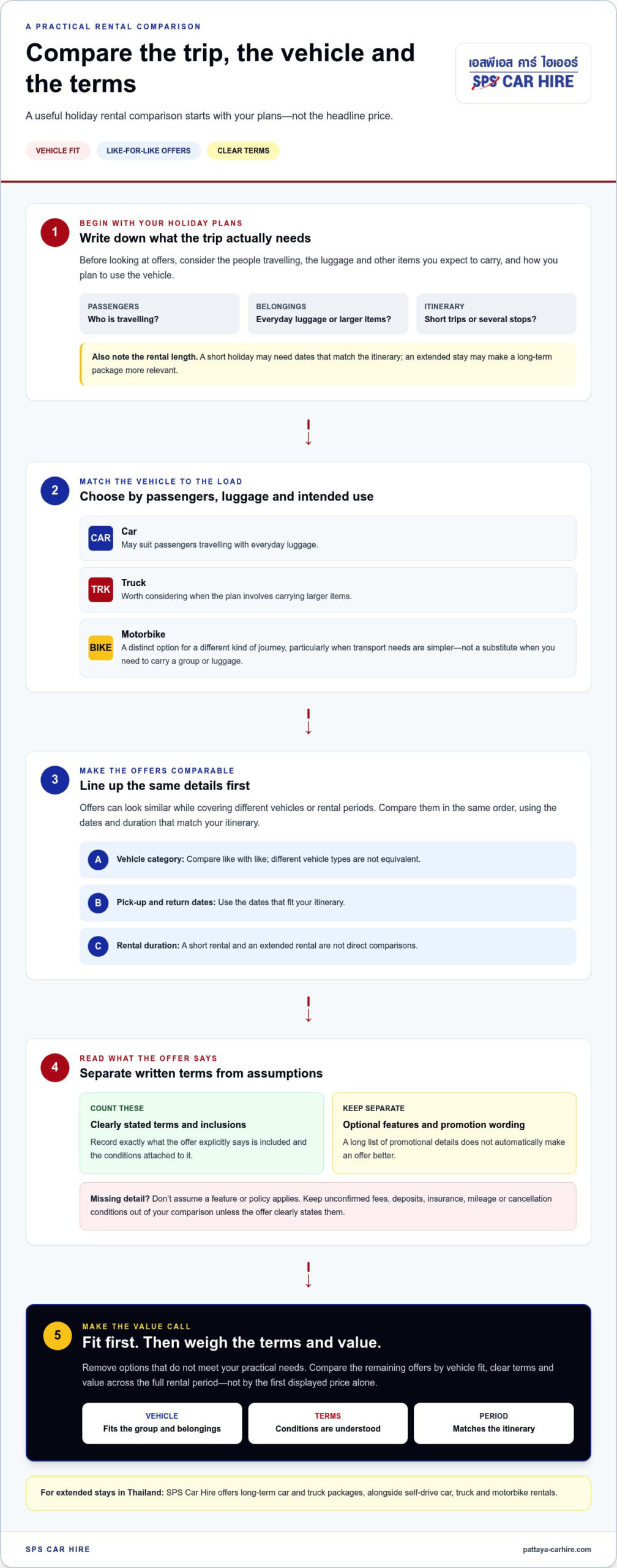
A practical checklist for arranging a holiday rental
Preparing a few details makes it easier to choose a self-drive rental that suits your plans and understand the offer before committing. Work through the decision in order: define the trip, choose a category, check official driving guidance, and read the terms for the rental you’re considering.
Prepare the details needed to choose a suitable rental
Begin with your itinerary, not a vehicle listing. Write down your travel dates, expected rental duration, passenger count, and luggage needs. Then consider how you’ll use the vehicle, what you plan to carry, and the kind of journeys involved. These details help you decide whether a car, truck, or motorbike is the most practical category to compare.
- Set your dates and duration. Note your planned start and end dates, and compare rental periods that match your itinerary.
- Count passengers and bags. Consider the group and its luggage together. A vehicle that suits the passenger count may not suit the amount of luggage.
- Choose a category based on use. Consider a car for enclosed passenger transport, a truck when your planned use calls for one, or a motorbike if it suits your journey and needs.
- Review your driving documents. Check current official guidance for the documents and requirements that apply to your circumstances. Requirements can depend on your situation, so use an appropriate official source rather than relying on general assumptions or outdated advice.
Review the rental terms before making a decision
Once you’ve narrowed down the category, read the terms shown for that rental. Check that the dates and vehicle category match your plan, and identify the conditions and inclusions explicitly stated. Don’t assume that a policy or feature applies because you encountered it with another rental. Base your decision on the terms for the option you’re reviewing.
Insurance is one part of the terms to read carefully. For a separate explanation, see the car rental insurance guide. Keep general information distinct from the conditions stated for a particular rental, and base your decision on the terms that apply to the option you’re considering.
Before booking, use this final checklist: do the dates match, does the category suit your passengers and luggage, have you checked current official driving-document guidance, and have you read the rental terms? If any answer is no, resolve that point before deciding. A careful review helps you compare practical value without relying on assumptions.
Use your trip details to explore SPS Car Hire’s self-drive rental options and find a vehicle category that aligns with your plans.
Find a self-drive holiday rental with SPS Car Hire
SPS Car Hire is a locally owned, independent rental agency serving customers across Thailand. Its budget-focused self-drive range includes cars, trucks, and motorbikes, with long-term car and truck packages for extended stays. Start by identifying the category that suits your plans, then review the terms before deciding.
A budget-focused offer can help narrow your search, but a useful deal still depends on trip fit and the details of the selected rental. Compare like with like, read the stated terms, and choose based on what you need the vehicle to do. This keeps the decision grounded in your holiday rather than a headline or an assumption about what a rental includes.
Choose from budget-focused self-drive vehicle categories
Start with the kind of travel you have planned. Each category serves a different purpose, so consider passengers, luggage, and intended use before deciding which options to compare.
- Cars: Consider a car for self-drive travel with passengers and personal luggage. Assess the specific vehicle details against your group’s needs.
- Trucks: A truck may suit plans that call for this category. Consider what you intend to carry and whether a truck fits the task.
- Motorbikes: A motorbike is a distinct choice for journeys that suit this type of transport. Consider whether it matches your passenger, luggage, and travel requirements rather than treating it as a replacement for every car journey.
Choose by purpose, not assumption. Don’t infer a particular model, transmission, seating capacity, or configuration from the category name alone. Use the details shown for the rental you’re considering, and compare them with your itinerary.
Take the next step toward a suitable rental
Before settling on an option, make three checks: does the vehicle category fit your trip, are you comparing equivalent dates and durations, and are the terms and stated details clear? If one of these points doesn’t line up, revisit the options rather than letting the headline price make the decision for you.
For an extended stay, SPS Car Hire’s long-term car and truck packages may suit your plans. For a shorter holiday, focus on the rental period that matches your travel dates and the category that fits your needs. Either way, compare the stated details carefully so your decision reflects how you’ll use the vehicle.
Explore the self-drive range and select a category that fits your passengers, luggage, and itinerary. Explore self-drive rental options.
Make your next travel decision with confidence
Your transport choice can shape how smoothly your holiday plans come together. When comparing rental deals, look beyond the booking itself and choose an option that supports your itinerary, whether you want flexibility between stops or need to carry particular items. A practical choice should suit your needs before the trip begins.
Review the self-drive options with your priorities in mind. You don’t need to choose the most elaborate option; focus on what suits your travel plans. Once you know what matters, it’s easier to compare categories and terms and feel settled about your decision.
Explore SPS Car Hire’s self-drive rental options and start planning transport that fits your holiday.
Frequently Asked Questions
Are holiday car rental deals worth booking in advance?
Planning ahead gives you time to compare vehicle categories, dates, and rental terms without rushing. First decide who’s travelling, what you’ll carry, and how long you need transport. Then review the details for your chosen dates before committing. Booking early doesn’t guarantee a particular vehicle, price, or availability, so base your decision on the terms presented for the rental.
What should I compare when looking at holiday car rental deals?
Compare options with the same rental duration and vehicle category, then read the terms and clearly stated inclusions. A headline price alone can’t show whether an offer fits your plans. Note what each option actually states, and don’t assume details about deposits, insurance, mileage allowances, or cancellation conditions. Use the terms for the specific rental you’re considering.
Can I rent a car, truck, or motorbike for a holiday in Thailand?
Yes. SPS Car Hire offers self-drive rentals across car, truck, and motorbike categories. Choose according to how you expect to use the vehicle, how many people and belongings need transport, and which type you’re comfortable driving. A motorbike may suit different needs from a car carrying passengers and luggage. Review the details for the rental option you’re considering rather than assuming a particular model or availability.
How do I choose the right rental vehicle for my holiday?
Start by listing the number of travellers, luggage, trip duration, and what you’ll use the vehicle for. Then compare car, truck, and motorbike categories against that list. A category label doesn’t guarantee a particular model, feature, or configuration, so read the details for the specific rental. If your plans change, reassess passenger and luggage needs before choosing.
Can I rent a vehicle for an extended holiday in Thailand?
Yes. SPS Car Hire offers long-term rental packages for cars and trucks. If you expect to stay for an extended period, consider your travel needs and compare a longer rental option with a shorter one using the terms presented for each. The right fit depends on your plans. Review the specific rental details before deciding rather than assuming what a package includes.
What documents do I need to rent a vehicle in Thailand?
Document requirements can depend on your circumstances and the rules in effect, so consult relevant official guidance before arranging your trip. Then read the rental terms for the option you’re considering, paying attention to any stated document requirements. Avoid relying on outdated travel advice or assuming another driver’s situation applies to yours. Preparing the relevant information early can help you address requirements before making a booking.
 -
- -
- -
- -
- -
- -
- -
-