

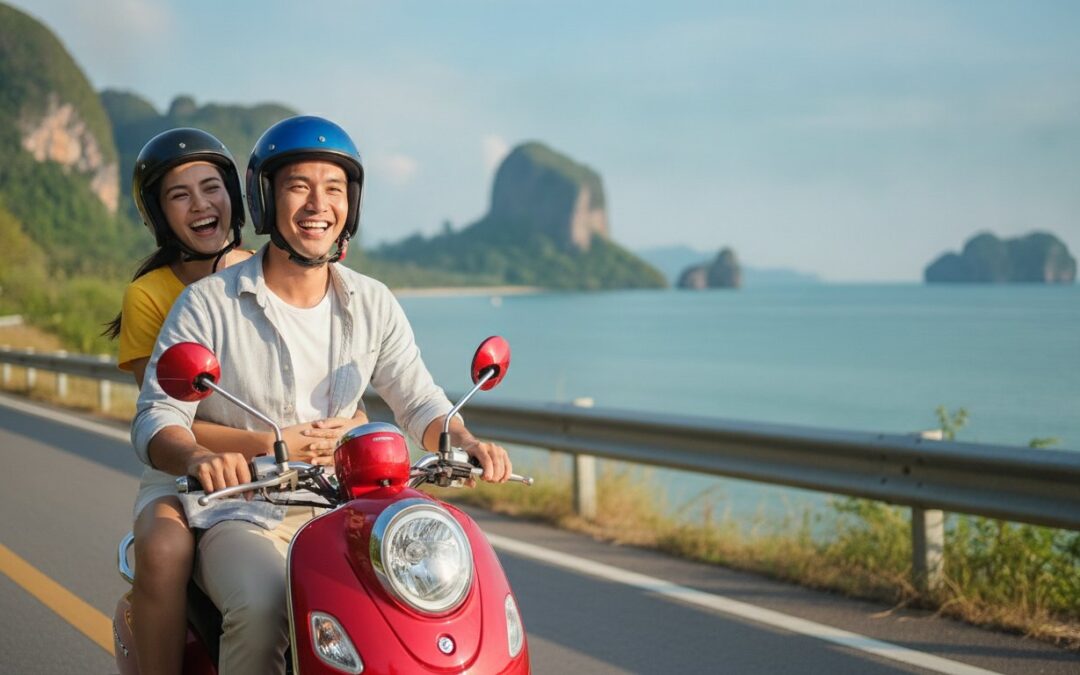
Did you know that over 20,000 foreign travelers were arrested in Phuket alone last year simply because they lacked the correct license? It’s a staggering figure that highlights how easy it is to get caught out when you aren’t prepared. We know that organizing a motorbike hire in Thailand often feels like a gamble between finding a great deal and falling for a scam. You want the wind in your face and the freedom to explore hidden beaches, not the anxiety of hidden repair costs or inadequate insurance coverage.
We’re here to take the guesswork out of your journey. This guide provides total clarity on the 2026 legal landscape, including the mandatory registration rules and specific IDP requirements you need to stay on the right side of the law. You’ll learn exactly which engine size suits your skill level and route, ensuring you don’t overpay for power you don’t need or end up on an underpowered bike in the mountains. From understanding the 2026 fine structures to securing a well maintained ride at a guaranteed best price, we’ve got the inside track to keep your trip stress-free and safe.
Key Takeaways
- Understand the economic and logistical advantages of choosing two wheels over four for accessing Thailand’s most remote locations and narrow routes.
- Match your specific route to the perfect engine size by comparing the urban agility of 125cc scooters against the climbing power of 160cc models.
- Navigate the 2026 legal landscape for motorbike hire with expert advice on International Driving Permits and the mandatory Category A endorsements needed to stay legal.
- Identify the ideal rental duration for your itinerary to secure the best possible rates and unlock long-term savings of 50% or more.
- Learn how to secure a reliable, well-maintained vehicle with a best-price guarantee through transparent rental agreements that eliminate hidden fees.
Navigating Motorbike Hire: Why Two Wheels Beat Four in 2026
Thailand’s roads are vibrant, busy, and occasionally chaotic. While a car offers air-conditioned comfort, choosing a motorbike hire provides a level of agility that four wheels simply cannot match. You’ll find that the real magic of the Kingdom often hides down narrow “sois” (alleys) or at the end of unpaved coastal tracks where a standard sedan would struggle to turn around. Motorbikes are one of the most common modes of transport in Thailand for a reason; they offer total autonomy in a landscape that wasn’t always built with large vehicles in mind. In 2026, as urban centers become more densely packed, the ability to park within meters of your destination rather than hunting for a garage is a luxury in itself.
Fuel Efficiency and Cost Savings
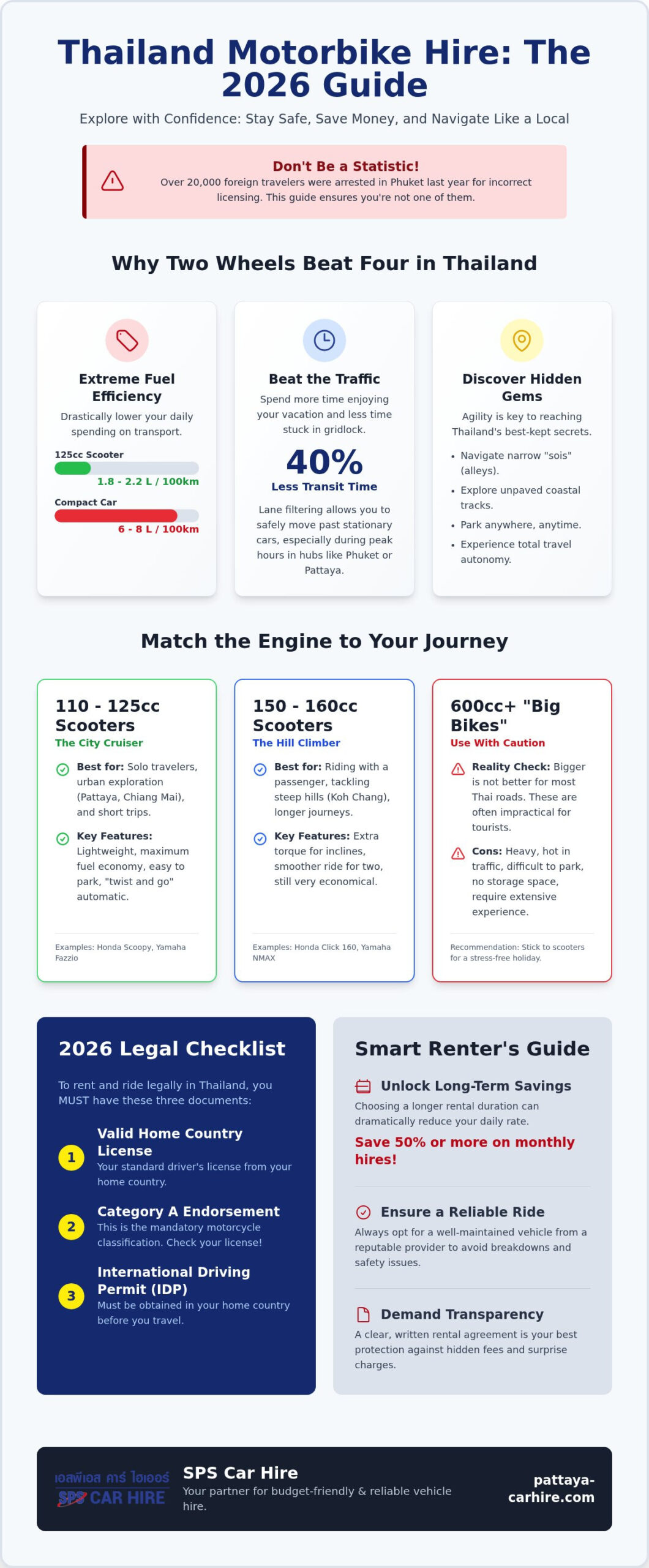
Managing your holiday budget is more important than ever as global fuel prices continue to climb. A standard 125cc scooter, such as a Honda Scoopy or Yamaha Fazzio, typically consumes between 1.8 and 2.2 liters of fuel per 100km. Compare this to a compact car which might use 6 to 8 liters for the same distance. When you calculate the daily savings against a daily car rental, the difference is substantial. Choosing a budget-friendly bike rental allows you to keep your overheads low without sacrificing the quality of your ride. These savings add up quickly over a two-week trip, leaving you with more Baht for island hopping, street food tours, or premium diving experiences.
- Drastically lower daily spend: Fueling a bike costs a fraction of what you’d pay for a car or truck.
- Efficient hill climbing: Modern fuel-injected scooters handle coastal inclines with minimal effort and maximum economy.
- Budget flexibility: Redirect your transport savings into better accommodation or longer excursions.
Time Management in High-Traffic Regions
Time is your most precious resource on vacation. In popular hubs like Phuket, Pattaya, or Chiang Mai, traffic gridlock is a daily reality that can swallow hours of your afternoon. Motorbikes have a distinct advantage known as “lane filtering.” This practice allows riders to move safely between stationary cars at traffic lights, ensuring you stay at the front of the pack. You can realistically reduce your transit time between attractions by up to 40% during peak hours. A motorbike hire ensures you spend less time staring at brake lights and more time enjoying the destination. It’s the ultimate solution for time-poor travelers who want to see everything without the frustration of the wait.
Comparing Motorcycle Types: Choosing the Right Engine for Your Journey
Selecting the right machine for your motorbike hire isn’t just about aesthetics; it’s about matching mechanical capability to your specific itinerary. Thailand’s rental market is dominated by small-displacement scooters for good reason. They’re lightweight, fuel-efficient, and incredibly easy to park in crowded markets. For solo travelers staying within urban hubs like Pattaya or Chiang Mai, the 110cc to 125cc class is the sweet spot. These bikes offer enough zip to keep up with traffic without being cumbersome in tight alleys. If you plan on tackling the steep hills of Koh Chang or riding two-up with a passenger, upgrading to the 150cc or 160cc class is a wise move. The extra torque ensures you won’t struggle on inclines, providing a smoother and safer experience for everyone on board.
Don’t fall for the trap of thinking bigger is always better. While it might be tempting to hire a 600cc “Big Bike” for the status, they’re often impractical for Thailand’s secondary roads. High-performance motorcycles are heavy, generate significant heat in traffic, and lack any meaningful storage. In the humid heat of a Thai afternoon, you’ll appreciate the agility of a scooter more than the raw power of a sportbike. Before you sign any papers, check the official travel and safety advice regarding vehicle rentals. It’s a great resource for understanding why choosing the right bike size and having the correct license is non-negotiable for your safety.
The Automatic Scooter: The Gold Standard for Tourists
Most visitors gravitate toward fully automatic scooters like the Honda Click or Yamaha NMAX. These bikes utilize a “twist and go” mechanism, meaning there are no gears or clutches to manage. This simplicity allows you to focus entirely on the road and your surroundings rather than fumbling with gear levers. Storage is another massive benefit; most modern automatics feature a “U-Box” under the seat. This compartment is perfect for stashing your helmet, a rain poncho, or groceries. Beginners should always prioritize these modern models because they often come equipped with combined braking systems that make stopping more predictable for inexperienced riders. If you’re looking for the best price motorbike rental that balances ease of use with reliability, an automatic scooter remains the smartest choice.
Semi-Automatic and Manual Options
The Honda Wave is the undisputed king of Thai roads. It’s a semi-automatic bike, which means you change gears with your left foot but don’t have to deal with a hand clutch. It’s incredibly durable and offers superior fuel economy compared to automatic belts. You might want a manual or semi-automatic if you’re heading deep into the mountains where engine braking is essential for long descents. However, for the vast majority of tourists, the convenience of an automatic outweighs the marginal fuel savings of a manual. Choose your transmission based on your comfort level; if you’ve never shifted gears before, your holiday isn’t the time to start learning on busy national highways.
Rental Requirements and Insurance: Protecting Your Journey
Setting off on a motorbike hire in Thailand without understanding the legal paperwork is a recipe for a ruined holiday. In 2026, authorities have significantly ramped up enforcement, particularly in tourist hotspots where new amendments to the Motor Vehicle Act now mandate stricter registration for rental fleets. If you’re stopped at a checkpoint, simply showing a car license from home won’t cut it. You’ll likely face a fine between 1,000 and 2,000 THB on the spot. More importantly, riding without the correct endorsement voids almost every travel insurance policy, leaving you personally liable for medical bills or vehicle damage.
When you sign your rental agreement, expect to provide a copy of your passport and a security deposit. We strongly advise against leaving your physical passport with any agency; instead, offer a cash deposit. Standard deposits for 125cc scooters usually hover around 2,000 THB. Always take a timestamped video of the bike’s condition before you leave the shop. Document every scratch, dent, or scuff to ensure your deposit is returned without dispute. It’s also worth noting that helmets are mandatory for both riders and passengers, with fines reaching 500 Baht for non-compliance.
The 2026 License Checklist
Thailand recognizes International Driving Permits (IDP) from both the 1949 and 1968 conventions. However, the critical detail is the “Category A” stamp. If your IDP only shows a car endorsement, you’re riding illegally. To legally ride a 125cc scooter in 2026, you must carry an International Driving Permit that specifically includes a motorcycle endorsement (Category A). Don’t listen to shop owners who say it doesn’t matter; they aren’t the ones paying the fines or dealing with the police when things go wrong.
Understanding Motorbike Rental Insurance
Every registered rental must include Compulsory Third Party Liability (CTPL), known locally as “Por Ror Bor.” This covers basic medical expenses for third parties up to 80,000 THB but offers zero protection for damage to the bike or your own injuries. It’s helpful to apply the same scrutiny you would to car rental insurance when reviewing your bike’s coverage. Because motorcycle safety statistics show that bikes are involved in over 70% of road accidents in Thailand, relying on the bare minimum is risky. Always check if your travel insurance specifically covers “motorcycling” and verify the engine displacement limits, as many policies cap coverage at 125cc. If you’re looking for the best price motorbike rental, ensure the quote includes a clear breakdown of what’s covered in the event of a collision.
Calculating the Real Cost of Motorbike Hire
Understanding the full financial picture of a motorbike hire requires looking past the daily sticker price. Most travelers focus solely on the 24-hour rate, but the true value lies in how you structure your rental period. While a bike is significantly more affordable than a car, you should still evaluate the cost of renting a car to see which fits your group size and luggage needs. For solo adventurers or couples, the motorbike remains the undisputed champion of budget travel. Beyond the rental fee, you must account for fuel, small parking fees at major attractions, and the occasional 100 THB for a secure overnight garage if your accommodation lacks one.
Short-Term vs. Long-Term Value
Rental agencies often reward longer commitments with aggressive pricing tiers that favor the patient traveler. You’ll often find that a three-day rental is priced similarly to a five-day block because of the administrative overhead involved in processing the vehicle. We recommend looking for the “sweet spot” at the weekly mark, where daily rates typically drop by 20% to 30%. For retirees or digital nomads staying for a month or more, long-term packages are a total game changer. These monthly contracts can reduce your daily expense by 50% or more compared to standard daily rates. At SPS Car Hire, we apply our best-price guarantee to these extended hires, ensuring you get the most competitive rate in the market without having to haggle with multiple vendors.
Avoiding the ‘Cheap’ Trap: Maintenance and Reliability
The lowest price on the street is often a warning sign rather than a bargain. Choosing an old, poorly maintained bike might save you 50 Baht a day, but it could cost you thousands in unfair repair fees for pre-existing mechanical issues. Established agencies follow strict fleet maintenance schedules, ensuring your tires have deep tread and your brakes are sharp. Your rental price should always include high-quality helmets, a sturdy disc lock, and basic roadside support. Don’t risk your safety or your deposit on a “back-alley” deal that lacks transparent terms and reliable vehicles. Travelers who want to understand how bait-and-switch pricing works across all vehicle types should read our guide on finding a cheap car rental in Pattaya that delivers genuine total value. If you want a reliable ride with no surprises, book your best price motorbike rental with a team that values your safety as much as your budget.
Choosing SPS Car Hire for Your Budget Motorbike Needs
We’ve spent years refining our service to ensure that your motorbike hire experience is as smooth as the coastal roads you’re about to explore. We aren’t a detached global corporation; we’re a locally owned agency that takes pride in being your savvy local guide. We understand that trust is built through transparency, not fine print. That’s why we’ve eliminated hidden fees and the “foreigner pricing” traps that often catch travelers off guard. When you book with us, you’re getting the inside track on the best routes and the most reliable vehicles, all backed by a team that genuinely cares about your ease and safety on the road.
Our commitment to your journey goes beyond just handing over a set of keys. We position ourselves as a one-stop solution for all your transport needs, whether you’re looking for a quick city scooter or a specialized long-term rental package. By focusing on self-drive value, we put the control and the savings directly into your hands. You won’t have to worry about inflated commissions or poorly maintained fleets. We treat every bike in our inventory with the same care we’d give our own, ensuring that your budget choice never feels like a compromise on quality.
The Best Price Guarantee Explained
Our team monitors market rates daily to ensure our budget vehicles remain the most competitive in the region. We believe that top-tier maintenance shouldn’t come with a premium price tag. Our independent status is a major advantage for you; it allows us to offer flexible long-term packages that larger franchises simply can’t match. If you’re planning an extended stay, we’ll work with you to create a deal that makes sense for your wallet. This assertive approach to value is why so many expats and repeat visitors skip the street-side shops and come straight to us for their Best Price Motorbike Rental.
Getting Started with Your Hire
We’ve stripped away the friction from the booking process to get you on the road faster. From your initial inquiry to the final inspection, our staff provides clear, straightforward guidance. If you’re still weighing your options, it’s worth comparing a car rental vs taxi or a motorbike to see which fits your specific travel goals. For those who crave the freedom of motorbike hire, follow this final checklist for a stress-free experience:
- Confirm your endorsement: Double-check that your IDP has the Category A stamp.
- Verify your coverage: Ensure your personal travel insurance covers the engine size you’ve chosen.
- Inspect and record: Use your phone to take a quick video of the bike during the handover.
- Secure your gear: Always use the provided disc locks and high-quality helmets we supply.
Ready to explore Thailand on your own terms? Our team is standing by to help you choose the perfect ride for your 2026 adventure.
Your Road to a Stress-Free Thailand Adventure Starts Here
Thailand’s roads are waiting for you, and now you have the tools to navigate them like a savvy local. You’ve learned that a successful motorbike hire in 2026 depends on having the right Category A endorsement and choosing a machine that perfectly matches your specific route. We’ve shown you how to bypass the traffic gridlock and avoid the “cheap trap” by prioritizing well-maintained fleets over risky street-side bargains. Understanding these legal and mechanical essentials is what separates a great holiday from a costly mistake.
As an independent, locally owned agency, we take pride in removing the friction from your journey. We don’t just provide bikes; we provide peace of mind through our Best Price Guarantee on all rentals and specialized long-term packages for expats and digital nomads. Our goal is to ensure you spend your time enjoying the stunning scenery rather than worrying about hidden fees or inadequate insurance coverage. Trust our expertise to keep your trip moving forward without the usual headaches.
Secure the best price for your 2026 motorbike hire with SPS Car Hire today!
Don’t leave your holiday transport to chance. Grab your helmet, follow the legal checklist, and get ready to experience the incredible freedom that only two wheels can offer. We’ll see you on the road!
Frequently Asked Questions
Do I need a special license for motorbike hire in Thailand in 2026?
Yes, you must have a valid motorcycle license from your home country along with an International Driving Permit (IDP) that specifically includes a Category A endorsement. In 2026, Thai authorities have increased enforcement at checkpoints, and a standard car license is legally insufficient. Riding without the correct bike endorsement will result in fines and will likely void your travel insurance coverage in the event of an accident.
What happens if I have an accident on a rented motorbike?
Contact your rental agency immediately and document the scene with clear photos before moving the vehicle. If there are injuries or significant third-party damage, you are required to notify the police to file an official report. Most rental agreements make the rider responsible for repair costs to the bike itself, so keeping the agency informed helps prevent disputes over repair bills later on.
Is insurance included in the motorbike rental price?
Every registered motorbike hire includes Compulsory Third Party Liability (CTPL) by law, but this only provides minimal medical coverage for third parties. It does not cover damage to the rented motorcycle, theft, or your own medical expenses. We strongly recommend verifying that your personal travel insurance specifically covers motorcycle riding and checking if they have engine displacement limits, such as a 125cc cap.
Can I rent a motorbike with a car license?
No, a car license does not legally permit you to ride a motorbike in Thailand. While some informal shops might not check your credentials, you’ll be riding illegally and risk being stopped at frequent police checkpoints. Beyond the legal fines, insurance companies will almost certainly deny any claim if they discover you were operating a vehicle without the proper class of license for that specific vehicle type.
What is the average cost of motorbike hire per day?
Daily rates depend on the engine size and the total duration of your rental period. Budget-friendly 125cc scooters are the most affordable option for city travel, while more powerful 150cc or 160cc models cost more due to their increased performance. You’ll find the best value by booking weekly or monthly packages, which often reduce the daily rate significantly compared to a single-day hire.
Should I choose a 110cc or a 150cc motorbike for long-distance travel?
Choose a 150cc or 160cc model if you plan on tackling mountainous terrain or riding long distances on national highways. These larger engines provide the necessary torque for steep inclines and offer a more stable experience at higher speeds. While 110cc models are excellent for nipping through city traffic, they can feel underpowered and strained when carrying a passenger or heavy luggage on rural routes.
What documents do I need to provide to the rental agency?
You need to provide a copy of your passport, your original home country license, and your International Driving Permit. Most reputable agencies also require a cash security deposit to cover potential minor damages. Never leave your physical passport with a rental shop as collateral; a professional agency will be satisfied with a copy and a standard cash deposit instead.
Are helmets provided with the motorbike hire?
Yes, we provide helmets with every rental as they are a mandatory safety requirement for both the rider and the passenger. It’s illegal to ride without one, and police frequently issue on-the-spot fines for non-compliance. Before you leave the shop, ensure the helmet fits snugly and the chin strap is in good working order to ensure maximum protection during your trip.
 -
- -
- -
- -
- -
- -
- -
-