


The days of ultra-cheap local rides are officially over, and if you aren’t careful, your daily cost of transport in Thailand will quietly eat through your holiday budget before you’ve even started exploring. It’s frustrating to step off a plane and immediately feel like a walking ATM, especially with the 2026 enforcement of stricter ride-hailing regulations and the first public transit fare hikes in a decade. You probably came here for the vibrant culture and incredible food, not to spend your afternoon navigating unexpected surcharges or negotiating inflated fares for short trips.
This guide is designed to show you exactly how to navigate these changes like a seasoned traveler who knows the inside track. We provide a complete breakdown of current 2026 expenses, from updated local public transport fares to the price gap between popular apps like Bolt and Grab. You’ll get a clear daily budget framework and learn when considering a self-drive rental from trusted providers like SPS Car Hire becomes the most cost-effective way to regain control of your journey. We’re stripping away the confusion so you can focus on the destination, not the meter.
Key Takeaways
- Understand how the 2026 fare updates for songthaews and motorbike taxis change the math on your daily commuting expenses.
- Compare the latest reliability and pricing data for Bolt and Grab to avoid common surge pricing traps during peak hours.
- Discover why calculating the total cost of transport in Pattaya often reveals that a budget car or truck rental is cheaper than daily ride-hailing apps.
- Use our strategic 30-day framework to decide when a long-term rental package offers better value than public transit for your specific stay.
- Gain the confidence to explore beyond the city center by mastering the legal requirements and fuel budgeting for self-drive options.
The National Transport Landscape: What to Expect in 2026
The transportation scene in this coastal city has undergone a major transformation. If you last visited a few years ago, the old rules of thumb no longer apply. As you explore Pattaya’s transportation network, you’ll notice a clear hierarchy of options that range from the iconic 15-baht songthaews to private car rentals. Economic shifts in 2026, driven by rising fuel costs and new labor regulations, have pushed fares higher across the board. For the first time in over a decade, the standard “Baht Bus” fare has increased, signaling that the era of ultra-cheap transit is tightening.
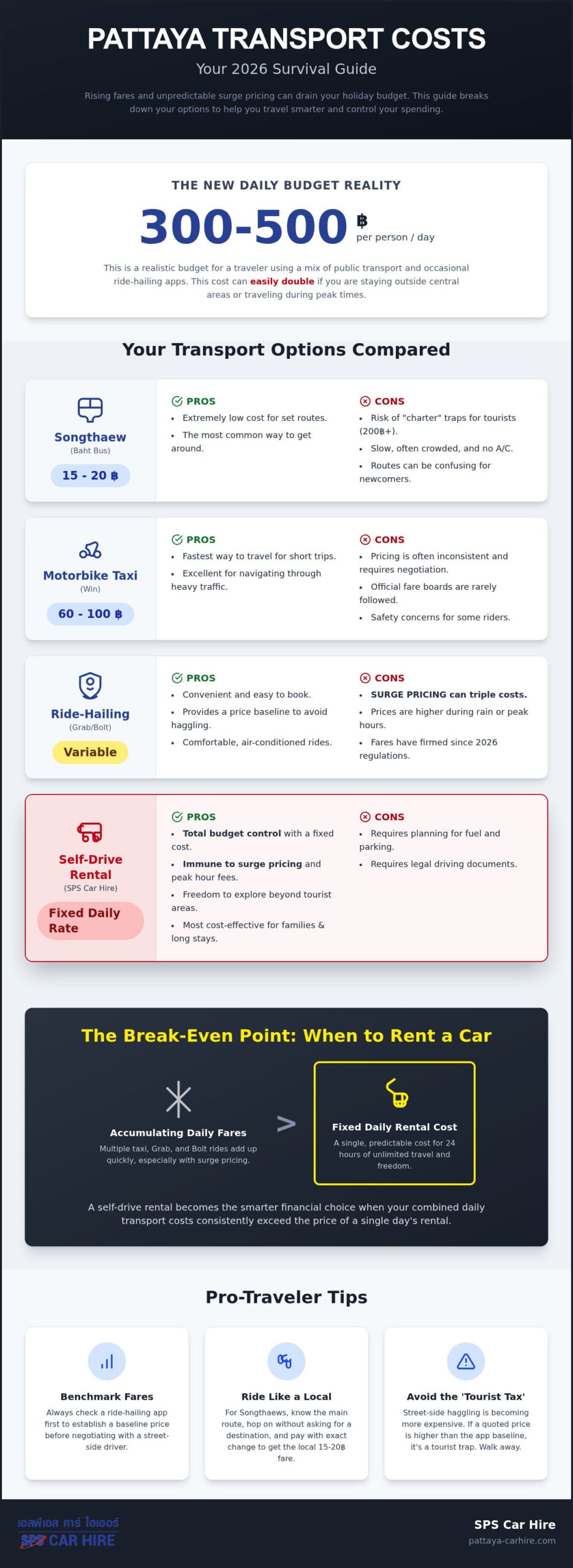
Understanding the total cost of transport in Pattaya requires looking at more than just the sticker price of a single ride. You have to account for the “Tourist Tax,” which is the unwritten premium added when you try to hail a taxi or motorbike on the street without a clear plan. Street-side haggling is becoming more expensive and less successful as drivers pivot toward fixed-rate digital platforms. A realistic daily budget for a traveler relying on a mix of public transit and occasional taxis now sits between 300 ฿ and 500 ฿, but this can easily double if you are staying outside the central loops.
The Shift Toward App-Based and Private Solutions
Digital platforms have fundamentally changed how people move. While apps like Bolt and Grab have standardized many fares, they’ve also introduced surge pricing that can triple your costs during a sudden tropical downpour or at 2:00 AM. Since the March 31, 2026, enforcement of public transport registration for app drivers, the pool of available vehicles has stabilized, but prices have stayed firm. Many savvy visitors now realize that having your own wheels is the ultimate budget hack. Choosing a budget car and truck rental gives you a fixed daily cost, removing the stress of surge pricing and the exhaustion of waiting for a ride in the midday heat.
Understanding Local Pricing Tiers
There is a significant gap between local commuter rates and what visitors often end up paying. Locals know the exact routes of the songthaews and pay the 15 ฿ or 20 ฿ fare without a word. Visitors often get caught in “charter” traps where a driver offers a private trip for 200 ฿ for a route that should cost 20 ฿. Reliability is the hidden cost here. While public options are cheap, they are often slow and lack air conditioning. To spot a fair price, always check a ride-hailing app first to establish a baseline before talking to a street-side driver. If the quote is higher than the app, it’s time to walk away.
Public Transit and Local Commuting Costs
Living and moving in this city requires a bit of street smarts, especially since the 2026 fare updates. The most common way to keep your cost of transport in Pattaya low is the songthaew system. These dark blue pickup trucks with benches in the back are the lifeblood of the city. As of April 2026, the standard fare for a short trip within the central loops is 15 ฿, while longer routes like the Pattaya-to-Jomtien stretch now cost 20 ฿. These rates are monitored by local officials following policy frameworks from the Thai Ministry of Transport.
The trick to using them like a local is simple: never ask the driver if they’re going to a specific destination. If you do, they might treat the ride as a private charter and demand 200 ฿ or more. Instead, just check the direction they’re heading and hop on. Managing the daily cost of transport in Pattaya becomes much easier once you master these local nuances. When you reach your stop, press one of the buzzers located on the roof. Walk to the driver’s window, hand over the exact change, and walk away. It’s efficient and avoids unnecessary price disputes.
Mastering the Songthaew Routes
While the loop system is convenient, it’s easy to end up on a “dead end” route if you aren’t paying attention. Most trucks follow a predictable path along Beach Road and Second Road. However, if a driver turns off the main loop, they might be heading to a private destination. If you find yourself alone on a bus, the driver might offer to take you directly to your hotel for a “special price.” Unless you’re in a hurry and happy to pay 150 to 250 ฿ for the convenience, it’s usually better to hop off and find another truck on the main line.
Motorbike Taxis: Pricing and Safety
When time is tight, the motorbike taxis, known locally as “Win,” are your best bet for short hops. You can recognize official riders by their numbered orange vests. While there are government-regulated fare boards at most stands, they’re rarely followed to the letter in tourist areas. For a typical 2 to 5 kilometer trip, expect to pay between 60 ฿ and 100 ฿. It’s a speed-price trade-off; you’ll get through the gridlock on Second Road much faster than a car, but you’ll pay a premium for that agility.
These riders often bridge the “last mile” gap between a bus stop and your hotel. If you find yourself using them multiple times a day, the costs add up quickly. For those who want more freedom without the constant negotiation, looking into a best price motorbike rental can offer significant savings and let you explore at your own pace. Just remember that safety should always come first; always wear a helmet and ensure you have the correct license for self-drive options.
Navigating Ride-Hailing Apps and Traditional Taxis
While the recent changes to local songthaew fare structures offer a cheap baseline, many travelers prefer the door-to-door convenience of a car. In 2026, the battle for your Thai Baht is fought primarily between Bolt and Grab. Bolt remains the champion of low-cost rides, often pricing journeys 15% to 30% lower than its competitors. A typical trip within the city center on Bolt usually ranges from 60 ฿ to 120 ฿. Grab, while more expensive, offers higher reliability and faster pickups during peak times. If you’re in a hurry, paying the premium on Grab is often worth it to avoid the higher cancellation rates sometimes seen on budget-focused apps.
Don’t get caught in the surge pricing trap. When the sky opens up or the bars close on Walking Street, app prices can triple instantly. A ride that normally costs 100 ฿ can jump to 300 ฿ in seconds. This volatility makes the fixed cost of transport in Pattaya difficult to predict if you rely solely on apps. Traditional metered taxis exist, but the “meter” is largely a myth for local trips. Most drivers will insist on a flat rate, often starting at 200 ฿ for even the shortest hops. If a driver refuses the meter, which officially starts at 52.50 ฿, you’re almost always better off booking through an app or walking a block away to find a more reasonable offer.
The Pros and Cons of Digital Booking
Digital platforms provide price transparency that eliminates the stress of haggling. You know exactly what you’ll pay before the car arrives. However, wait times during the high season can be significant. It’s also vital to manage your payment methods; while apps allow credit cards, keeping cash on hand is smart for when drivers prefer immediate payment. App-based rides are generally safer due to GPS tracking, but they aren’t always the cheapest way to move if you’re making multiple stops throughout the day. Indriver is another option that allows you to bid on fares, though it requires more user interaction than the standard one-tap booking.
Airport Transfer Costs and Haggling
Planning your arrival is the first step in mastering your budget. A private taxi from Suvarnabhumi (BKK) to Pattaya starts at 1,000 ฿, while Don Mueang (DMK) is closer to 1,400 ฿. These are standard fixed rates. If a driver at the airport asks for significantly more, walk away. For cross-town trips, if you must use a street taxi, aim for a flat rate between 150 ฿ and 250 ฿ depending on the distance. Anything over 300 ฿ for an in-city car trip is a “tourist trap” price that you should never accept. Comparing these daily one-off costs against a weekly rental package often reveals where the real savings are hidden.
Self-Drive Rentals: Calculating the Real Cost and ROI
While songthaews and apps serve their purpose for short hops, they quickly become a drain on your wallet if you’re making more than three trips a day. For those staying a week or longer, the total cost of transport in Pattaya can be slashed significantly by choosing a self-drive option. It’s a choice between the uncertainty of surge pricing and the predictability of a fixed daily rate. Savvy travelers in 2026 are moving away from the “per-ride” mentality and embracing the freedom that comes with having their own keys.
Mastering your budget means looking at the long-term picture rather than just the next ride. We provide a Best Price Guarantee on all budget vehicles to ensure you aren’t overpaying for your independence. You get a reliable machine without the “tourist premium” found at unverified street-side stands. This approach doesn’t just save you money; it removes the friction of constant negotiation from your holiday experience.
Comparing Car and Motorbike Rental Costs
The math is straightforward. If you’re a family of four, just two round-trip taxi rides can equal the daily cost of a budget car rental. When you factor in the air-conditioned comfort and the ability to store groceries or beach gear, the ROI becomes obvious. For solo travelers, a motorbike is the ultimate low-cost solution for navigating traffic, though it requires a higher level of situational awareness. Choosing a rental over daily ride-hailing apps lets you explore the surrounding regions without watching a digital meter tick upward every time you hit a red light.
Truck Rental for Utility and Business
Sometimes a compact car isn’t enough for the task at hand. If you’re an expat moving house or a business owner transporting equipment, a budget truck rental provides the utility you need without the high overhead of a private moving service. These vehicles are also perfect for rugged regional exploration beyond the city limits. Long-term car rental packages offer massive savings, often reducing the effective daily rate by 40% or more compared to short-term bookings. It’s the most logical way to stabilize your monthly expenses while maintaining total mobility.
Insurance and Peace of Mind
Don’t be tempted by “no deposit” offers from unlicensed shops; these are often a gateway to disputes over minor scratches. A legitimate cash deposit protects both parties and ensures you’re dealing with a professional agency. Understanding what car rental insurance actually covers is the difference between a minor inconvenience and a financial disaster. First-class insurance is absolutely non-negotiable for foreigners because it provides the legal and financial shield required to navigate Thai road regulations safely. We prioritize your peace of mind by focusing on comprehensive coverage for every vehicle in our fleet. Stop worrying about the meter and secure your best price car rental today to start saving on every kilometer.
Strategic Budgeting for Long-Term Transportation
Most travelers make the mistake of looking at their expenses one day at a time. If you’re staying for a month or more, that approach is a recipe for a blown budget. We recommend the “30-Day Rule”: if your stay exceeds four weeks, you should stop relying on unpredictable apps and start a monthly car rental. This shift moves your cost of transport in Pattaya from a variable expense that spikes during rain or rush hour to a fixed, manageable line item. It’s about taking control of your mobility rather than being at the mercy of a driver’s availability.
The final verdict on the most cost-effective way to move depends entirely on your stay length. For a weekend, the songthaew loop is unbeatable. For a week, a mix of Bolt and the occasional motorbike taxi works. But for anything longer, the math heavily favors self-drive. When you look at the total cost of transport in Pattaya over a full month, the savings from a long-term package can often pay for a week’s worth of dining out.
The Expat Strategy: Monthly Rentals
Expats often face the dilemma of whether to buy a used vehicle or stick with rentals. Buying a car in Thailand involves complex paperwork, residency certificates, and the looming risk of expensive repairs on an older model. Choosing a long-term car hire removes these headaches entirely. You get a modern, well-maintained vehicle with support from a locally owned agency that understands the terrain. When you compare the car rental vs taxi costs over 30 days, the rental isn’t just more convenient; it’s often significantly cheaper than the cumulative total of four daily taxi trips. Plus, our flexible packages allow you to extend your stay without the stress of re-negotiating rates from scratch.
Practical Tips for Reducing Transport Spend
Budgeting for fuel in 2026 requires a bit of planning. To keep your regional road trips affordable, we suggest planning your routes to avoid the heavy congestion of Sukhumvit Road during school run hours. Use your rental strategically. We recommend using your car for “big shop” days at stores like Makro or for exploring the hills of Silverlake, where taxis are rare and expensive. On days when you’re just heading to a crowded beach spot with limited parking, hop on a 15-baht songthaew for the “last mile.” This hybrid approach is the hallmark of a savvy local. It keeps your fuel consumption low while ensuring you always have the utility of a car or truck when you actually need it.
Take Control of Your Pattaya Journey
Navigating the 2026 transport landscape requires more than just loose change. You’ve seen how the new 15-baht songthaew fares and the volatility of app-based surge pricing can complicate your daily spending. By understanding the true cost of transport in Pattaya, you can stop reacting to the meter and start planning for total mobility. Whether you’re here for a week of exploration or a month of expat life, switching from public transit to a private rental is the most effective way to eliminate “tourist pricing” from your holiday.
It’s time to stop worrying about the rain or the rush hour. Lock in your 2026 transport budget with a best-price rental from SPS Car Hire. We provide a Best Price Guarantee on all vehicles and offer First-Class Insurance options for total peace of mind. You’ll find no hidden fees or “tourist” markups here, just straightforward value from local experts who know the city best. Grab your keys and discover the freedom of the open road today.
Frequently Asked Questions
How much does a Baht bus cost in 2026?
A standard Baht bus ride within central Pattaya costs 15 ฿ as of April 2026. If you are traveling on longer routes, such as the trip between Pattaya and Jomtien, the fare is 20 ฿. These rates were updated recently to reflect rising operating costs and fuel prices. Always pay the driver at the end of the trip to ensure you are charged the standard local rate rather than a private charter price.
Is it cheaper to use Grab or Bolt for transport?
Bolt is generally the more budget-friendly option, often saving you 15% to 30% compared to Grab for the same route. While Bolt offers a lower cost of transport in Pattaya, Grab typically provides a more reliable service with faster pickups. It’s a trade-off between price and speed. Many savvy locals keep both apps installed to compare live pricing during peak hours or heavy rain to find the best deal.
What is the average cost of a budget car rental per day?
A small eco-car typically costs between 1,200 ฿ and 1,500 ฿ per day from most agencies in the current market. These rates fluctuate based on the season and the specific model you choose. If you are looking for a best price car and truck rental, opting for a longer booking period will significantly reduce your daily expenditure. This makes self-drive a much more predictable expense than relying on daily taxis or ride-hailing apps.
Do I need an International Driving Permit to rent a car?
You legally require an International Driving Permit (IDP) alongside your original home country license to drive in Thailand. Most reputable rental agencies will ask to see both documents before handing over the keys. Driving without an IDP can lead to fines at police checkpoints and may void your insurance coverage in the event of an accident. It’s a simple requirement that ensures you stay on the right side of the law while exploring the region.
Is insurance included in the rental price at SPS Car Hire?
We provide first-class insurance options for every vehicle to ensure you have total peace of mind while on the road. This coverage is a core part of our service because we believe your safety and financial protection shouldn’t be optional extras. While some agencies might hide these costs, we prioritize transparency. You’ll know exactly what is covered before you start your journey, protecting you from unexpected repair bills or legal disputes.
Can I rent a truck for moving house or business needs?
You can absolutely rent a budget truck for utility tasks like moving house or transporting business inventory. We offer various truck models that provide the extra space and power required for heavy loads. This is a much more cost-effective solution than hiring a private moving company for local jobs. Our trucks are well-maintained and ready to handle the demands of regional exploration or local logistics whenever you need the extra capacity.
What happens if I stay longer-are there monthly rental discounts?
Staying longer automatically unlocks our dedicated long-term car rental packages, which offer the best value for expats and extended visitors. The daily rate drops significantly when you commit to a monthly stay compared to a short-term booking. This strategy is the most effective way to stabilize your cost of transport in Pattaya. We make it easy to extend your rental if your plans change, ensuring you always have the most competitive rate available.
Is it safe to use motorbike taxis for long distances?
Motorbike taxis are best suited for short hops rather than long-distance travel. While they are fast for cutting through city gridlock, the physical strain and exposure to traffic make them less ideal for journeys over five kilometers. For longer distances, a car or truck provides far superior safety and comfort. If you need to travel across town frequently, a private rental is a much more secure and relaxing choice for your daily commute.
 -
- -
- -
- -
- -
- -
- -
-