

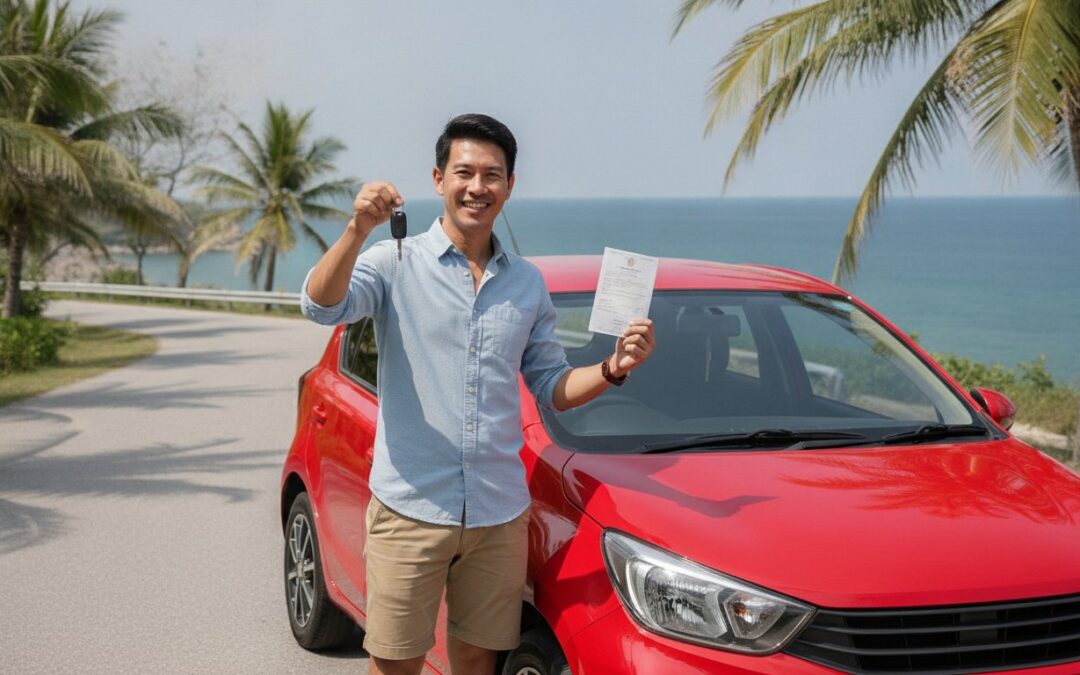
Did you know that car rental complaints in Thailand recently jumped by 15 percent? Most of these headaches come from simple misunderstandings about insurance or the mandatory 1949 and 1968 International Driving Permits. If you’re researching car rental mistakes to avoid Pattaya, you’ll likely want to sidestep the stress of hidden fees and aggressive traffic patterns. You probably feel a bit of anxiety about navigating local roads or getting hit with unexpected costs. We believe your journey should focus on the scenery, not on whether your paperwork will pass a police checkpoint.
Discover how to navigate the complexities of Thai vehicle hire, avoid hidden costs, and ensure a stress-free journey with expert local advice. We’re here to give you the inside track on local driving norms so you can avoid fines of up to 4,000 THB for common mistakes. We’ll walk you through a foolproof vehicle handover checklist and explain how to choose insurance that actually protects you. By the end of this guide, you’ll have the confidence to handle any rental situation like a seasoned local pro.
Key Takeaways
- Ensure you’re fully legal and covered by understanding the mandatory requirements for the 1949 or 1968 International Driving Permit alongside your standard license.
- Protect your budget by learning the car rental mistakes to avoid Pattaya, specifically regarding hidden VAT charges and the nuances of local insurance policies.
- Prevent handover disputes by using a 360-degree video rule to document the vehicle’s condition, including often-missed areas like the roof and under-chassis.
- Gain confidence on the road by learning the unwritten hierarchy of local traffic and what to expect at common police checkpoints.
- Find the best value by comparing global brands with local independent agencies that offer superior flexibility for long-term vehicle hire packages.
Documentation and Legal Requirements for Renting in Thailand
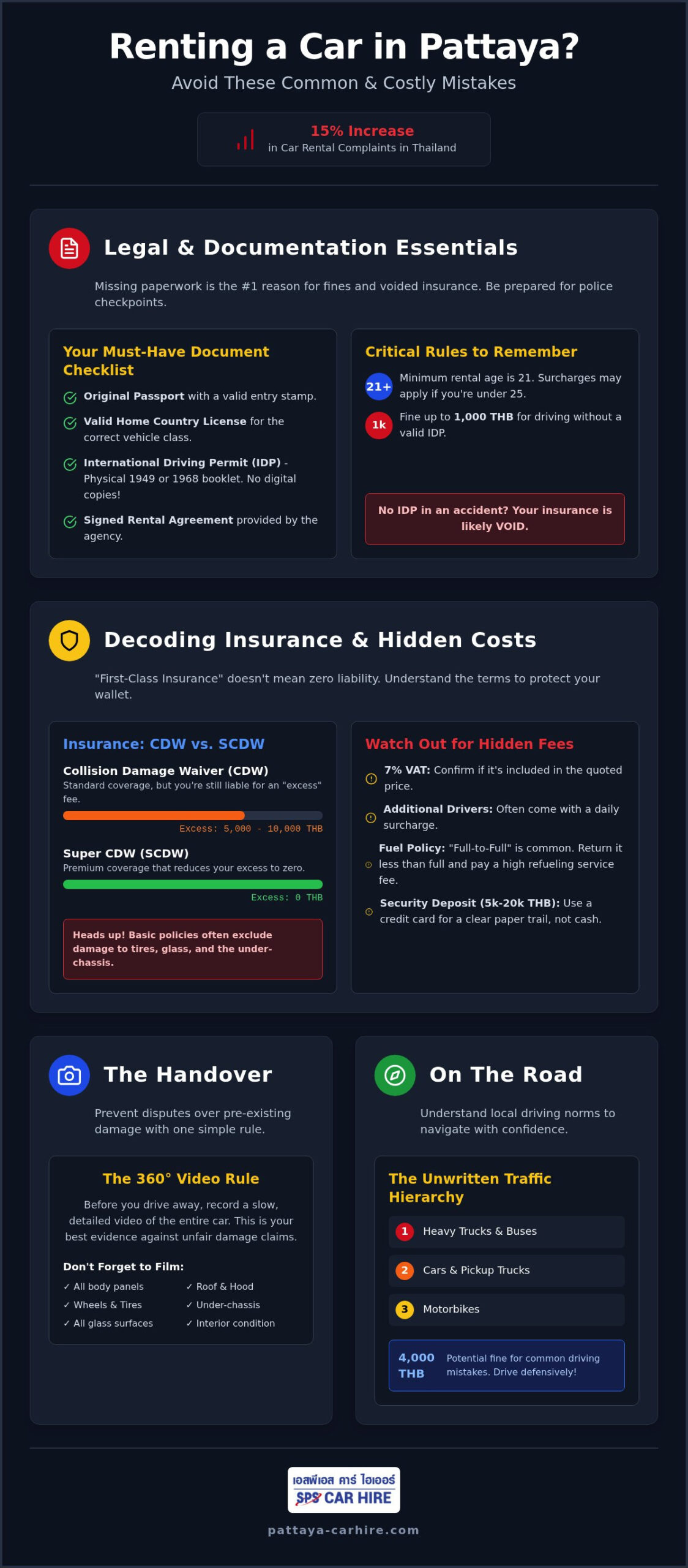
Driving through the lush landscapes of Thailand is a fantastic way to explore, but you’ve got to play by the rules to stay protected. One of the biggest car rental mistakes to avoid Pattaya is assuming your home country’s driver’s license is a universal pass. It isn’t. While some informal shops might hand over the keys with just a plastic card from your home country, the police at checkpoints have a much stricter perspective. You need to carry your original passport with a valid entry stamp, your home license, and a valid International Driving Permit to stay on the right side of the law.
Age is another factor that catches many travelers off guard. You must be at least 21 years old to rent a vehicle here. If you’re under 25, be prepared for potential surcharges or restrictions on certain vehicle categories. Rental agencies are legally required to keep a copy of your passport and visa details on file for every transaction. This transparency protects you and ensures the agency can verify your legal status in the country during your rental period.
The International Driving Permit (IDP) Explained
The International Driving Permit isn’t just a helpful suggestion; it’s a legal necessity for non-ASEAN visitors. As of 2026, Thai authorities are strictly enforcing the requirement for either the 1949 or 1968 convention permits. If you’re stopped at a checkpoint without one, you’ll face an immediate fine of up to 1,000 THB. Even more critical is the impact on your car rental insurance. Many providers will completely void your coverage if you’re involved in an accident without a valid IDP. This means you’d be personally responsible for every satang of damage. Don’t rely on digital versions on your phone; the physical booklet is the only format the police and insurance adjusters will accept.
Validating Your Home Licence
Your home license must be valid for the entire duration of your trip and cover the specific category of vehicle you intend to drive. If you’re hiring a truck for business or moving needs, double check that your license allows for that specific weight class. For those with licenses issued in languages other than English, a certified translation is often necessary to comply with Thai driving license regulations. To avoid any friction during your journey, keep this documentation checklist in your glovebox at all times:
- Original Passport: Must show your current, valid entry stamp.
- Home Country License: Ensure it hasn’t expired and matches your vehicle type.
- International Driving Permit: The physical 1949 or 1968 booklet.
- Rental Agreement: A signed copy provided by your agency.
By preparing these documents in advance, you eliminate the most common car rental mistakes to avoid Pattaya. This preparation ensures that your focus remains on the road and your destination, rather than navigating legal hurdles at a roadside checkpoint.
Understanding Insurance and Avoiding Hidden Costs
Insurance in the Thai rental market is often wrapped in marketing jargon that can be misleading. One of the most frequent car rental mistakes to avoid Pattaya is believing that “First-Class Insurance” means you have zero financial responsibility. In reality, this typically refers to a standard Collision Damage Waiver (CDW). Under a CDW, you’re still liable for an excess amount, usually ranging from 5,000 to 10,000 THB for economy vehicles. If you want to walk away from an accident with zero out-of-pocket costs, you must specifically ask for Super Collision Damage Waiver (SCDW). This upgrade is vital because basic policies often exclude damage to glass, tyres, and the under-chassis, which are high-risk areas on local roads.
Hidden fees can easily inflate your bill if you don’t read the fine print. Always confirm if the daily rate includes the mandatory 7% Value Added Tax (VAT). Some agencies also charge extra for additional drivers or impose heavy cleaning fees for minor interior messes. Your security deposit also requires careful planning. Most reputable agencies will hold between 5,000 and 20,000 THB. While some local shops accept cash, using a credit card is a much smarter move. It preserves your spending money and provides a formal paper trail for the refund process once you return the vehicle.
Fuel policies are another area where costs can creep up. Most providers operate on a “Full-to-Full” basis. The trap here isn’t the policy itself, but the refueling service fee. If you return the tank even slightly less than full, the agency may charge you a premium rate per liter plus a service fee. To stay safe and legal, follow the U.S. Embassy guidelines on driving in Thailand by ensuring you have the correct permit to match your insurance requirements. If you’re unsure about the best coverage for your trip, the team at SPS Car Hire can walk you through the specifics of our transparent policies.
Budget Rental Pricing Strategies
Securing a best price car rental requires looking beyond the initial sticker price. Unlicensed agencies often offer “too good to be true” rates because they skip expensive commercial insurance entirely. This leaves you legally and financially exposed. If you’re planning an extended stay, stop looking at daily rates. A monthly car rental package provides a much lower cost-per-day and usually includes more robust maintenance support. We recommend choosing a provider that balances budget-friendly prices with the security of a professional, independent agency.
The Physical Inspection: Preventing Handover Disputes
Handover day is where the most expensive car rental mistakes to avoid Pattaya are either made or prevented. Don’t let the excitement of your trip cause you to rush through the paperwork. We recommend adopting the 360-degree video rule as your primary line of defense. Use your phone to record a slow, continuous walk-around of the entire vehicle. Pay close attention to the roof and the under-chassis. These areas are frequently overlooked by travelers but are the first places an agent might check upon return. Don’t forget to film the spare tire and the jack assembly in the trunk to ensure they’re present and in good condition.
Safety on the road begins with what’s under the car. Check the tire tread depth and look for any bulges in the sidewalls. With local fuel costs for Gasohol hovering around 40 to 45 THB per liter, you don’t want to waste money driving on under-inflated tires that kill your fuel economy. Ask the agent for a pressure gauge if the tires look low. Finally, test the air conditioning immediately. In the tropical heat, a failing compressor isn’t just an inconvenience; it’s a safety hazard that causes driver fatigue.
Interior and Functional Checks
Inside the cabin, your first task is verifying the fuel gauge. Ensure the needle sits exactly where the contract says it should. If the tank is supposed to be full, it must be at the very top. Turn on every electronic component. Test the window regulators, the wipers, and the headlights. We also suggest a quick smell test. If the car smells of cigarette smoke or dampness, request a different vehicle immediately. These odors are often impossible to remove and can indicate poor maintenance or previous water damage.
Documenting Pre-existing Damage
Watch the rental agent like a hawk while they fill out the condition report. Every single scratch, no matter how small, must be marked on the diagram. If you see a chip in the paint that they missed, point it out and insist they add it. Take your own time-stamped photos of these specific marks. Taking these precautions is the best way to handle car rental mistakes to avoid Pattaya before they become financial burdens. If you discover a mechanical issue after driving away, stop immediately. Take a photo and send it to the agency via a messaging app right then. This creates a digital trail that proves the damage existed before you took full control of the vehicle.
Navigating Thai Road Culture and Traffic Laws
Driving on the left is only the beginning of your journey. In Thailand, the “might is right” hierarchy is an unofficial but widely accepted rule. Large trucks and buses often expect smaller vehicles to yield, regardless of who technically has the right of way. One of the primary car rental mistakes to avoid Pattaya is assuming that Western-style traffic etiquette will protect you. You must stay alert and adapt to the local flow, which often prioritizes momentum over strict lane discipline. Defensive driving isn’t just a suggestion here; it’s a necessity for your safety.
Police checkpoints are a common sight as of 2026, especially on main arterial roads. If you’re flagged down, stay calm and be polite. Officers will typically ask to see your passport and your International Driving Permit. Under the stricter enforcement laws implemented in April 2026, failing to carry a valid license carries a fine of up to 1,000 THB. Other common violations like running a red light or using a mobile phone without a hands-free kit can result in fines of up to 4,000 THB. We recommend keeping your documents in an easy-to-reach spot to make these interactions as quick as possible.
Parking requires a sharp eye for curb markings to avoid a heavy fine or a wheel clamp. Follow these simple rules to stay in the clear:
- Red and White: Absolute no-parking zone. Your car will likely be towed or clamped.
- Yellow and White: Short-term parking or loading zones only. Don’t leave your car here for long.
- Left Turn on Red: This is generally legal unless a sign specifically forbids it. Always stop first and check for oncoming traffic.
The Unwritten Rules of Thai Driving
Communication on the road can be counterintuitive. If a driver behind you flashes their headlights, they aren’t telling you to go ahead. They’re actually warning you that they are coming through and you should stay put. You also need to manage the constant swarm of motorbikes. They will filter through traffic on both sides of your vehicle. Check your mirrors every few seconds, especially before changing lanes or turning. To ensure you have the right vehicle for these conditions, book your budget-friendly car or truck rental with a team that understands local road demands.
Navigating Roundabouts and Intersections
Roundabouts can feel chaotic because lane discipline is often non-existent. Drivers may cut across multiple lanes to exit. Enter slowly and keep a steady pace. Most major routes feature signage in both Thai and English, making navigation relatively straightforward if you have a reliable GPS. If you experience a breakdown or an accident, your first call should be to your rental agency’s emergency number. They’ll coordinate with local recovery services and guide you through the reporting process to ensure your insurance remains valid.
Choosing the Right Rental Provider for Your Needs
Picking a provider is the final hurdle in your planning process. While global chains offer a sense of familiarity, they often lack the personalized touch and deep local knowledge of an independent agency. One of the most common car rental mistakes to avoid Pattaya is assuming the biggest brand always offers the best value. Local agencies typically provide much better long term car hire flexibility. We can tailor packages for expats or long-stay visitors that corporate giants simply won’t touch. You get direct access to decision-makers who can solve problems on the spot rather than waiting for a regional manager’s approval.
Safety and reliability should always come before a bottom-dollar price. Watch out for red flags like a business that operates without a physical office or uses vague, handwritten contracts. A shady rental business might try to meet you at a random landmark instead of a professional premises. This makes it nearly impossible to resolve disputes later. We pride ourselves on transparency and provide 24/7 local support. If you have a flat tire or a mechanical issue at midnight, you need a provider who picks up the phone and dispatches roadside assistance immediately.
Evaluating Customer Reviews and Reputation
With car rental complaints jumping by 15 percent as of 2026, doing your homework on a company’s reputation is vital. Don’t just look at the star rating. Read the text of the reviews to spot genuine feedback versus manufactured praise. Look for mentions of vehicle maintenance standards and how the staff handled problems. Clear communication in English is non-negotiable. If you can’t understand the terms of your contract or explain a breakdown to the support team, your stress levels will skyrocket. A savvy local guide will always have staff who can bridge that communication gap effectively.
Matching the Vehicle to Your Trip
Your choice of vehicle should depend entirely on your itinerary. A budget compact car is perfect for solo travelers or couples who need to navigate tight city streets and find parking easily. However, if you’re moving house or running a business, a pickup truck rental offers the durability and cargo space you need. We keep our fleet in top condition to ensure you never have to worry about a breakdown in the middle of a busy highway. Ready for a stress-free trip? Check out our best-price budget rental options today!
Drive with Total Confidence on Your Next Thai Adventure
You’re now equipped with the inside track on how to navigate the complexities of Thai vehicle hire. By securing your 1949 or 1968 IDP and conducting a meticulous 360-degree video inspection, you’ve already bypassed the most expensive car rental mistakes to avoid Pattaya. Remember that transparency is your best friend on the road; always insist on clear insurance terms and documented condition reports before you drive away. Our team at SPS Car Hire has provided independent local expertise since our founding, and we’re dedicated to removing every bit of friction from your journey.
We back every vehicle with a Best Price Guarantee and offer first-class insurance options for total peace of mind. Whether you need a compact car for city streets or a rugged truck for business, we have the right solution ready for you. Secure Your Budget-Friendly Car or Truck Rental Today and experience the freedom of the open road with a partner who truly knows the local landscape. Your stress-free adventure starts right here. Enjoy the drive!
Frequently Asked Questions
Is it safe to rent a car in Thailand for the first time?
Driving for the first time is safe if you remain vigilant and adapt to the local “might is right” hierarchy. You’ll need to get used to left-side driving and the constant flow of motorbikes filtering through traffic. We recommend starting your journey on less crowded roads to build confidence. Staying alert and practicing defensive driving are the best ways to ensure a smooth trip across the country.
Can I rent a car in Thailand with just my UK or US driving licence?
You cannot legally drive with just a UK or US license alone. Thai law requires you to carry your original home country license alongside a valid 1949 or 1968 International Driving Permit. As of the April 2026 regulatory updates, police are strictly checking for these documents at roadside checkpoints. Driving without the correct permit can void your insurance coverage entirely, leaving you financially responsible for any damages.
What happens if I have an accident in a rental car?
If you’re involved in an accident, your first step is to contact your rental agency’s emergency support line. Don’t move the vehicle unless the police or your agency instructs you to do so. You’ll need to provide your documentation and a copy of the rental agreement to the attending officers. Having first-class insurance options helps minimize your financial liability for repairs and third-party claims during these stressful situations.
How much is a typical security deposit for a budget car rental?
A typical security deposit ranges from 5,000 to 20,000 THB depending on the vehicle category. We strongly advise using a credit card for this transaction rather than cash. This method ensures a clear digital paper trail and makes the refund process much faster once you return the car. It also prevents you from tying up a significant portion of your holiday spending money while you explore the country.
Are there hidden taxes or VAT in the quoted rental price?
Transparent agencies will include the mandatory 7% Value Added Tax in their initial quote. However, some providers might wait until the final checkout to add this cost. Verifying the total price upfront is one of the key car rental mistakes to avoid Pattaya. Always ask for a breakdown that includes VAT, additional driver fees, and any cleaning charges to ensure the price you see is the price you pay.
Can I take my rental car to other provinces in Thailand?
You are generally free to drive your rental car across various provinces to explore the national landscape. However, please note that we do not offer one-way rentals to other cities. You must return the vehicle to the original pickup location at the end of your contract. This policy allows us to maintain our fleet standards and keep our rental packages budget-friendly for all of our customers.
What should I do if the police pull me over in a rental car?
Remain calm, pull over safely, and stay in your vehicle. You must present your passport and your International Driving Permit when requested. As of April 2026, fines for minor infractions like not carrying a license can reach 1,000 THB, while mobile phone use while driving carries a fine of up to 4,000 THB. Being polite and having your paperwork ready will usually make the process quick and straightforward.
Is insurance included in the daily rental rate?
Basic third-party liability and a standard Collision Damage Waiver are usually built into our daily rates. While these provide legal minimum coverage, they often carry a high excess. We recommend upgrading to first-class insurance options for total peace of mind. This extra layer of protection can reduce your financial responsibility for scratches or minor accidents to zero, allowing you to focus on your journey rather than potential repair bills.
 -
- -
- -
- -
- -
- -
- -
-