


Would you sign a legal document that could leave you liable for thousands of dollars over a single parking lot scrape just because you didn’t understand three letters on a page? For many travelers in Thailand, the rental counter often becomes a source of stress rather than the start of an adventure. You’re likely familiar with that sinking feeling when an agent mentions “excess” or “deductibles” while sliding a complex contract across the desk. It’s frustrating to feel like you’re being pressured into expensive add-ons simply because the terminology feels intentionally opaque.
We believe your journey should be about the drive, not the paperwork. This car rental damage waiver explained guide for 2026 is designed to strip away the jargon and give you total clarity on your financial liability. You’ll learn the critical differences between CDW and SCDW, how to spot hidden costs before they hit your credit card, and the exact steps to take when documenting your vehicle’s condition. By the end of this guide, you’ll have the confidence to accept or decline coverage offers like a savvy local expert, ensuring your budget stays focused on your travels rather than unexpected repair bills.
Key Takeaways
- Get the car rental damage waiver explained simply so you can distinguish between a legal contract and a financial insurance product before you reach the counter.
- Decode confusing acronyms like CDW and LDW to understand exactly what is covered and which parts of the vehicle, like tires or windows, might still be your responsibility.
- Learn how to manage your “excess” or out-of-pocket limits to prevent unexpected credit card holds and high repair costs after an accident.
- Master the 360-degree inspection process using photos and video to ensure you aren’t held liable for pre-existing damage when returning your vehicle.
- Discover why independent local agencies often offer more transparent terms and better value on protection compared to large global franchises.
What is a Car Rental Damage Waiver?
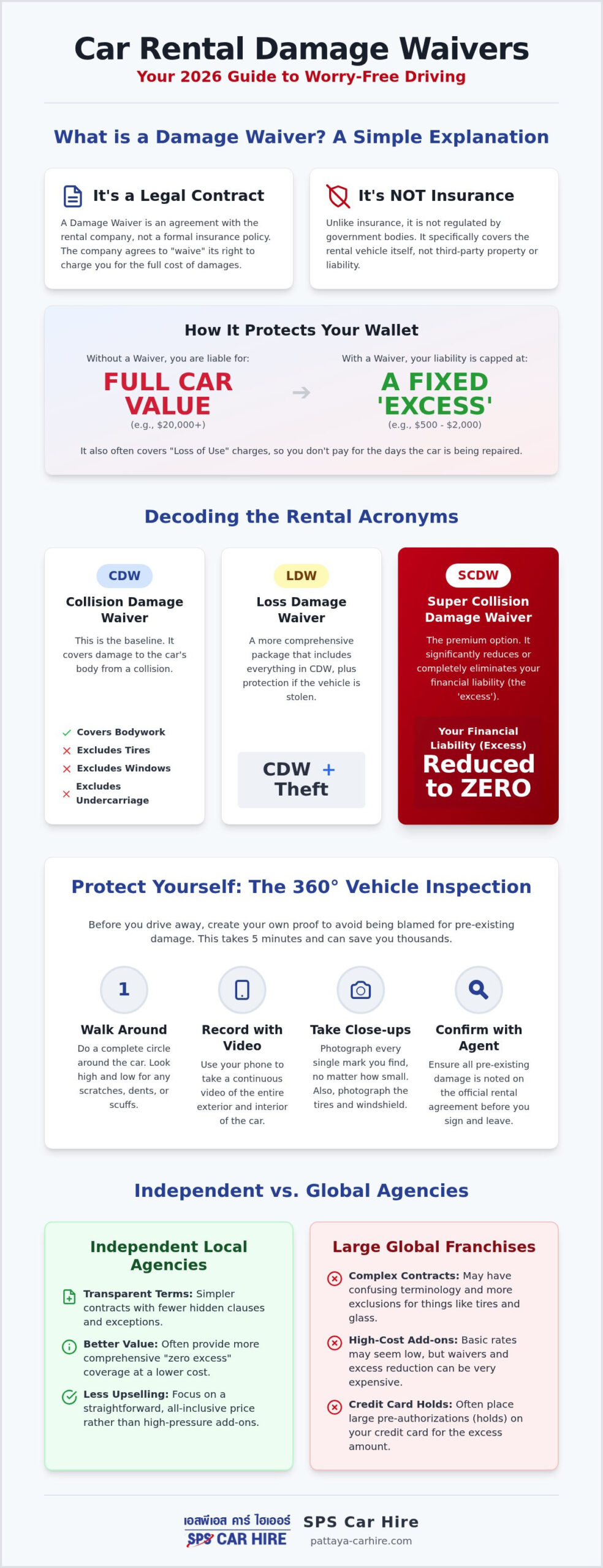
When you step up to a rental desk, the paperwork can look like a mountain of fine print. At its core, a car rental damage waiver explained simply is a legal handshake between you and the rental company. It isn’t a regulated insurance policy sold by a broker; rather, it’s an amendment to your rental contract. By signing it, the rental provider agrees to “waive” their right to charge you for the full cost of repairs if the vehicle is damaged during your trip. This Damage waiver (DW) shifts the bulk of the financial burden from your shoulders back to the agency.
Rental companies use these agreements to manage the massive financial risk of maintaining a fleet. Without them, a single accident could cost a traveler tens of thousands of dollars. However, this protection isn’t a “get out of jail free” card. You still maintain a “Duty of Care.” If you drive under the influence or take a budget sedan off-roading through a jungle river, the waiver becomes void. You’re expected to treat the vehicle with the same respect you’d show your own car. It’s about mutual trust.
How Waivers Protect Your Wallet
The most immediate benefit of a waiver is how it caps your financial exposure. Instead of being responsible for the total value of a car, your liability is limited to a pre-agreed “excess” amount. This is a massive relief if you’re navigating unfamiliar roads where minor scrapes are common. It keeps your holiday budget intact.
Beyond just the repair bill, waivers often protect you from “loss of use” charges. When a car is in the shop, the rental company loses daily income. A solid waiver ensures you aren’t stuck paying for the days the vehicle sits idle in a garage. It turns a potentially catastrophic expense into a manageable, fixed cost. This simplifies the claims process significantly, as you won’t have to argue over repair labor rates or parts costs for a minor dent.
Waiver vs. Third-Party Liability
It’s vital to understand that a damage waiver only protects the physical vehicle you are driving. It does not cover damage to other people’s property or medical costs for others involved in an accident. In Thailand, car rental requirements typically include basic third-party liability by law, but the waiver is what shields you from the cost of the rental car itself. Having the car rental damage waiver explained in this context helps you see where one protection ends and another begins.
For a truly stress-free experience, you need both. Liability takes care of the world around you, while the waiver takes care of the keys in your pocket. This dual layer of protection is the secret to driving with confidence. It ensures that a moment of bad luck won’t derail your entire journey or leave you facing complex legal hurdles in a foreign country.
CDW, LDW, and SCDW: Decoding the Rental Acronyms
Stepping into a rental office can feel like entering an alphabet soup of acronyms. If you want the car rental damage waiver explained without the headache, you need to start with the three big ones: CDW, LDW, and SCDW. These aren’t just random letters; they define exactly how much money stays in your pocket if things go wrong on the road. Understanding these terms is the first step toward a worry-free trip across Thailand.
Collision Damage Waiver (CDW) is the most common baseline. It covers the body of the car if you hit another vehicle. However, it’s rarely a total shield. Standard CDW often leaves out “vulnerable” parts like the windows, tyres, and the undercarriage. If you catch a stone in the windshield or clip a curb, you might still be on the hook for the bill. It’s a smart move to check FTC consumer advice on renting a car to see how these contractual waivers differ from traditional insurance products.
Loss Damage Waiver (LDW) simply takes CDW and adds theft protection to the mix. It’s a more comprehensive package that ensures you aren’t paying for a replacement vehicle if the car is stolen. While theft is relatively rare when you use reputable providers, having it bundled provides that extra layer of security for your journey. Many agencies include this as their standard “basic” level of protection.
The CDW Standard: What’s Usually Included?
Standard protection focuses on the “shell” of the vehicle. If you’re looking for a low cost car and truck rental, you’ll likely start with this level of cover. It’s primarily designed for accidents where another party is involved. If you back into a stationary pole on your own, some basic waivers might not apply because there was no “collision” with another vehicle. Always verify if your waiver covers single-vehicle accidents before you drive away.
SCDW: Is ‘Zero Excess’ Worth the Extra Cost?
Super Collision Damage Waiver (SCDW) is the premium choice. It’s often called “Zero Excess” because it removes your financial liability entirely for most types of damage. For a first-time driver navigating the unique flow of national traffic, the peace of mind is often worth the daily premium. You can drop the keys off at the end of your trip without worrying about every tiny door ding or minor scrape.
However, if you’re a long-term renter, the math changes. Paying a high daily rate for SCDW over several months can cost more than a standard excess would in the event of a small claim. Savvy travelers often choose a standard waiver with a small, manageable excess to keep their daily rates budget-friendly. It’s about balancing your personal risk tolerance with your total trip length and budget.
The ‘Excess’ Explained: Managing Your Financial Liability
Understanding the “excess” is the most critical part of having the car rental damage waiver explained properly. Many travelers think that because they have a waiver, they won’t pay a single baht if a scratch appears. That’s a common mistake. In reality, the excess is the maximum out-of-pocket amount you’re responsible for before the rental company covers the rest. Think of it as the ceiling of your financial risk; it limits your liability so a minor accident doesn’t turn into a financial disaster.
When you pick up your vehicle, the agency will usually place an “authorisation hold” on your credit card. This isn’t a direct charge. It’s a temporary block on your funds that matches the excess amount. It ensures the company can recover costs if the car returns damaged. Once you bring the vehicle back in its original condition, that hold is released. Be aware that it can take several business days for your bank to show the updated balance, so plan your holiday spending accordingly.
How Excess Amounts are Calculated
The amount of your excess isn’t random. For standard budget cars, the amount is typically lower than what you’d see for larger pickup trucks or specialized vehicles. Several factors influence this number, including the driver’s age and the specific vehicle model. If you’re under 25, you might face a higher excess due to the perceived risk level in the national market. This is standard practice across the industry to balance fleet safety with rental costs.
For those navigating car rental for foreigners, here is a quick deposit checklist to keep things simple:
- Ensure your credit card has a high enough limit to cover the authorisation hold.
- Check if the agency accepts debit cards; many local providers require a credit card for the security deposit.
- Verify if the deposit amount is reduced if you choose to upgrade to a premium waiver.
The ‘Non-Waivable’ Excess
Even the best agreement has limits. There are “non-waivable” situations where you become fully liable for damage, regardless of your waiver. If you’re caught driving under the influence, allowing an unauthorized person to drive, or taking a budget sedan off-road, your protection evaporates immediately. Having the car rental damage waiver explained in this context helps you see that the contract is a two-way street; it protects you only if you follow the rules of the road.
Certain types of damage, like tyre blowouts or undercarriage scrapes from high curbs, might also carry a higher specific excess. Rental companies often view these as preventable through careful driving. You can find these details in the “Terms and Conditions” or “Exclusions” section of your rental agreement. Look for specific tables that list repair costs for these items. Being aware of these clauses before you sign ensures there are no hidden surprises when you return the keys.
Step-by-Step: How to Verify Your Coverage Before Driving Away
Having the car rental damage waiver explained in a brochure is one thing, but seeing how it applies to the vehicle in front of you is where the real protection starts. A waiver is only as effective as the “Vehicle Condition Report” it’s attached to. If you fail to document a pre-existing dent, you’re essentially volunteering to pay for it later. Don’t let a busy rental lot or a rushing agent pressure you into a quick handover. Take your time. This is the moment you secure your deposit and ensure your journey starts on solid ground.
Start with a methodical 360-degree walkaround with the rental agent present. You’re looking for more than just major crashes. Every small scratch, paint chip, or door ding needs to be noted on the official paperwork. Check the fuel level against the contract immediately. If the tank is three-quarters full but the contract says “full,” you’ll be hit with “refuelling fees” that no waiver will cover. Look at the interior too. Standard waivers often exclude upholstery burns, stains, or damage to the dashboard, so report any mess before you sit down.
Documenting Pre-existing Damage
Use the “Time-Stamp” rule for every photo you take. Your images and videos must be recorded while the car is still on the rental lot. This provides indisputable proof that the damage existed before you took possession. Focus on the “hidden” areas that many travelers overlook. Crouch down to check under the front bumper for scrapes from high curbs and inspect the sills and the roof. These are high-risk areas for damage and are often the first places agents look during a return inspection.
Recording a quick video is even better than photos. Narrate what you see and ensure the agent’s voice is captured acknowledging specific marks. This level of detail makes it nearly impossible for a company to claim new damage later. It’s about creating a transparent record that protects both parties. If you’re looking for a provider that values this level of honesty, consider our budget car and truck rental options where we walk you through the inspection process personally.
Reading the Fine Print: Exclusions to Watch For
Even with a solid car rental damage waiver explained to you, certain items often fall through the cracks. Tyres and glass are the most common exclusions in standard packages. A single stray rock on a highway could lead to a cracked windshield that you’ll have to pay for out-of-pocket. Always ask if these specific items are included or if they require a small daily add-on for total peace of mind.
Don’t forget about geographic restrictions. Some waivers are only valid if you stay within certain provinces or avoid specific types of roads. If you plan a cross-country trip, verify that your protection follows you across every border. Finally, remember that “service” items like lost keys or interior deep-cleaning fees are almost never part of a damage waiver. Treat the key like gold and keep the interior tidy to avoid these avoidable “extra” charges at the end of your rental.
Why Independent Rental Agencies Offer Better Value on Damage Protection
Global franchises often rely on rigid corporate scripts and hidden fees that only appear when you’re already at the counter. In contrast, independent local agencies thrive on transparency and reputation. When you have the car rental damage waiver explained by a local provider, you aren’t just hearing a legal disclaimer. You’re getting a commitment to service from someone who lives and breathes the local market. This direct connection often leads to more flexible terms and a much faster resolution if you ever need to make a claim.
Choosing a budget car rental from a local expert means you’re avoiding the “hidden fee” culture that plagues larger brands. We don’t hide behind complex insurance acronyms or surprise you with undisclosed charges upon return. Our goal is to make the process as straightforward as possible. You can speak directly with decision-makers rather than waiting on a corporate hotline. This accessibility is invaluable when you’re navigating national road conditions and need immediate, reliable advice from a savvy local guide.
Personalised Service vs. Corporate Scripts
Corporate rental desks often use dense legal jargon designed to protect the company first. We take a different approach. We explain your waiver in plain English so you know exactly where your liability starts and ends. Having the car rental damage waiver explained by a local expert ensures you aren’t caught off guard by regional nuances. We understand the specific risks of driving across Thailand, from monsoon rains to unique traffic flows. We share this inside track with you to help you avoid accidents in the first place.
Building trust is our priority, especially for those looking at long-term car rental packages. We want you to feel like a neighbor, not just another transaction number. By fostering a direct relationship, we can offer protection levels that actually make sense for your specific itinerary. You’ll get honest recommendations based on years of local experience rather than a one-size-fits-all corporate policy that might not suit your needs.
Choosing the Right Vehicle for Your Protection Level
Your choice of vehicle significantly impacts your protection needs. A sturdy pickup truck might offer different waiver benefits and a higher sense of security on rural roads compared to a small hatchback. If you’re planning to explore mountainous regions, a vehicle with more ground clearance can reduce the risk of undercarriage damage. As we’ve already noted, undercarriage scrapes are often excluded from standard waivers, so the right car choice is its own form of protection.
Match your vehicle to your driving confidence and your destination. If you’re a seasoned driver, a budget-friendly sedan with a standard waiver might be perfect. If you’re new to the area, you might prefer a larger vehicle with a premium waiver for total peace of mind. Ready for a transparent rental? Book your budget-friendly vehicle with SPS Car Hire today and experience the difference that local expertise makes.
Drive with Confidence and Total Clarity
Navigating the roads of Thailand should be the highlight of your trip, not a source of financial anxiety. You now have the car rental damage waiver explained from the inside out, from decoding complex acronyms like CDW and SCDW to mastering the art of the 360-degree vehicle inspection. Understanding that a waiver is a contractual ceiling on your risk rather than a hidden fee lets you make informed decisions that protect your budget. Documenting every scratch and verifying your excess limits are the most powerful tools in your travel kit. Don’t leave your protection to chance when you can have total transparency instead.
As a locally owned and operated independent agency, we take pride in removing the friction from your journey with straightforward terms and a best price guarantee on all vehicle rentals. Whether you need a short-term solution or one of our comprehensive long-term packages for expats and businesses, we’re here to provide the local expertise you deserve. Secure your best-price car or truck rental with transparent protection at SPS Car Hire and start your next adventure today. We look forward to seeing you on the road!
Frequently Asked Questions
Is a car rental damage waiver mandatory in Thailand?
No, it’s not legally mandatory like Compulsory Third Party Liability (CTPL), but it’s highly recommended. Most reputable agencies include a basic waiver in the rate. Driving without one leaves you liable for the full market value of the car. It’s a contractual choice rather than a government requirement, but skipping it is a massive financial risk for any traveler. Reputable providers won’t even rent a car without some form of basic protection.
Does my credit card insurance cover car rental damage?
Sometimes, but you must check your specific bank’s policy for international coverage in Thailand. Many cards only provide secondary coverage, meaning they pay what your other policies don’t. You usually have to decline the rental agency’s waiver to trigger the card’s benefit. However, the agency will still block a large deposit on your card because they don’t have a direct contract with your bank or insurance provider. This can limit your available spending money.
What happens if I have an accident without a damage waiver?
You’re financially responsible for the total cost of repairs and the “loss of use” while the car is in the shop. If the vehicle is totaled, you might owe the full replacement value of the car. Without a waiver, there’s no “excess” or ceiling to your liability. This can lead to legal complications and immediate, heavy charges against your security deposit or credit card that could derail your entire holiday budget and travel plans.
Does the waiver cover damage to the car’s interior?
No, standard waivers almost never cover the interior of the vehicle. This includes cigarette burns, permanent stains on upholstery, or damage to the dashboard and electronics. These are classified as negligence or wear and tear rather than collision damage. Always keep the cabin clean and avoid smoking inside to prevent high cleaning fees or repair charges that fall outside your waiver protection. Most agencies check the cabin thoroughly during the return process.
Can I buy a damage waiver for a motorbike rental?
Yes, many local providers offer waivers for motorbikes, though the terms are often stricter than car rentals. Because bikes are more prone to minor drops and scratches, the excess might be higher relative to the vehicle’s value. When you get a motorbike rental from a savvy local guide, they’ll explain the specific exclusions, which often include riding without a helmet or off-road beach driving. Always verify these terms before you ride away from the lot.
Will the waiver cover me if I’m not at fault in an accident?
Yes, the waiver protects you regardless of fault, provided you haven’t breached the rental agreement. If another driver hits you, the waiver caps your out-of-pocket costs at the agreed excess amount. The rental company then handles the recovery from the other party’s insurance. This is a primary reason to have a car rental damage waiver explained before you start your trip, as it simplifies the aftermath of any collision on busy national roads.
What is the difference between CDW and LDW?
CDW (Collision Damage Waiver) covers physical damage to the car’s body from an accident. LDW (Loss Damage Waiver) is a more comprehensive package that includes collision protection plus theft protection. If your car is stolen, CDW won’t help you, but LDW will. Most modern rental agreements in Thailand bundle these together to ensure you aren’t liable for the car’s full value if it disappears overnight. It’s a vital distinction for total security and peace of mind.
Does a damage waiver cover theft of personal items from the car?
No, waivers only apply to the vehicle itself. If someone breaks a window to steal your laptop or luggage, the car rental damage waiver explained in your contract will cover the broken glass but not your missing belongings. You’d need separate travel insurance or a personal homeowners policy to recover the cost of stolen electronics or valuables. Never leave expensive items visible in a parked rental car while you are away exploring the local area.
 -
- -
- -
- -
- -
- -
- -
-