


In Thailand, the most expensive mistake you can make isn’t choosing the wrong vehicle; it’s misunderstanding the fine print of your coverage. You’ve probably seen the confusing acronyms like CDW and TPL and felt that familiar spike of anxiety about 20,000 ฿ credit card deposits or being blamed for a scratch you didn’t cause. Understanding the car rental insurance requirements Thailand mandates in 2026 is the only way to ensure your holiday doesn’t turn into a financial headache.
We know how intimidating the local rental market can feel when you’re just looking for a reliable way to explore. It’s frustrating to feel like you’re one minor accident away from a massive bill. That’s why we’ve put together this expert breakdown to give you total peace of mind. You’ll learn exactly what the law requires, which “extra” protections are actually worth your money, and how to handle a claim without the stress. We’ll walk you through everything from mandatory Por Bor Or coverage to the secrets of zero-excess waivers so you can focus on the road ahead.
Key Takeaways
- Understand that “insurance” is often a legal waiver that shifts financial liability from you to the agency, preventing you from being held responsible for the vehicle’s total value.
- Navigate the car rental insurance requirements Thailand enforces by learning to decode essential acronyms like CDW, LDW, and TPL before you sign any agreement.
- Identify why “First-Class Insurance” is the gold standard for driving in Thailand, offering the most robust protection and the lowest possible excess amounts for your trip.
- Learn to spot the “Big Three” common exclusions; tyres, windscreens, and undercarriages, so you aren’t surprised by repair bills for items most policies don’t cover.
- Discover how to balance budget-friendly pricing with premium protection by choosing rental terms that prioritize transparency and safety over hidden costs.
What is Car Rental Insurance? Understanding the Basics
When you step off the plane and look for a set of wheels, the term “insurance” gets thrown around a lot. In reality, what you’re usually buying is a combination of legally mandated coverage and a contractual agreement with the rental agency. Understanding the car rental insurance requirements Thailand enforces is the first step toward a stress-free trip. Every vehicle on the road must have Compulsory Motor Insurance, known locally as Por Bor Or. This covers basic medical expenses for injured parties, but it won’t pay a single satang toward the damage to your rental car or the other person’s property.
The rental agreement is actually the most important document you’ll sign. It defines the legal relationship between you, the rental agency, and the insurance company. While the agency owns the car and the insurer provides the financial backing, the agreement dictates exactly how much money you’ll owe if things go wrong. Because transportation in Thailand involves navigating busy streets and unique traffic flows, this legal clarity is your best friend. It transforms a potentially devastating financial loss into a manageable, predefined risk.
Insurance vs. Waivers: What is the Difference?
A Loss Damage Waiver (LDW) isn’t actually insurance in the traditional sense. It’s a deal where the rental company agrees to waive their right to collect the full cost of the vehicle from you if it’s damaged or stolen. While third-party insurance is there to protect everyone else on the road, the waiver is specifically designed to protect your wallet from the astronomical costs of vehicle replacement. A Damage Waiver is a legal shield against high repair costs. Without it, you’re essentially driving a 500,000 ฿ asset with zero protection, which is a gamble you don’t want to take while on holiday.
Why Basic Coverage Might Not Be Enough
Most standard car rental insurance requirements Thailand agencies offer come with “The Excess.” This is the fixed amount you’re responsible for before the waiver kicks in. If your excess is 10,000 ฿ and you get a minor scratch that costs 3,000 ฿ to fix, you’re paying that entire bill yourself. In many cases, a single day’s worth of upgraded coverage costs less than a decent dinner, yet it can save you from a bill that’s ten times your daily rental rate. Choosing a package with a lower or zero excess provides the peace of mind needed to enjoy the scenery instead of staring nervously at your bumpers every time you park.
Decoding the Jargon: CDW, LDW, and TPL
Walking into a rental office can feel like you’ve accidentally entered a linguistics seminar. You’ll hear terms like CDW, TP, and TPL thrown around as if they’re common knowledge. These acronyms aren’t just industry fluff; they’re the building blocks of the car rental insurance requirements Thailand mandates for safe travel. Decoding these terms is the first step in protecting your holiday budget from the “alphabet soup” confusion at the rental desk.
Collision Damage Waiver (CDW) Explained
Imagine you’re navigating a tight car park and accidentally clip a concrete pillar. Without coverage, the rental agency could hold you responsible for the total cost of the repairs. Collision Damage Waiver (CDW) is the agreement where the agency waives its right to charge you for the full value of the vehicle. Instead, your liability is capped at a specific amount known as the “Excess.” In 2026, a standard CDW excess in Thailand typically ranges from 5,000 ฿ to over 20,000 ฿, depending on the vehicle class. Checking a comprehensive car insurance explainer is the best way to see how these tiers apply to different car models.
While CDW covers damage from accidents, Theft Protection (TP) covers the loss of the vehicle itself. Most agencies bundle these together into a Loss Damage Waiver (LDW). This single protective layer ensures you aren’t financially ruined if the car is stolen or written off in a major crash. It’s the most common form of protection you’ll encounter when booking, though it’s vital to remember that a waiver is a contract, not a personal insurance policy.
Third-Party Liability: Your Legal Shield
Third-Party Liability (TPL) is the non-negotiable part of the equation. It’s the legal requirement that covers medical costs and property damage for anyone else involved in an accident where you’re at fault. This is the bedrock of road safety, and the UK government travel advice emphasizes the importance of ensuring your vehicle has valid legal coverage before you drive. Any reputable agency will include TPL in the base price of your rental. Don’t let “budget” providers trick you into paying for TPL as an optional extra; it should already be there to protect you and the local community.
You shouldn’t have to be a legal expert to get a fair deal. If you’re looking for transparent terms and reliable vehicles, check out the options at SPS Car Hire to see how we keep things simple for our drivers.
First-Class Insurance: The Gold Standard for Thailand Rentals
If you’re looking for the absolute peak of protection on Thai roads, you’ll eventually hear the term “First-Class Insurance.” This isn’t just a marketing buzzword; it’s a specific tier of comprehensive coverage that stands as the gold standard for the industry. While the basic waivers we discussed earlier provide a safety net, First-Class Insurance builds a fortress around your finances. It’s the preferred choice for savvy expats and those choosing long-term vehicle hire options because it simplifies the entire rental experience. By meeting the highest car rental insurance requirements Thailand offers, this coverage ensures that a single mistake doesn’t end your trip early.
What Does First-Class Actually Cover?
First-Class Insurance is designed to remove the “grey areas” that often lead to disputes at the rental desk. It covers the big risks like high-speed collisions, total vehicle theft, and fire damage, but it also includes a critical feature many tourists overlook: Bail Bond coverage. In Thailand, if an accident results in serious injury, the police have the authority to detain the driver during the investigation. Having a Bail Bond included in your policy means the insurer provides the surety for your release, acting as a vital legal shield for foreigners. For those on extended contracts, this tier often includes a No-Claim Bonus, rewarding safe drivers with even better value over time. It’s a comprehensive package that covers the vehicle, the driver, and your legal standing all in one go.
Is First-Class Insurance Worth the Extra Cost?
You might wonder if the daily upgrade fee is necessary when you’re already on a budget. The reality is that First-Class coverage is a “zero-stress” necessity for anyone unfamiliar with local traffic patterns. When you consider that a major accident could result in a bill for hundreds of thousands of Baht, paying a few extra hundred Baht per day is the smartest investment of your entire trip. It’s particularly logical for families and business travellers who can’t afford the downtime or the financial risk of a standard waiver. Most budget-friendly agencies now use First-Class coverage as their baseline because it protects their assets while giving you total peace of mind. Many policies even cap the excess at a mere 1,000 ฿ for “no-party” accidents, which is the 2026 industry standard for premium budget rentals. It’s a small price to pay to ensure your only worry is which beach to visit next.
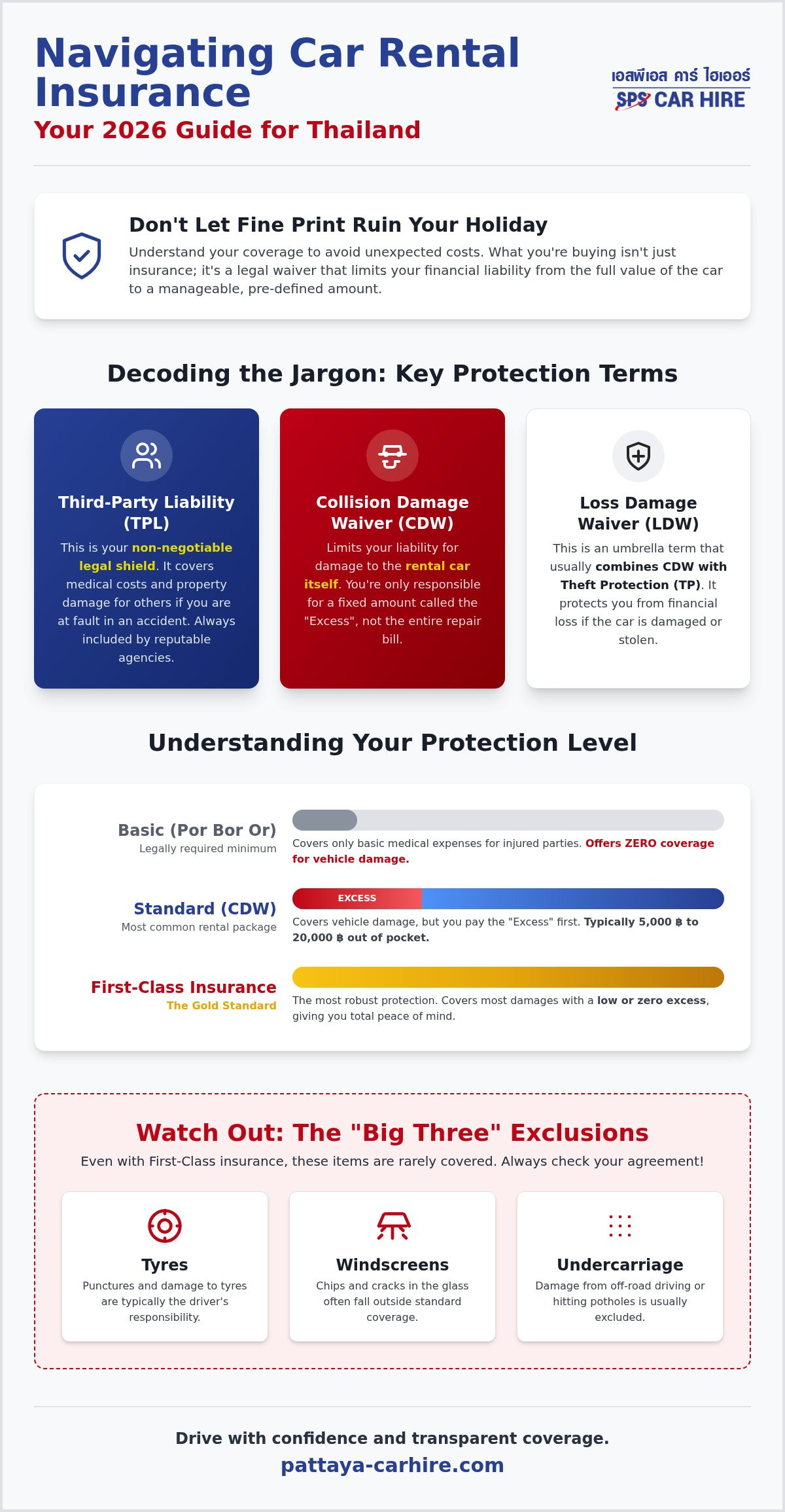
Common Exclusions: What Most Policies Do Not Cover
Even the most robust First-Class coverage has its limits. Many drivers mistakenly assume “comprehensive” means they are protected against every possible mishap. In reality, meeting the car rental insurance requirements Thailand agencies set often involves navigating a list of standard exclusions. The “Big Three” items almost never covered by basic waivers are tyres, windscreens, and undercarriage damage. If you clip a kerb or a stray stone chips the glass, you’ll likely be paying for those repairs out of your own pocket.
Interior damage is another area where insurance won’t help you. Cigarette burns, deep stains, or torn upholstery are classified as service fees rather than insurance claims. Perhaps the most expensive mistake you can make is the “Wrong Fuel” error. Misfuelling a vehicle can lead to massive engine repair costs that are never covered by a standard waiver. It’s a simple mistake that can cost tens of thousands of Baht, so always double check the fuel type before you pump.
The “Off-Road” and “Negligence” Trap
Taking a budget rental onto unpaved mountain tracks or sandy beaches usually voids your entire waiver. These vehicles are designed for gazetted roads; if you damage the car while off-roading, you’re responsible for the full bill. Gross negligence is the ultimate deal-breaker. Driving under the influence of alcohol or drugs immediately renders all protection useless. You should also keep your rental agreement inside the vehicle at all times. Many insurers in Thailand require the original document to be present for a claim to be processed. Finally, don’t forget that losing your vehicle keys is a direct replacement charge, not a loss covered by your CDW.
Protecting Yourself During the Inspection
Your smartphone is actually your best insurance policy. Before you drive away from the rental desk, perform a quick 30-second walk-around. Take time-stamped photos of all four sides of the car, the wheels, and the roof. Documenting every existing scratch or dent is the only way to protect yourself against false damage claims when you return the vehicle. This simple habit removes the “he-said, she-said” stress from the process. If you want a rental experience built on honesty and clear terms, book your Best Price Car Rental with us today and drive with confidence.
Why SPS Car Hire Simplifies Your Coverage
At SPS Car Hire, we believe that saving money on your vehicle shouldn’t mean gambling with your safety. We’ve spent years refining our service to ensure that the car rental insurance requirements Thailand expects are not just met, but exceeded with total clarity. As a locally owned independent agency, we don’t hide behind corporate legalese or complicated overseas call centres. Instead, we offer a direct conversation with people who actually drive these roads every day. Our philosophy is simple: budget-friendly pricing must be paired with premium-level protection.
When you choose our best price car rental, you aren’t just getting a key; you’re getting a commitment to transparency. We’ve seen the confusion that “budget” rentals can cause at other agencies, and we’ve decided to do things differently. By focusing on First-Class Insurance as our standard, we remove the guesswork from your journey. Whether you need a compact car for a quick trip or a rugged truck for a month-long expedition, our fleet is maintained to the highest standards and backed by the most reliable coverage in the country.
Transparent Terms for Budget Rentals
Every vehicle in our fleet, from our family SUVs to our budget scooter rental options, comes with a clear, written explanation of the excess. You’ll know exactly what you’re responsible for before you even start the engine. We prioritize making the claim process as painless as possible. If an accident happens, you won’t be left fighting with an automated system. Our local team is here to guide you through the paperwork and get you back on your way. We handle the logistical heavy lifting so you can stay focused on your travel plans.
Ready to Hit the Road?
Choosing the right provider is about more than just the daily rate. It’s about finding a partner who prioritizes your safety and financial security. For expats living here long-term, our specialized packages offer the most stable insurance rates available, ensuring your car rental insurance requirements Thailand needs are covered month after month without surprise price hikes. We invite you to browse our extensive fleet of cars, trucks, and motorbikes with total confidence. Secure your best-price guarantee today and experience the peace of mind that comes with comprehensive, local coverage. Your Thai adventure deserves a worry-free start.
Drive with Total Peace of Mind
You’ve now decoded the complex jargon and understand why basic coverage isn’t enough for a worry-free Thai holiday. From knowing that a Damage Waiver is your essential legal shield to recognizing the gold standard of First-Class Insurance, you’re ready to navigate the road like a savvy local. Correcting the confusion around car rental insurance requirements Thailand mandates is the best way to protect your budget and your sanity. You can now focus on the scenery instead of worrying about unexpected repair bills or large credit card deposits.
As a locally owned and operated independent agency, we’re dedicated to removing the friction from your journey with our Best Price Guarantee on all cars and trucks. We prioritize your safety by offering comprehensive First-Class Insurance options that leave nothing to chance. Don’t let insurance anxiety stall your adventure. Book Your Budget Rental with Transparent Insurance Today and get the expert support you deserve. Your journey across this beautiful country is waiting; we’re here to make sure you enjoy every kilometer with confidence.
Frequently Asked Questions
Is car rental insurance mandatory in Thailand?
Yes, every vehicle must have Compulsory Motor Insurance, known as Por Bor Or, by law. This mandatory coverage handles basic medical costs for third parties but offers no protection for the rental vehicle itself. To meet the practical car rental insurance requirements Thailand demands for a safe trip, most reputable agencies include a Collision Damage Waiver. Driving with only the legal minimum is risky, as you’d be personally liable for all property damage or car repairs.
What is the “Excess” in a Thai car rental agreement?
The excess is the fixed amount you agree to pay out of your own pocket toward repairs before the insurance company covers the remaining balance. For standard budget rentals in 2026, this typically ranges between 5,000 ฿ and 20,000 ฿ depending on the car class. If the repair cost is lower than your excess, you simply pay the actual repair amount. Upgrading to a zero-excess policy removes this financial liability entirely for the driver.
Does my credit card insurance cover me for a rental car in Thailand?
Many premium credit cards provide rental coverage, but it often works as secondary insurance. This means you must still pay the rental agency’s excess first and then claim a reimbursement from your card provider later. You should always verify if your specific card covers commercial rental vehicles in Thailand specifically. Understanding these car rental insurance requirements Thailand travelers face ensures you aren’t left with a massive upfront bill that your bank won’t actually refund.
Can I rent a car without a credit card deposit if I have full insurance?
Most large rental agencies require a credit card for a security block, even if you purchase full insurance. However, some locally owned independent agencies like SPS Car Hire may offer more flexible terms, such as smaller cash deposits, when you opt for premium First-Class Insurance. This “Zero Excess” coverage significantly reduces the agency’s risk, which sometimes allows for lower deposit requirements. Always check the specific terms of your rental agreement before arrival to avoid any surprises.
What should I do immediately after a car accident in a rental vehicle?
Your first priority is safety; move to a secure area and check for injuries. You must call the insurance company’s emergency 24-hour hotline immediately, as they often send a surveyor to the scene to document the incident. Contact the tourist police at 1155 or the local police at 191 to obtain a formal report. Take clear photos of all vehicles involved, the surrounding road conditions, and the other driver’s license for your records.
Does First-Class Insurance cover me if I am not the primary driver?
First-Class Insurance only covers individuals explicitly named in the rental agreement. If an unlisted person is driving during an accident, the insurance policy becomes void, leaving you fully liable for all damages and legal costs. Most reputable agencies allow you to add a second driver for a small fee or even for free. Ensure every person who might take the wheel provides their license details and is officially registered before you depart from the rental office.
Are tyres and windscreens covered in a standard CDW policy?
Standard Collision Damage Waiver policies typically exclude tyres, windscreens, and undercarriage damage. These are considered high-risk areas prone to wear or minor road debris impact. If you want protection for these specific items, you usually need to upgrade to a Super CDW or a “Full Protection” package. Without these additions, you will be charged the full replacement cost for a punctured tyre or a cracked windscreen upon returning the vehicle to the agency.
What happens if I lose the rental car keys?
Losing your rental car keys is considered a service issue rather than an insurance claim, so it isn’t covered by standard waivers. You’ll be responsible for the cost of the replacement key, which often involves expensive electronic programming, plus any delivery fees to your location. In some cases, the agency might also charge for the “loss of use” while the car is grounded. Always keep your keys in a secure, waterproof spot during your travels.
 -
- -
- -
- -
- -
- -
- -
-