


The lowest headline price can be the wrong choice if your group and luggage don’t fit comfortably. If you’re comparing 7 seater car hire options, start with the people and bags travelling, not just the number of seats in a listing. A full passenger count, bulky suitcases, or child-seat needs can all affect how practical a vehicle feels on the road.
It’s natural to want one rental that keeps everyone together and offers good value. Compare the vehicle’s seating and luggage space with your plans, then read the rental terms to understand what the price includes. This guide explains how to assess passenger and baggage needs, compare rental conditions, and prepare a booking request. SPS Car Hire offers budget-focused self-drive car rentals, with full first-class insurance included with every car rental at no extra charge. Looking beyond the headline rate can help you choose an arrangement that suits your group.
Key Takeaways
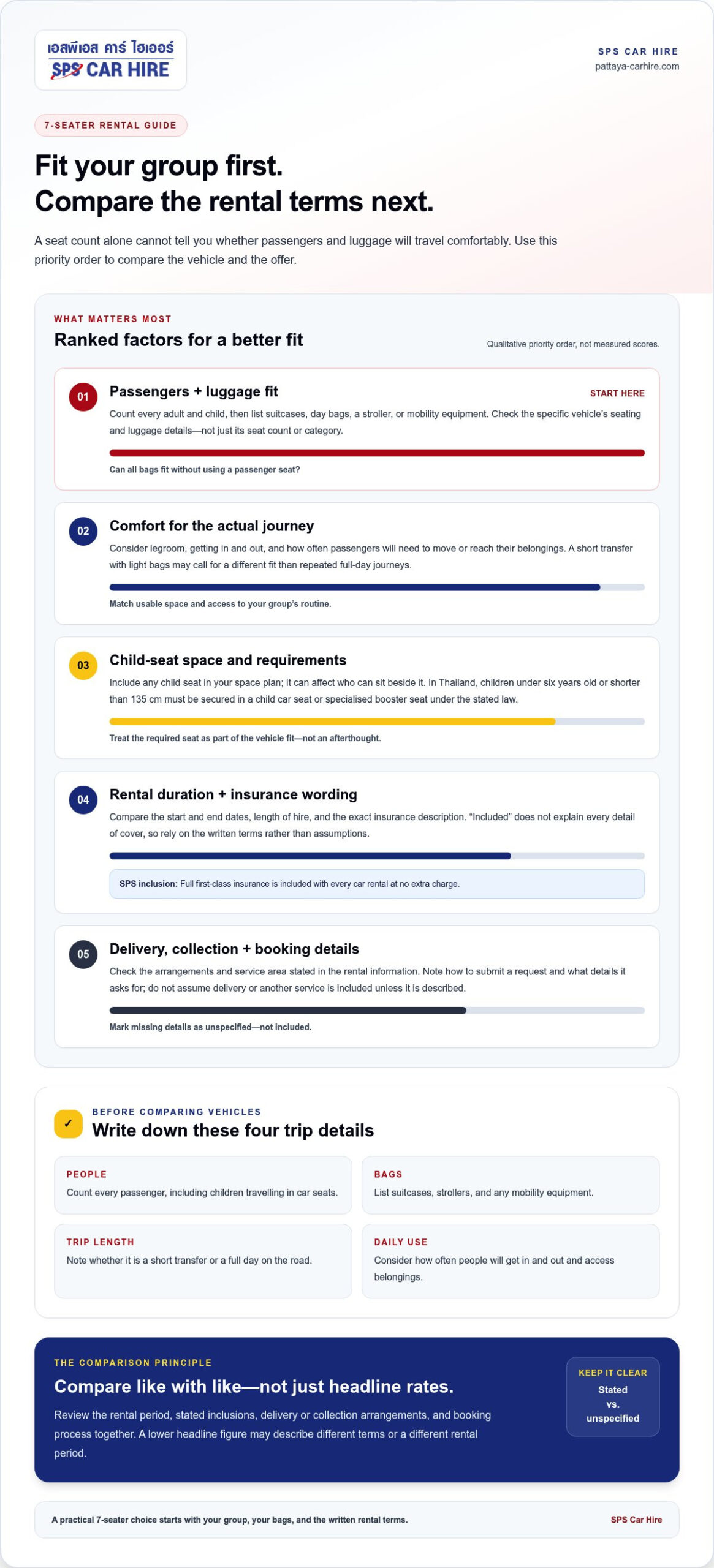
- Work out your passenger count and luggage needs before choosing a vehicle. Seat count alone doesn’t tell you how comfortable the journey will be.
- Compare rental duration, insurance, delivery details, and booking steps to understand the terms beyond the headline price.
- When considering 7 seater car hire Pattaya, match the vehicle to your group’s actual travel plans rather than assuming every seven-seat option offers the same space.
- Prepare your passenger count, luggage details, travel dates, and rental period before submitting a booking request.
- SPS Car Hire offers self-drive car rentals with full first-class insurance included at no extra charge.
Choosing a 7-Seater Hire Car Starts With Your Group’s Real Needs
Will every passenger and their luggage fit comfortably? Answer this before comparing vehicles. A listing’s seat count tells you how many places are provided, but not how much room each person has or how much baggage can travel without crowding the cabin.
Start with the actual group, not a rough estimate. Count every adult and child, including children who will travel in child seats. Then list what’s coming along: suitcases, day bags, a stroller, or mobility equipment. A vehicle may have enough seats for everyone but insufficient room for bulky items alongside the full passenger group.
Compare your list with the vehicle’s stated seating and luggage specifications. Vehicle categories can vary, so a general overview of car classification systems may help explain why a category label alone doesn’t guarantee the same layout or usable space. Use the specific vehicle information rather than assumptions based on its class or appearance.
Count passengers and luggage before comparing vehicles
Make a simple inventory before you browse. Note how many people are travelling, which children need car seats, and how many bags or larger items you’ll bring. For example, a stroller or mobility aid can take up space you might otherwise expect to use for suitcases. Compare your inventory with the vehicle’s stated seating and luggage details. Consider whether bags can be stored without using a passenger seat.
Decide what comfort means for this trip
Think beyond whether everyone can sit down. Legroom, ease of getting in and out, and how often passengers will change seats all affect comfort. A compact layout might suit a short transfer with light bags, while repeated full-day journeys call for a closer look at personal space and access. Don’t assume every seven-seat arrangement feels alike; judge the fit against your group’s routine.
Children and adults may have different practical needs. A child seat occupies space and can affect who can sit beside it, while adults may need more room for legs and shoulders on longer drives. In Thailand, children under six years old or shorter than 135 cm must be secured in a child car seat or specialised booster seat under the stated law. Factor the required seat into your space plan rather than treating it as an afterthought.
Before comparing rental terms, write down these four details:
- People: Count every passenger, including children travelling in car seats.
- Bags: List suitcases, strollers, and any mobility equipment.
- Trip length: Consider whether the journey is a short transfer or a full day on the road.
- Daily use: Think about how often passengers will get in and out and access their belongings.
This quick check gives you a realistic starting point for assessing a seven-seat vehicle. If the stated passenger and luggage details don’t suit your group, don’t rely on the seat number alone. Choose based on the usable space and comfort your plans require.
What to Compare in 7-Seater Car Hire Terms and Inclusions
A useful comparison goes beyond the advertised rate. Review the rental period, insurance wording, delivery or collection arrangements, and booking process together. These details help you compare like with like and distinguish a clearly stated inclusion from an assumption. Read the written rental information carefully instead of expecting every hire to work the same way.
Compare what the rental actually includes
Use a simple table to record what each offer says. If a detail isn’t stated, mark it as unspecified rather than treating it as included. This keeps your comparison accurate and helps you decide which terms suit your plans.
| Rental detail | What to compare |
|---|---|
| Rental duration | Check the start and end dates, length of hire, and how the rental period is described. |
| Insurance inclusion | Read the exact insurance description and check whether it is included in the car rental price. SPS includes full first-class insurance with every car rental at no extra charge. |
| Delivery or collection | Compare the arrangements and service area stated in the rental information. Don’t assume delivery is included unless it is described. |
| Booking process | Note how to submit a request and what information the booking process asks you to provide. |
Insurance wording deserves a careful read. “Included” tells you it forms part of the rental, but it doesn’t explain every detail of cover. For more context on the terminology, see this car rental insurance guide. SPS includes full first-class insurance with every car rental at no extra charge. Keep the comparison grounded in the stated description rather than assuming additional coverage details.
Look beyond the headline deal
An advertised rate is only one part of an offer. Compare the rental duration and stated inclusions alongside the booking route and service arrangements. A lower headline figure may describe a different rental period or different terms from another offer. Assess the information provided without assuming extra charges, discounts, or services that aren’t documented.
Booking platforms may also show timing advice or statistics. Treat a KAYAK booking-timing statistic as a claim specific to that platform, not a guarantee that the same timing will produce the best result for every traveller. Your dates, rental length, and preferred arrangements still matter.
For a 7 seater car hire Pattaya search, keep your comparison notes beside your travel dates and group requirements. You can also review SPS’s self-drive car rental options, including the stated insurance inclusion, as part of your comparison. This gives you a practical basis for assessing rental terms without relying on the headline price alone.
Seven Seats or Another Option? Match the Vehicle to the Trip
A seven-seat layout can help keep a group together, but the seat count alone won’t tell you whether it’s the right fit. Think about how your group will use the vehicle. A shared car may make it simpler to coordinate departure times and stops, while a different capacity configuration may better suit a trip with more luggage or a stronger need for personal space. Base the decision on the vehicle’s stated seating and luggage specifications, not the category label.
This matters when comparing 7 seater car hire Pattaya options. Vehicles described as seven-seat choices can have different interiors and luggage arrangements. Don’t assume how many passengers can travel comfortably with bags on board without checking the details for the vehicle. Read the specifications as a whole: seating, luggage capacity, and any stated layout information should all support your group’s plan.
When a seven-seat layout may suit the group
One shared vehicle may be practical when your group wants to travel together, follow the same schedule, and avoid coordinating separate journeys. It can suit your plans if the stated seating and luggage specifications fit your passengers and belongings at the same time. Treat that as a condition, not a guarantee: compare the details for the specific vehicle you’re considering, especially if child seats or bulky items are part of the plan.
When to reconsider the vehicle category
Bulky luggage can change the calculation. If the vehicle’s stated capacity leaves little room for bags alongside the full passenger group, consider another capacity configuration with specifications that better match the trip. Don’t infer that a larger-looking vehicle automatically offers more usable passenger or luggage space. Compare documented details rather than appearance.
Trip patterns also affect the decision. A short journey with few stops may make quick entry and exit less important, while repeated stops or longer drives can make access and personal space more noticeable. Consider how often passengers will get in and out, whether bags need to remain accessible, and how long everyone will spend in the vehicle. A practical match works throughout the day, not only at the start of the journey.
Use these questions to compare options:
- Passenger fit: Do the stated seating details suit everyone travelling?
- Luggage fit: Does the listed luggage capacity account for the group’s bags and equipment?
- Journey pattern: Will frequent stops, longer drives, or regular entry and exit affect comfort?
- Alternative arrangement: Would another vehicle configuration better match the documented needs?
If you’re weighing self-drive convenience against point-to-point travel, this car rental versus taxi comparison can help frame the choice around your itinerary. Choose the option whose stated capacity and arrangement make sense for the people, belongings, and travel routine involved.
A Simple Checklist Before Requesting a 7-Seater Rental Booking
A clear request starts with clear details. Before submitting one, write down who is travelling, what needs to fit, and exactly when you need the vehicle. This preparation helps you compare rental options on equal terms and see whether the stated vehicle specifications and rental inclusions match your plans.
Prepare the details that make comparisons easier
Gather the information you’ll use to assess the vehicle and rental. Be specific about luggage and dates, and account for any child-seat or accessibility needs in your planning. These needs can affect which arrangement works for your group, so consider them before choosing an option rather than treating them as last-minute details.
- Settle the passenger count. Record every traveller, including children who will use a child seat. This gives you a reliable number to compare with the vehicle’s stated seating specifications.
- Estimate the luggage. Note the number and general size of your bags, plus bulky items such as a stroller or mobility equipment. Compare that list with the vehicle’s stated luggage capacity, not just its seat count.
- Choose your dates. Write down when you need the rental to begin and end. Exact dates keep your search focused on options that fit your itinerary.
- Set the rental period. Decide how long you need the vehicle, then compare offers using the same duration. A shorter or longer hire period can make a headline rate difficult to compare fairly.
- Review the vehicle details. Read the stated seating and luggage specifications together. If either doesn’t appear to accommodate your group’s requirements, don’t assume the vehicle will work based on its category name alone.
- List special requirements. Note child-seat or accessibility needs before making a request. Include them in your planning rather than assuming a particular item or arrangement.
Review terms and complete the booking request
Before committing, read the stated rental terms and insurance description. Separate clear inclusions from assumptions, and compare the terms alongside your dates and chosen rental period. SPS includes full first-class insurance with every car rental at no extra charge. Use the stated description rather than inferring details beyond it.
When you’re ready to submit a booking request, follow the booking route shown with SPS’s rental options and provide the details requested. Keep your passenger, luggage, date, and duration notes nearby so you can enter consistent information and compare the stated terms efficiently.
A little preparation can make the decision simpler and more value-focused. Use your checklist as you browse available car rental options, then compare the stated vehicle details and rental terms with your group’s actual needs.
SPS Car Hire: Straightforward Value for Self-Drive Car Rental
Good value means understanding what the rental offers, not just looking for the lowest headline rate. SPS Car Hire (SPS) provides budget-friendly self-drive car rentals, competitive rates, and long-term rental packages for customers planning an extended hire. Reviewing the rental details helps you decide whether an option suits your schedule and budget.
For group travel, keep the vehicle’s stated details central to your decision. Compare its seating and luggage information with your passenger count and belongings, then consider how you’ll use the car during the trip. A vehicle category or familiar model name isn’t a substitute for checking the specifications relevant to your group.
Verified benefits that keep car hire straightforward
SPS includes full first-class insurance with every car rental at no extra charge. This is a clear inclusion to factor into your comparison. The description identifies the insurance included with the rental, but it shouldn’t be read as a promise about specific coverage details beyond those words. Review the rental terms as a whole so you understand the offer you’re choosing.
SPS offers competitive rates and long-term rental packages, giving customers an option to consider for different rental periods. English- and Thai-speaking staff are available to assist customers. These stated benefits make the rental information straightforward, with assistance available and the insurance inclusion clearly presented.
Choose the next step with confidence
Before making a booking request, compare your group’s needs with the vehicle details provided. Check the stated seating and luggage specifications, consider your rental dates and duration, and read the terms and inclusions carefully. This keeps the decision grounded in your trip rather than assumptions about a vehicle’s size or suitability.
If you’re looking for a value-focused self-drive rental, SPS offers car hire options, including long-term rentals. Match the rental details to your plans, then use the online information to prepare your request. A well-prepared request starts with knowing what your group needs and what the terms say.
Ready to plan your rental? Browse car rental options and request a booking.
Make Your Group’s Next Trip Easier to Plan
Turn your travel plans into a clear rental request by noting your dates, rental period, and any practical needs that could affect your choice. Then use the stated vehicle details to decide what fits. This gives you a more confident starting point for 7 seater car hire Pattaya and helps you plan around your group’s actual requirements.
Choose an option that works for the way you’ll travel, not just the way it looks in a listing. A little preparation can make it easier to settle the details and focus on enjoying the journey together.
Ready to explore a straightforward self-drive option? Browse SPS Car Hire’s rental options and request a booking. Start by comparing the stated details with your group’s plans.
Frequently Asked Questions
Can a seven-seat hire car fit seven passengers and their luggage?
Not necessarily. A vehicle’s seating capacity doesn’t establish how much luggage it can hold or how comfortable the full group will be. Compare the specific vehicle’s stated seat and luggage specifications with your plans. Bulky cases may take up more room than expected, while child seats can affect usable space. Trip length matters too: a tight fit may feel manageable briefly but less practical over a longer drive.
How do I choose the right seven-seat rental for a family trip?
Start by counting everyone travelling and estimating the bags, then consider how long you’ll be on the road. Check the vehicle’s stated seating and luggage details, and account for child seats and how easily passengers can get in and out. For example, frequent stops can make access especially relevant. Compare rental terms using the same dates and duration so you’re judging equivalent plans, not just similar-looking listings.
Is insurance included with a car rental from SPS Car Hire?
Yes. Full first-class insurance is included with every SPS car rental at no extra charge. This is useful to know when comparing rental terms, but rely on the stated description rather than assuming details beyond it. For more context on insurance considerations, read the car rental insurance guide as you consider which rental arrangement suits your trip.
What should I compare when booking a seven-seat rental?
Compare the vehicle’s stated seating and luggage specifications, rental duration, insurance inclusion, delivery or collection terms, and booking instructions. Use the same dates and duration when comparing options; otherwise, the headline deal may describe a different hire period from the one you need. For a 7 seater car hire Pattaya search, keep your itinerary beside the rental details so you can assess the arrangement against your plans.
How far in advance should I book a seven-seat rental?
There isn’t one booking window that suits every trip. Timing depends on your travel dates and vehicle demand, so plan early, particularly if your schedule is fixed. KAYAK’s advance-booking statistic is a platform-specific claim, not a universal rule or a promise of savings. Treat it as one reference point, then base your decision on your dates and the rental details available for the period you need.
Is a seven-seat rental better than taking taxis for a group?
It depends on how your group plans to travel. A self-drive rental lets everyone travel together and gives the driver control over the itinerary; separate taxi rides can suit groups that prefer not to drive. Think about luggage, stop frequency, parking, and whether someone in your group wants to drive. There’s no universal saving or best choice. This car rental versus taxi comparison offers a broader way to weigh them.
Can I book a car for a longer rental period with SPS Car Hire?
Yes. SPS offers long-term car rental packages and competitive long-term rates. For an extended stay, consider how your routine may change over the rental period, such as whether you’ll need the vehicle every day or only for planned outings. Compare the stated rental duration and vehicle details with those plans. This helps you assess a long-term car hire option against your needs without making assumptions about the vehicle configuration or package term.
 -
 -
 -
 -
 -
 -
 -