

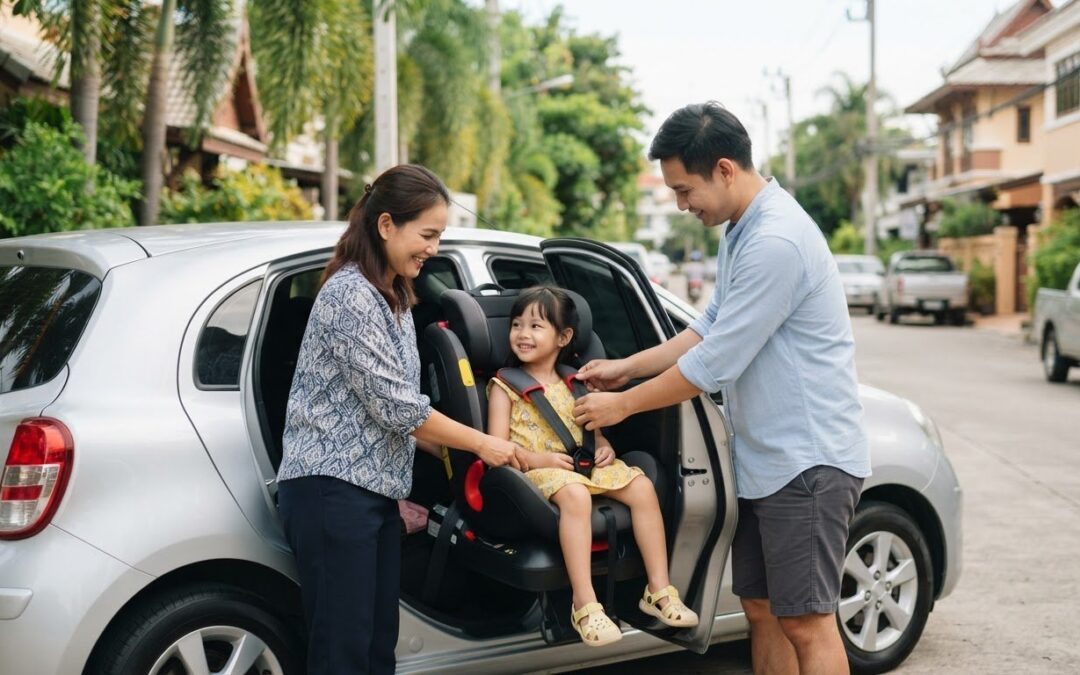
What does Thai law require when a child rides in a car in Thailand? The child safety seat laws Thailand can be confusing, especially when legal rules and broader safety advice differ. Since August 17, 2023, children under six or 135 centimetres tall or less must use a child safety seat or special booster seat in private cars, pickups, and minivans.
If you’re unsure which rule applies to your child or how to plan transport for a family trip, start with the legal thresholds. Then check that the restraint fits your child and can be installed correctly in the vehicle.
This guide explains who the law covers, the stated exception and penalty, and how the rules differ from safety advice. It also covers practical checks for choosing a restraint and preparing for car journeys with children, including self-drive travel in Thailand.
Key Takeaways
- Understand the child safety seat laws Thailand and distinguish legal requirements from additional safety advice.
- Match the restraint to your child and the vehicle, and follow the manufacturer’s instructions.
- Before travelling, check whether the restraint and vehicle support installation with ISOFIX or a seat belt, then inspect the fit.
- Build a pre-trip routine: review current official guidance, prepare a suitable restraint, and check its installation before setting off.
Child safety seat laws in Thailand: what families need to know first
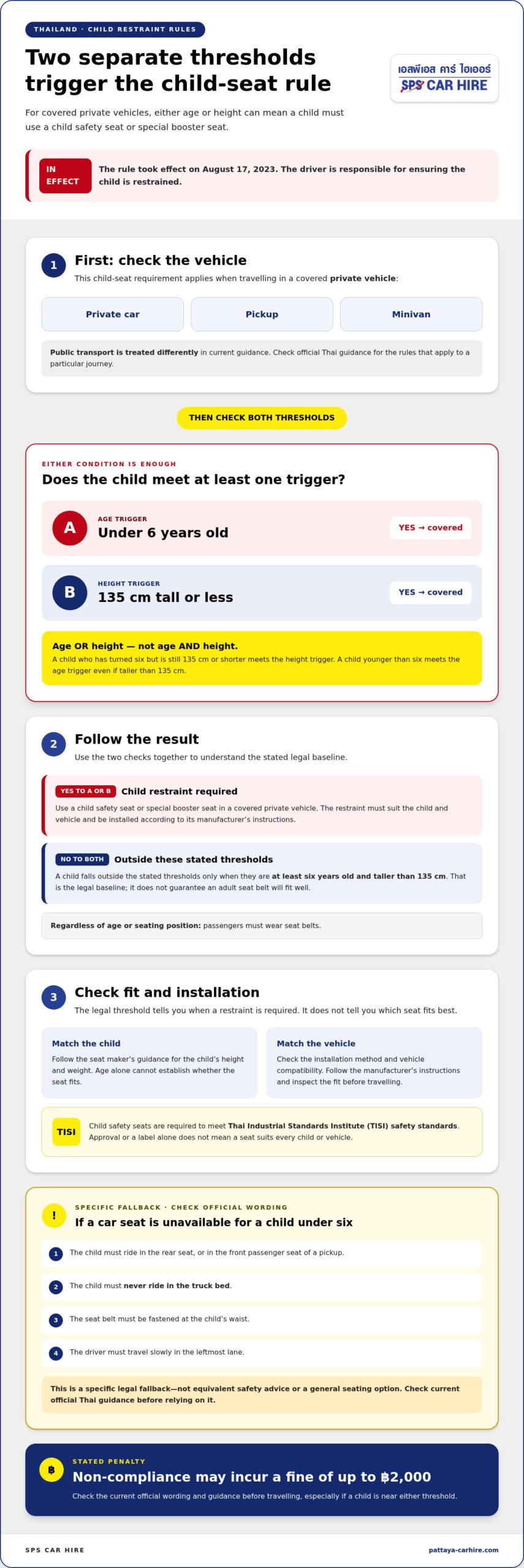
Short answer: Under Thailand’s amended Land Traffic Act, a child under six years old or 135 centimetres tall or less must use a child safety seat or special booster seat when travelling in a private car, pickup, or minivan. These are separate thresholds, so either one is enough to trigger the requirement. The driver is responsible for ensuring the child is restrained. Check the current wording in the Royal Gazette before travelling, as laws and enforcement guidance can change.
Current guidance treats public transport, such as buses and vans, differently from private vehicles. An exemption is provided when a child can’t be secured for health or physical reasons. The law also requires passengers of all ages and in all seating positions to wear seat belts. A specific alternative may apply when a child restraint isn’t available, so check the official wording before relying on it.
What the law requires, and what safety advice adds
Legal duties, product approval, and safety recommendations answer different questions. The law sets a minimum restraint requirement. Child seats are required to meet Thai Industrial Standards Institute (TISI) safety standards, while recommendations about rear-facing use, seat type, and fit can go beyond that minimum. A seat’s label or approval doesn’t automatically mean it suits every child or vehicle. For general background on restraint types and how they work, see this overview of the child safety seat. Use official Thai guidance for legal requirements.
In short, the legal duty is to restrain children who meet either threshold in covered private vehicles. Safer practice also means choosing and fitting a restraint for the child and following its manufacturer’s instructions.
Which official sources should families use?
Start with the Land Traffic Act and relevant amendments published in the Royal Gazette. Then consult current Royal Thai Police or Department of Land Transport guidance for practical explanations, where available. The Act is the legal text; agency summaries can help explain it but shouldn’t replace it if details differ.
As of October 2026, available guidance states that the child-seat rule took effect on August 17, 2023, and non-compliance may incur a fine of up to ฿2,000. Check authoritative Thai guidance for interpretations about enforcement and specific exceptions. Recheck before travelling, especially if your child is near either legal threshold.
How Thailand’s child-restraint rules apply by age, height, and seating position
For the child safety seat laws Thailand sets two separate triggers: a child must use a child safety seat or special booster seat if they are under six years old or 135 centimetres tall or less. Either condition is enough. A child who has turned six but is still 135 centimetres or shorter remains within the height threshold. A child younger than six is covered even if taller than 135 centimetres.
How to handle a child near either threshold
Don’t treat age and height as interchangeable, or assume that reaching one threshold removes the other. If your child is close to six or 135 centimetres, use the exact statutory wording and check current official Thai guidance before travelling. A child falls outside these stated thresholds only when they are both at least six years old and taller than 135 centimetres. That is the legal baseline, not a guarantee that an adult seat belt will fit well.
International safety advice may recommend a restraint for longer than Thai law requires. Keep the distinction clear: advice from another country doesn’t become Thai law, and meeting a legal threshold doesn’t establish that a child is ready to use an adult seat belt safely.
Seating position and restraint fit
For a child who must use a restraint, choose a suitable child seat or booster and follow the manufacturer’s instructions for the child’s height and weight, the installation method, and the vehicle. Age alone can’t tell you whether a seat fits. Check that the harness sits snugly as directed, or that the vehicle belt lies correctly across the child’s body when using a booster. An approved restraint may not provide its intended protection if it’s installed or adjusted incorrectly.
Thai guidance also describes a conditional alternative when a car seat isn’t available for a child under six: the child must ride in the rear seat, or in the front passenger seat of a pickup, never in the truck bed; the seat belt must be fastened at the child’s waist; and the driver must travel slowly in the leftmost lane. This is a specific legal fallback, not equivalent safety advice or a general seating option. Check the current official wording before relying on it. Passengers must also wear seat belts regardless of age or seating position.
For self-drive travel, plan the vehicle and restraint together, but check them separately. Before setting off, make sure the restraint fits your child and can be installed correctly in the vehicle.
Child car seats, booster seats, and seat belts: what the law does, and does not, say
Thailand’s legal requirement identifies a child safety seat or special booster seat for children under six years old or 135 centimetres tall or less in covered private vehicles. It doesn’t prescribe one restraint type for every child. Choose based on the child’s size, the seat’s limits, and whether it can be installed correctly in the vehicle.
The restraint stages below describe typical safety functions, not universal age cutoffs or a substitute for product instructions. Under the current information available, child safety seats must meet Thai Industrial Standards Institute (TISI) safety standards. References to ECE R44/04 or ECE R129 are product-standard references, not proof on their own that a seat satisfies Thailand’s requirements.
| Restraint type | Typical safety function | Legal status and source verification |
|---|---|---|
| Rear-facing seat | Supports a smaller child with the harness and seat shell; use only within the seat’s stated limits. | Not separately specified by the Thai rule. Check TISI requirements and the manufacturer’s limits. |
| Forward-facing seat | Uses a harness to restrain a child who fits the seat’s forward-facing limits. | Not a distinct statutory stage. Verify the seat’s TISI compliance and fit. |
| Booster seat | Raises the child so the vehicle’s lap-and-shoulder belt can fit more appropriately. | A special booster seat is named in the legal requirement. Check current Thai wording and product approval. |
| Adult seat belt alone | Restrains a passenger using the vehicle belt, when it fits correctly. | The child-restraint thresholds apply below six years old or at 135 centimetres or less. Seat belts are required for all passengers; check current law and vehicle guidance. |
ECE R44/04 and ECE R129 are often discussed as child-restraint standards, but neither label should be treated as automatic proof of Thai legal compliance. A draft regulation published in January 2024 proposed TIS standards based on these UN regulations. Available information as of October 2026 does not confirm that the draft became mandatory. Verify current TISI and Royal Gazette information before relying on a standards claim.
An adult belt may be legally sufficient once a child is both at least six years old and taller than 135 centimetres, based on the stated child-seat thresholds. Legal sufficiency and good fit are separate questions. As practical safety guidance, the lap belt should sit low across the hips, and the shoulder belt should cross the chest and shoulder rather than the neck or face. If it doesn’t fit properly, consult the restraint instructions and vehicle manual before the journey. Follow their compatibility and installation guidance, and keep the child within the seat’s stated height and weight limits.
How to prepare a child restraint for a car journey in Thailand
Check the restraint before departure so you can address installation problems before reaching the road. Use this sequence in your own car or an unfamiliar vehicle:
- Confirm the current rule. Check which legal requirement applies to your child and the type of vehicle. Review official Thai guidance before travelling.
- Select a suitable restraint. Match it to your child’s height and weight, and follow the seat’s stated limits and instructions.
- Check vehicle compatibility. Confirm the restraint can be installed in the intended seating position using a method approved for both the seat and vehicle.
- Install and inspect. Follow the instructions step by step, then check the harness, belt route, and seat stability as directed by the manufacturer.
Correct installation matters as much as choosing the right child restraint. A suitable seat won’t provide its intended protection if it’s incompatible with the vehicle or installed incorrectly.
Check the seat before travelling
Read the labels and manufacturer’s instructions, and confirm your child falls within the restraint’s stated height and weight limits. Check whether the seat is designed for installation with ISOFIX, the vehicle belt, or either method. Compatibility varies: ISOFIX anchors and seat-belt routing differ between vehicles, and the restraint’s instructions specify which methods are allowed.
After installation, inspect the belt path or ISOFIX connections and harness adjustment using the seat manual. Check movement at the points and in the way the manufacturer describes, rather than relying on a general rule that may not suit your model. If you’re unsure about the installation, use the manufacturer’s guidance or seek support from a qualified child-seat fitter. Do a trial fit before departure, then recheck after installing the restraint in its final position.
Plan for rental or unfamiliar cars
For a rental or other unfamiliar car, identify the vehicle model and review its manual so you can assess compatibility before the journey. Don’t assume a child restraint will be supplied. If you’re bringing a seat you arranged yourself, leave enough time to install and inspect it before setting off, especially if you haven’t used that vehicle or installation method before.
If the restraint doesn’t fit or you can’t verify a safe installation, pause the trip and resolve the issue. Don’t travel with a child unrestrained to save time or find a more convenient option. Understanding the child safety seat laws Thailand is one part of trip preparation; checking the seat-and-vehicle fit is another.
Planning a self-drive family trip? Explore car and truck rental options as part of arranging your transport, and plan separately for a restraint that suits your child and the vehicle.
Plan safer family travel and understand your next steps
A confident family journey starts with three checks: the current legal requirement, whether the restraint fits your child, and whether it’s installed correctly in the vehicle. For private cars, pickups, and minivans, the stated Thai rule covers children under six years old or 135 centimetres tall or less. Confirm the current wording with authoritative Thai sources before departure, since legislation and enforcement guidance can change.
What should parents confirm before departure?
Use this quick pre-trip checklist:
- Verify the rules: Review the latest Land Traffic Act and amendments in the Royal Gazette, along with current guidance from the Royal Thai Police or Department of Land Transport where available.
- Check your child’s fit: Measure your child and compare their height and weight with the restraint’s stated limits. The legal threshold and the seat’s fit limits are separate checks.
- Inspect the restraint: Read its labels and instructions, then confirm the correct harness or belt path and installation method.
- Confirm vehicle compatibility: Check the car manual and restraint instructions to see whether ISOFIX, a vehicle belt, or another permitted method suits both.
- Allow time to install: Do a trial fit before departure and inspect the setup again in the vehicle you’ll use for the journey.
Build time for these checks into your schedule. A rushed installation can create an avoidable problem. A careful check gives you time to address fit or compatibility issues before setting off.
How does self-drive travel fit into family planning?
Self-drive travel can give families more control over departure times, planned stops, and the pace of a journey. That flexibility is useful with children, but it doesn’t replace preparation: the restraint still needs to suit the child and the specific vehicle, and it must be installed according to its instructions. For a rental car, plan to bring or otherwise arrange an appropriate restraint rather than assuming one is included.
Keep the plan practical. Allow time at the start of the trip to secure and check the restraint. Don’t set off with a child unrestrained because the correct setup is inconvenient or taking longer than expected. If you’re planning to drive yourself, browse SPS Car Hire’s self-drive rental options as one part of arranging your family transport.
Make your next family journey safer and simpler
Plan with three checks in mind: understand the current child safety seat laws Thailand requirements, choose a restraint that fits your child, and install it correctly in the vehicle. The legal thresholds are only the starting point. Seat limits, vehicle compatibility, and manufacturer instructions matter too.
Before travelling, recheck the latest official Thai guidance, especially if your child is near a legal threshold or regulations have changed. Allow time to fit and inspect the restraint before setting off, whether you’re driving your own car or an unfamiliar vehicle.
For the transport side of your plans, SPS Car Hire offers budget-friendly car and truck rentals, including long-term options. Explore SPS Car Hire’s self-drive rental options as you organize your trip, and plan separately for a restraint that suits your child and vehicle.
A little preparation goes a long way. With the right checks in place, you can set out with greater confidence and focus on enjoying the journey together.
Frequently Asked Questions
Are child car seats legally required in Thailand?
Yes. In private cars, pickups, and minivans, a child safety seat or special booster seat is required if a child is under six years old or 135 centimetres tall or less. Either threshold applies. An exemption is provided when a child can’t be secured for health or physical reasons. Current guidance treats public transport, including buses and vans, differently. Check the latest Thai legal text and official guidance before travelling.
At what age or height can a child stop using a car seat in Thailand?
The stated child-seat requirement no longer applies only when a child is both at least six years old and taller than 135 centimetres. A child who has turned six but is 135 centimetres or shorter still meets the height threshold; a younger child remains covered even if taller. All passengers must wear seat belts. For safety, keep using a suitable booster if the vehicle belt doesn’t fit the child properly.
Can children ride in the front seat in Thailand?
The available legal guidance doesn’t establish a general front-seat rule for every child-restraint situation, so don’t assume either blanket permission or prohibition. It describes a specific alternative for a child under six when a car seat isn’t available: the child may sit in the rear, or in a pickup’s front passenger seat, but never in the truck bed, subject to stated conditions. Check current official Thai guidance before relying on this alternative.
Do taxis or rental cars in Thailand have to provide child seats?
Rental status doesn’t remove the child-restraint requirement from a private car, pickup, or minivan. The information available here doesn’t establish that rental companies must provide a child seat. Public transport such as buses and vans is treated differently, while taxi classifications and requirements depend on current Thai rules. For any family journey, plan how to use a suitable restraint rather than assuming one will be provided.
Is ISOFIX required by child safety seat laws in Thailand?
No requirement for ISOFIX is established in the current information. The legal duty is to use a child safety seat or special booster seat for a child who meets either threshold, and the seat must meet applicable Thai Industrial Standards Institute requirements. Installation may use ISOFIX or the vehicle belt, depending on the specific restraint and car. Follow both manuals, because a method is suitable only when both approve that installation.
What happens if a child travels without the required restraint in Thailand?
Failure to comply with the child-restraint requirement may result in a fine of up to ฿2,000. Current guidance describes a conditional alternative when a car seat isn’t available for a child under six, but it has specific seating, seat-belt, and driving conditions. Don’t treat it as equivalent to a correctly fitted restraint. Check current official Thai wording before travelling, as enforcement guidance and legal interpretations can change.
Are ECE R129 and ECE R44/04 the same as Thai legal requirements?
No. ECE R129 and ECE R44/04 are product-standard references, not proof by themselves that a restraint complies with Thai law. TISI safety standards are the relevant Thai product-approval reference. A draft regulation published in January 2024 proposed TIS standards based on those UN regulations, but available information as of October 2026 doesn’t confirm that proposal became mandatory. Verify current requirements through TISI and the Royal Gazette before relying on a label.
 -
- -
- -
- -
- -
- -
- -
-