


A late return doesn’t automatically stop you from renting again. In Thailand, the car rental grace period for return is often about 30 minutes, though the rental terms determine what happens after that. A minor delay usually doesn’t affect your ability to rent again, while repeated late returns could affect your rental privileges.
It’s understandable to worry that even a short delay could mean extra charges or affect a future booking. To avoid surprises, plan a return time with a buffer and contact the rental company as soon as you know you may be late. Don’t assume a grace period will cover the delay.
This guide explains how to choose a practical return time, what to do when you need an extension, and how grace periods and late returns can affect your next rental. You’ll also learn why arranging more rental time in advance can help you avoid an unplanned delay turning into a bigger hassle.
Key Takeaways
- Contact the rental company as soon as you expect a delay and agree on how the added rental time will be handled.
- Plan your return around the rental period and allow extra time for traffic, refuelling, and reaching the return location.
- Treat any grace period as a limited buffer, not an extension you can count on; the rental terms determine late-return charges.
- A minor delay usually won’t prevent future rentals, but repeated late returns could affect your rental privileges.
Calling the rental company to arrange an extension
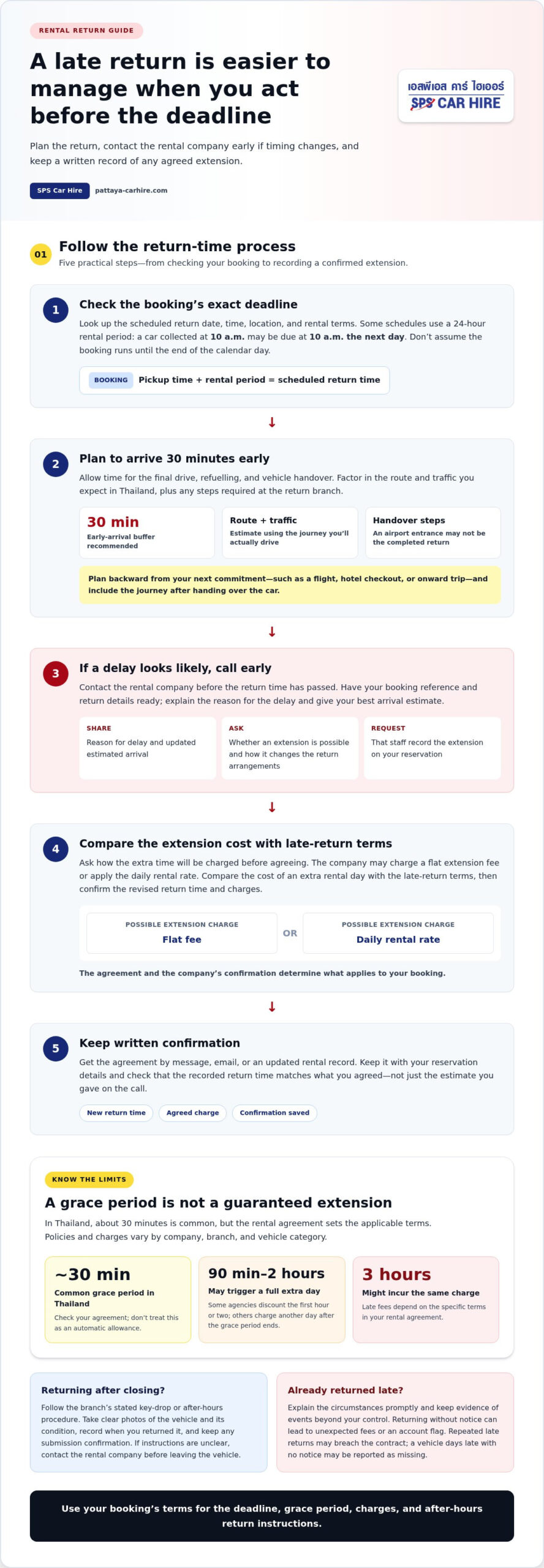
- Check your reservation and rental terms before calling. Note the scheduled return date, time and location, along with your booking reference. Then estimate your arrival using the route you’ll actually drive in Thailand. A realistic estimate helps the rental company explain whether an extension is possible and what the revised return arrangements will be.
- Call as soon as a delay seems likely, rather than waiting until your return time has passed. Explain the reason, give your best arrival estimate and ask the staff member to record the extension on your reservation. For example, explain that traffic is slowing your journey and give your updated estimated arrival time.
- Before agreeing to an extension, ask how the extra time will be charged. The company may charge a flat extension fee or apply the daily rental rate. Compare the cost of an extra rental day with the late-return terms, and confirm the revised return time and charges.
- Get the agreement in writing, by message, email or an updated rental record. Keep the confirmation with your reservation details, including the new return time and any agreed charge. If the extension is shorter than you requested, check that the recorded time matches what you agreed, not just the estimate you gave on the call.
- If you’ve already returned the vehicle late, explain the circumstances promptly and keep evidence of any event beyond your control. Documentation may help if you appeal a late fee. Returning without notice can lead to unexpected fees or an account flag. Repeated late returns may breach the rental contract, and a vehicle that is days late with no notice may be reported as missing.
Choosing the scheduled vehicle return time
- Start with the pickup time and the rental period shown in your reservation. Some rental schedules use a 24-hour period, so a car collected at 10 a.m. may be due at 10 a.m. the next day. Read the terms and conditions for the exact return time, date, and location. Don’t assume the booking runs until the end of the calendar day.
- Choose a return time that leaves room for the final drive, refuelling, and vehicle handover. Aim to arrive 30 minutes before the scheduled deadline. That buffer can absorb traffic or a stop at a fuel station without relying on a grace period. In Thailand, account for the route and traffic conditions you expect on the day.
- Plan backward from your next fixed commitment. If you’re catching a flight, allow time to drive to the return location and reach the terminal after handing over the car. For a hotel checkout or onward trip, include the journey from the rental location to your next stop and any planned stops along the way.
- Check the return location’s instructions before choosing your route. An airport return, for example, may require you to find a designated parking area and complete a counter handover. Include these steps in your schedule: reaching the airport entrance doesn’t mean the return is complete. Confirm that your route ends at the correct branch.
- Set a reminder for the scheduled return time and a second one before your planned departure. If the route changes or a stop takes longer than expected, use that early warning to adjust your timing. For a rental trip, plan your journey around the return point and your onward travel, not just the distance shown on a map.
Grace period for returning a rental car
In Thailand, a grace period of about 30 minutes is common, but the rental agreement sets the applicable terms. If the branch is closed, follow its stated after-hours return procedure and document the vehicle’s return.
-
Check the Rental Agreement
Check your agreement for the return-time, grace-period and late-return terms. Find the exact deadline, how any grace period is measured, and whether charges are hourly or based on an extra rental day. Your agreement is the best reference for the grace period and late fee that apply to your reservation.
Some agencies discount the first hour or two, while others charge for another day once the grace period ends. A return 90 minutes to 2 hours late may trigger a full extra day, and a delay of three hours might incur the same charge. Don’t treat a commonly offered 30-minute window as an automatic entitlement.
-
Compare Grace Period Variations
Use the terms for your specific booking, branch and vehicle category, rather than relying on another rental’s policy. Grace periods and late-return charges vary by company, and your agreement sets the rules for your return. If you booked an airport location, read its return instructions separately from those for a city branch.
For a return after closing, follow the branch’s stated key-drop or after-hours process, if one is provided. Take clear photos of the vehicle and its condition, record when you returned it, and keep any submission confirmation. If your agreement doesn’t explain what to do after hours, contact the rental company before leaving the vehicle. A flight departure doesn’t extend your return window, so arrange more time in advance if your schedule may run late.
Does the rental car grace period vary by country, location, or vehicle type?
- Use the terms for your specific booking, not a general rule found online. Return policies vary between rental companies, and the applicable terms may depend on the location or vehicle category. In Thailand, refer to the agreement for your selected branch and vehicle. Don’t assume another booking’s grace period applies to yours.
- Check the stated grace period and what happens when it ends. A grace period of about 30 minutes is common across rental agencies, but that isn’t a universal allowance. Some companies discount the first hour or two, while others charge for another day after the window ends. The agreement explains which approach applies to your rental.
- Check the return instructions for your specific location, especially if you’re returning the vehicle to a different branch. An airport desk and a city return point may have different procedures, opening hours or arrangements. These details affect how you complete the handover, even if the grace-period wording is similar. Use the branch address and return time shown on your reservation.
- Read the vehicle category and booking details alongside the late-return clause. A car, truck or motorbike rental may have different terms, and specialized providers such as Bext Oahu outline unique return policies for specific vehicle models. Never assume the return rules for one vehicle type apply to another, and check whether extra time is charged hourly, as a flat extension or as another rental day.
- Use the exact terms to plan your return, then arrange an extension before the deadline if your schedule changes. For a rental trip in Thailand, choose a rental option for your journey and build your return plan around its stated location and booking terms.
SPS Car Hire: Low Cost Car and Truck Rental
SPS Car Hire offers low-cost car and truck rentals for travellers who want to drive themselves in Thailand. For a longer stay, its long-term car rental packages may suit a rental period that goes beyond a short trip. Choose a rental period that fits your plans, then schedule pickup and return around your itinerary.
Before booking, consider your route, how long you need the vehicle, and where your journey ends. Read the rental terms so you understand the scheduled return time and how to handle a delay. For a car or truck rental that matches your travel plans, contact SPS Car Hire or visit pattaya-carhire.com.
Make your next rental plan work around your trip
Before your next drive in Thailand, choose a rental period that accounts for parts of your itinerary that could change. Flights, hotel checkouts and road journeys can take longer than planned, so leave enough time for your actual travel needs. Treat the car rental grace period for return as a backup, not the foundation of your itinerary. Planning ahead leaves more time to enjoy the journey.
SPS Car Hire offers low-cost and best-price car and truck rentals, as well as long-term car rental packages. These options can suit different plans, from a shorter trip by car or truck to a longer stay that calls for an extended rental. Choose the rental period that fits your journey, then plan your return around your schedule.
Contact SPS Car Hire for assistance with your next rental plan. Start planning with confidence and make more room for the road ahead.
Frequently Asked Questions
What is the standard grace period for returning a rental car?
There isn’t one standard grace period across rental companies in Thailand. A car rental grace period for return is often about 30 minutes, but your booking’s terms set the actual allowance. Treat it as a short buffer, not extra rental time to build into your plans. If your return time is approaching, arrange an extension rather than relying on a general industry practice.
How many minutes late can you return a rental car before being charged extra?
About 30 minutes is a commonly offered grace period, but the charge point depends on the terms for your rental. Use the car rental grace period for return as a brief buffer, not as a promised extension. The clock may be measured from the scheduled return time, so note the exact time shown in your booking. If traffic delays you, contact the rental company before the deadline.
Do rental car companies charge by the hour or a full extra day for late returns?
Both approaches are common. A rental company may charge an hourly rate for a short delay, while another may charge for a full extra day once its grace period ends. The charge depends on the company’s terms and how late the vehicle is returned. If you expect a significant delay, compare the cost of an approved extension with the late-return terms before deciding.
What are the late return policies of major car rental companies?
Major rental companies don’t follow a single late-return policy, and terms can vary by booking and return location. Compare the grace period, when late charges start, whether extra time is billed hourly or daily, and how to return the vehicle after branch hours. In Thailand, read the policy attached to your reservation rather than relying on another company’s rules or a policy from another country.
How can you request an extension or report a late rental car return?
Call the rental company as soon as you know your return will be delayed. Give your booking reference, current location, reason for the delay and a realistic arrival estimate. Ask staff to record the new time and explain how the extra time will be charged. If you’ve already returned late, report it promptly and keep relevant evidence, such as a breakdown or road incident record.
Can a rental car company charge an extra day even if the return is only slightly late?
Yes. Some rental agreements charge for a full extra day once the grace period ends, even if the delay seems short. Others allow a discounted first hour or two, so the charge depends on the contract’s billing rule and your actual return time. If you arranged an extension before returning the car, keep a copy of the approval or updated return record.
 -
 -
 -
 -
 -
 -
 -