

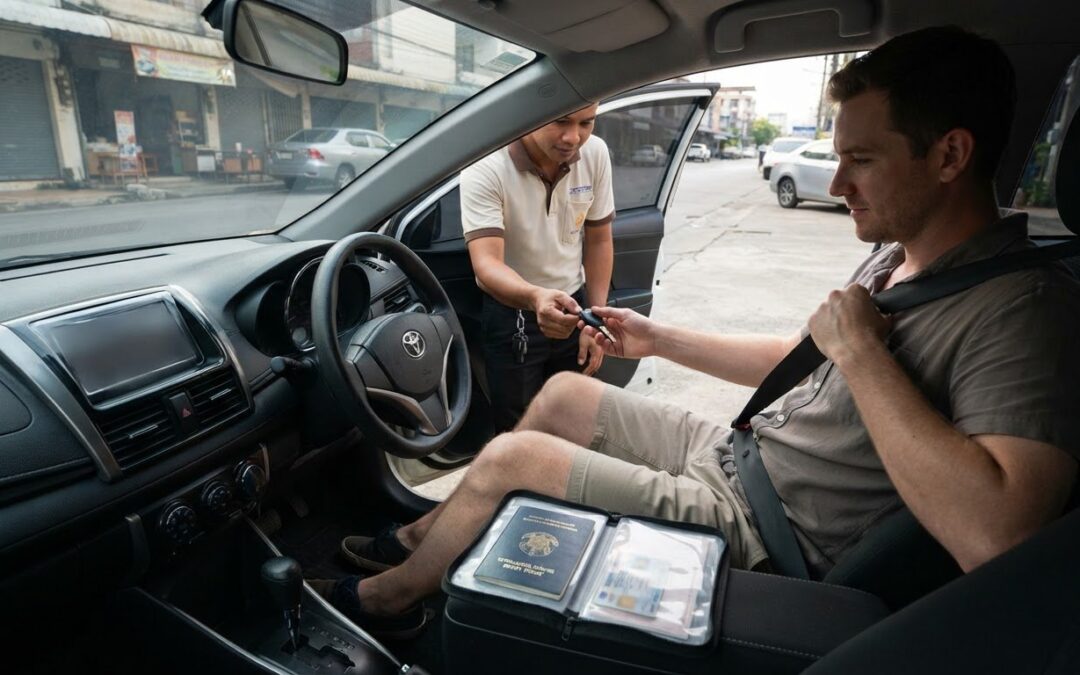
A foreign driving licence alone isn’t enough to drive in Thailand. An international driver’s license for Thailand means a valid International Driving Permit (IDP), recognized here when issued under the 1949 Geneva Convention or the 1968 Vienna Convention. Carry it with your national driving licence, since the permit translates rather than replaces your original licence.
It’s easy to assume that a licence valid at home will be accepted abroad, but Thailand’s rules make the distinction important. Having the right documents helps you understand what you can use on the road and whether you need to arrange a permit before travelling.
This guide explains where eligible drivers can apply for an IDP in Thailand, who qualifies, how long a Thai-issued permit is valid, and how Thailand recognizes foreign licences and permits.
You’ll also find the practical difference between getting an IDP for travel from Thailand and using a foreign-issued licence when driving here, so you can prepare for the situation that applies to you.
Key Takeaways
- Find out which Department of Land Transport office handles IDP applications, especially if you’re applying near Pattaya.
- Learn whether your Thai licence and age meet the requirements before preparing an application.
- Understand why applying in the country that issued your licence may be the practical route for visitors to Thailand.
- Know the key distinction between a foreign-issued permit for driving in Thailand and a Thai-issued permit for travel abroad.
Applying for an international driving licence in Thailand
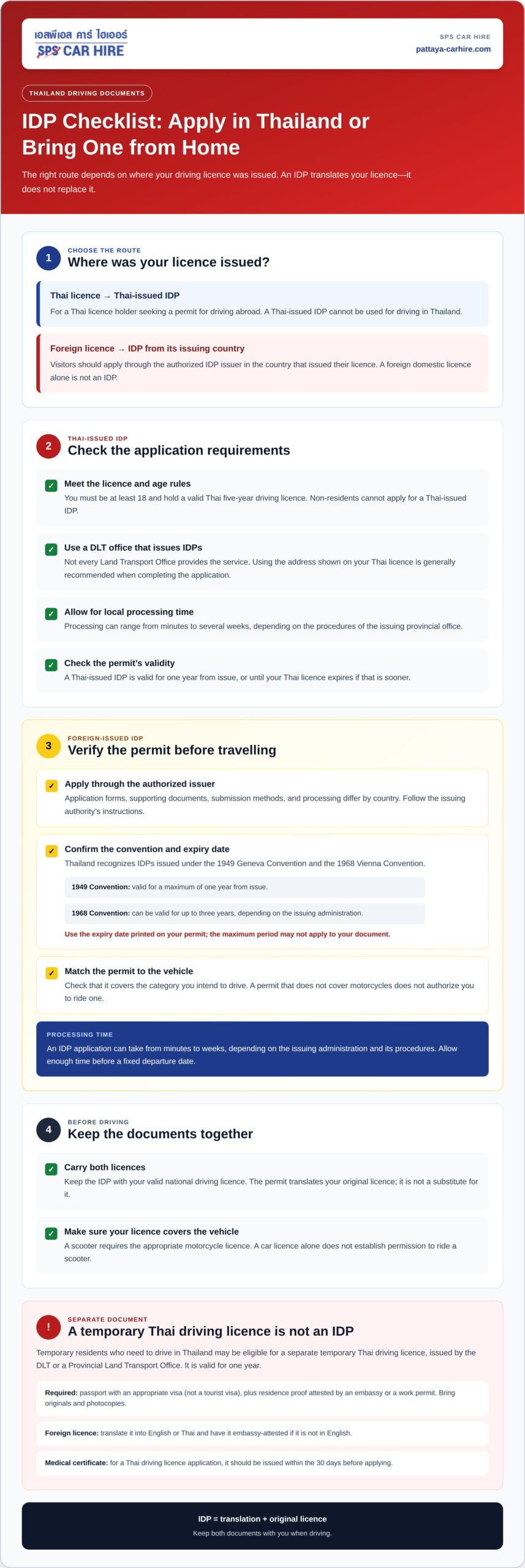
A Thai-issued International Driving Permit (IDP) translates a Thai driving licence for use abroad. The Department of Land Transport (DLT) issues permits under the 1949 and 1968 conventions, but applicants must hold a Thai driving licence. You must be at least 18, and a valid Thai five-year driving licence is required for an IDP for overseas travel.
Apply through a DLT office that issues IDPs. Not every Land Transport Office provides this service nationwide. Processing times can range from minutes to several weeks, depending on the specific procedures of the issuing provincial office. It is generally recommended to use the address shown on your Thai licence when completing the application.
A Thai-issued IDP is valid for one year from its issue date, or until the Thai licence expires if sooner. Carry it with your domestic driving licence when driving abroad; the permit does not replace that licence. A Thai-issued IDP cannot be used for driving in Thailand. Non-residents cannot apply for one in Thailand, so visitors generally need to arrange an IDP through the country that issued their licence.
A temporary Thai driving licence is a separate document that may suit temporary residents who need to drive in Thailand. The DLT or any Provincial Land Transport Office can issue one, valid for one year. Applicants need a passport with an appropriate visa, excluding a tourist visa, plus residence proof attested by an embassy or a work permit, with originals and photocopies. A foreign licence must be translated into English or Thai and embassy-attested if it isn’t in English. A medical certificate for a Thai driving licence application should be issued within the 30 days before applying.
For a scooter, the rider needs the appropriate motorcycle licence, and the IDP should accompany the national licence. Driving without the correct licence or permit can lead to enforcement action; the applicable penalty depends on the violation.
Applying for an IDP in the country that issued your licence
An International Driving Permit (IDP) is a translation of your domestic driving licence for use in places that recognize it. If you’re visiting Thailand, apply through the authorized IDP issuer in the country that issued your licence. Thailand recognizes permits issued under the 1949 Geneva Convention and the 1968 Vienna Convention, so the convention shown on your permit matters.
Start by identifying the authorized issuer in your home country and following its application process. Requirements differ by country, so use that authority’s instructions for the application form, supporting documents, submission method, and processing. Keep your valid domestic licence available, since the IDP accompanies it rather than replacing it. An IDP on its own is not a valid substitute for your original driving licence.
Check the permit’s convention and expiry before travelling. A 1949-convention IDP is valid for a maximum of one year from its issue date. A 1968-convention IDP can be valid for up to three years, but the permitted period depends on the issuing administration. Don’t assume the longest possible term applies to your document. Use the expiry date printed on the permit when planning your stay.
Processing can take from minutes to weeks, depending on the issuing administration and its procedures. Apply with enough lead time, especially if your departure date is fixed. Before travelling, confirm that the permit covers the vehicle category you intend to drive, and keep it with your national licence while driving in Thailand. For example, a permit that does not cover motorcycles does not authorize you to ride one. This route is for visitors who need an IDP based on a licence issued outside Thailand, rather than a Thai-issued permit for travel abroad.
Eligibility for an IDP
IDP eligibility depends on your age, domestic driving licence, and the issuing country. For a permit issued in Thailand, you must be at least 18 and hold a valid Thai five-year driving licence. A non-resident cannot apply for a Thai-issued IDP, even if staying in Thailand for travel.
An IDP translates information from your domestic licence for international driving. If your licence was issued outside Thailand, apply through the authorized issuer in that country. Application rules vary, but the IDP must be based on your domestic licence. It cannot replace your original licence, so carry both when driving.
Licence type matters too. The permit must cover the vehicle category you plan to drive, such as a car or motorcycle. A car licence alone does not establish permission to ride a scooter. Thailand’s minimum age for a car driving licence is 18; the listed minimum age for a motorcycle licence is 15. However, Thai-issued IDP applicants still need to meet the separate minimum age of 18.
For a Thai-issued permit, check that your Thai licence remains valid throughout your intended travel period. The IDP lasts one year from issue, or until the Thai licence expires if that happens sooner. A five-year Thai licence is required to obtain this permit for overseas use. If your Thai licence is temporary or expired, you do not meet that stated requirement. Visitors instead need an IDP based on a licence from their home country.
Use these distinctions before applying: a Thai resident with a valid five-year Thai licence may seek a Thai-issued IDP, while a visitor with a foreign licence applies through its issuing country. In either case, match the permit to your licence category and carry both documents when driving.
Recognition of foreign licences in Thailand
Recognition means Thailand accepts a valid International Driving Permit (IDP) issued under a recognized road traffic convention. Thailand recognizes IDPs under the 1949 Geneva Convention and the 1968 Vienna Convention. For visitors, an international driver’s license for Thailand is this permit, not a foreign domestic licence on its own. Carry the IDP and national driving licence together, and show them with your passport when asked.
The permit’s convention and validity both matter. A 1949-convention IDP is valid for a maximum of one year from its issue date. Thailand’s acceptance of an IDP may be limited to stays of up to 90 days. An international driver’s license for Thailand does not replace your original licence, and it must cover the vehicle category you intend to drive. An expired permit doesn’t become valid because your visit continues.
Converting a foreign driver’s licence to a Thai driving licence means applying through the Department of Land Transport (DLT) or a Provincial Land Transport Office. Temporary residents may be able to apply for a Thai driving licence. Applicants need a passport with an appropriate visa, excluding a tourist visa, and proof of residence attested by an embassy or a work permit. Provide originals and photocopies.
For the application, present a valid international driving licence or a national licence translated into English or Thai. If the original licence isn’t in English, the translation must be attested by your embassy. Applicants are instructed to obtain a certificate of residency from the nearest Thai Immigration Office and a medical report for driving-licence purposes. Without a valid state or international licence, applicants may need a driving course and test. Foreigners must be at least 18 for a car licence; the written test requires at least 45 out of 50 to pass.
After sorting out your documents, explore transport options for local travel.
Recognition periods vary by destination. Some countries recognize a foreign visitor’s International Driving Permit only for a few weeks, usually for as long as the visitor’s tourist visa is valid. In Thailand, visitors driving a vehicle or motorcycle are required by law to hold an international driving licence and, when asked, present it with their passport and national driving licence.
SPS Car Hire
SPS Car Hire helps you plan ground transport after you’ve sorted out the licence and permit required for driving in Thailand. If your documents qualify you to drive and you need a vehicle in the Pattaya region, its Low Cost Car and Truck Rental and Economy Car and Truck Rental options provide practical choices. Best Price Car and Truck Rental and Long-term Car Rental Packages can also suit different travel plans.
A rental is a transport option, not a substitute for the correct driving documents. Make sure you hold the licence and permit required for your situation before driving. If you’re planning a rental, contact SPS Car Hire to arrange a car, truck, or motorbike.
Plan your Thailand travel with confidence
Make your next step practical: decide where you’ll drive, which vehicle category fits your plans, and whether your documents support that choice. Treat an international driver’s license for Thailand as one part of your preparation, not a replacement for your national licence or a shortcut around local requirements. Keeping your travel paperwork and transport plans aligned can help you set out with clarity.
If you’re arranging travel around Pattaya, choose a rental option that suits how long you need a vehicle and what you’ll use it for. SPS Car Hire can help with that next step, while your licence and permit remain your responsibility as the driver. For a straightforward conversation about your rental needs, contact SPS Car Hire.
Get your documents in order, make a considered transport plan, and enjoy a more prepared start to your time in Thailand.
 -
 -
 -
 -
 -
 -
 -