

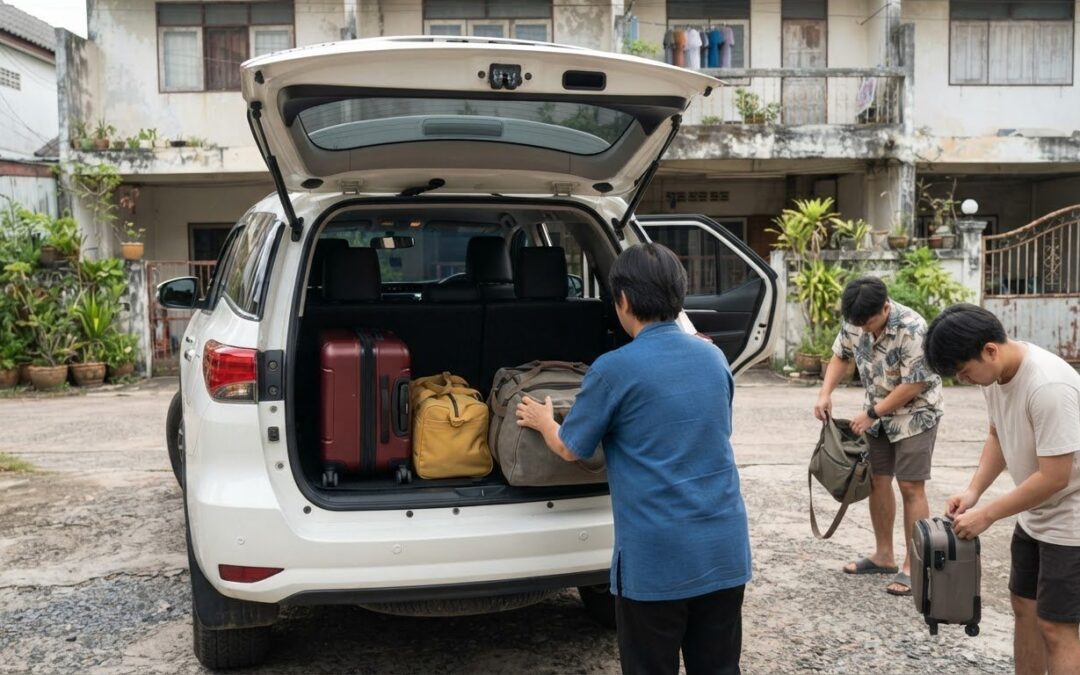
A standard rental car can seat five, but passenger count alone won’t tell you whether it suits your group. In rental listings, “standard” generally falls between midsize and full-size, although labels can overlap: standard, midsize and intermediate cars are commonly listed for five passengers and three to four bags. To work out how to choose a rental car size, consider luggage and trip plans as well as seating.
It’s easy to focus on fitting everyone into the car and assume the bags will fit too. Choose a vehicle with enough room for both passengers and luggage, while keeping it practical for your route in Thailand. Consider each person’s space needs, the number of bags, and whether your plans involve city driving or longer trips.
This guide compares common rental groups by passenger and bag capacity, then explains how to match a vehicle to your group, luggage and itinerary. A short city stay may call for a different choice from a longer drive with a full load of bags.
Key Takeaways
- Match the car group to both your passenger count and luggage, since seat capacity alone doesn’t guarantee enough room for bags.
- Rental labels can overlap: compare the listed passenger and bag capacity instead of relying on names like standard, midsize, or intermediate.
- Choose between economy and compact by considering how much luggage you’re carrying and how much space your group needs on the drive.
- Factor your itinerary into the decision, balancing passenger comfort and cargo space with the ease of driving and parking in Thailand.
Rental car categories by passenger and luggage capacity
Start with your passenger count, then match luggage space and vehicle type to your Thailand itinerary. Rental prices depend on vehicle group, rental dates, rental length and booking terms; the applicable price is given after a quote request.
-
Compare passenger capacity by vehicle category
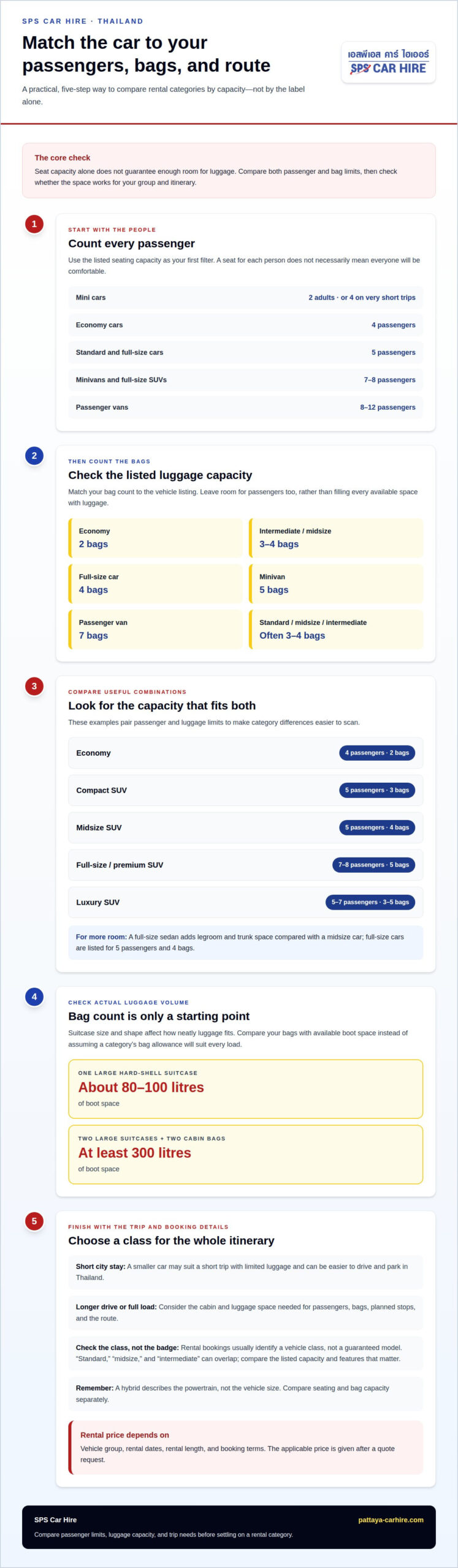
Count every passenger, then compare the vehicle’s listed seating capacity. Mini cars suit two adults, or four on very short trips; economy cars are listed for four passengers, while standard cars seat five. Minivans and full-size SUVs list capacity for seven to eight passengers, while passenger vans list eight to twelve. Don’t assume everyone will fit comfortably just because there’s a seat for each person.
-
Check luggage capacity across vehicle categories
Match your bag count to the vehicle’s listed luggage capacity, not just its seating. Economy cars are listed for two bags, intermediate and midsize cars for three to four, and full-size cars for four. A compact SUV lists five passengers and three bags; a midsize SUV lists five passengers and four. Minivans list five bags, while passenger vans list seven. Allow enough room for bags without crowding passengers.
-
Review full-size sedan and SUV space
Choose a full-size sedan when five passengers need more legroom and trunk space than a midsize car offers. Full-size cars are listed for five passengers and four bags, balancing passenger comfort with luggage capacity. For an SUV, compare the categories: compact and midsize options seat five, while full-size or premium SUVs list seven to eight passengers and five bags. Luxury SUVs list five to seven passengers and three to five bags. Don’t use a Volkswagen badge to judge size; check the booking category and capacity against your trip.
What is a “standard-size car” in a car rental?
Do rental companies guarantee the exact model or only the vehicle class? A booking usually identifies a class, not a specific model. Since the supplied vehicle may differ, compare the class capacity and the features that matter for your trip.
- Compare category names before choosing. Rental companies commonly use “standard,” “midsize” and “intermediate” interchangeably, even though the labels can suggest different sizes. These categories generally describe four-door cars for five passengers and three to four bags. A standard car is generally larger than a midsize vehicle and smaller than a full-size vehicle. Check the capacity details as well as the label.
- Use the listed vehicle class, rather than a familiar badge, as your guide. A compact car is a smaller category; midsize or intermediate sedans generally offer more cabin and luggage space. A full-size sedan adds legroom and trunk space compared with a midsize car. A Volkswagen name or hybrid engine alone doesn’t identify the rental class.
- Compare vehicle classes with your travel plans in Thailand. A smaller car may suit a short trip with limited luggage, while a road trip with several passengers may call for more cabin and luggage space. A hybrid describes the powertrain, not the vehicle’s size, so compare seating and bag capacity separately. If your destinations change, prioritize the capacity your group needs over a familiar model name.
- Use the category and capacity details shown in your Thailand rental booking, rather than assuming labels mean the same thing everywhere. “Standard,” “midsize,” and “intermediate” may describe similar sedans, while the listed passenger and bag limits help distinguish the practical fit. Compare those details with your trip plans and select the class that suits your needs. Explore car rental options as you plan your trip.
What is the difference between economy and compact rental cars?
- Compare passenger and bag allowances first. Economy cars are listed for four passengers and two bags; compact cars are listed for five passengers and two bags. That extra seat can help a vacation group, but it doesn’t add luggage capacity. Choose according to the passengers and bags travelling, not the category name alone. For a Toyota or another model, use the rental class details to guide your choice.
- Estimate luggage volume before booking. A large hard-shell suitcase needs about 80 to 100 litres of boot space, while two large suitcases and two cabin bags need at least 300 litres. Bag dimensions and shape affect how neatly they fit, so compare your luggage with the vehicle’s available boot space. Don’t assume a compact’s two-bag listing will suit two large cases and extra carry-ons.
- Include passenger comfort in your decision. Check whether child seats fit the intended seating positions, whether passengers can get in and out comfortably, and whether the driver has enough legroom for the journey. Consider accessibility needs and the space required for mobility equipment. A vehicle may meet the passenger count yet feel cramped once people, seats and luggage are together.
- Consider an SUV when its seating and cargo layout better suits your group. A compact SUV is listed for five passengers and three bags; a midsize SUV for five passengers and four bags. Compare those capacities with your luggage before choosing an upgrade. Fuel efficiency can also factor into the decision, but the right choice depends on the trip, vehicle and load, not the badge or model alone.
- A car that’s too small may not have enough boot space for luggage or legroom for passengers. You might need to rearrange bags, bring less, or choose a different vehicle class to fit everyone and their belongings.
Choosing a car group based on group size and itinerary
Plan for the full route, including city streets, longer drives and planned stops. Let your passenger group and luggage needs guide your choice of vehicle class before booking.
-
Choose a size for long road trips in Thailand
For a long road trip, prioritize a comfortable cabin and enough space for everyone’s belongings. List every passenger and bag, then compare your needs with the vehicle class capacity. A standard car can suit a smaller group, while a larger class may work better when passengers or luggage need more space. When deciding how to choose a rental car size, consider the longest drive, not just the initial pickup.
-
Choose a size for city driving and narrow roads
For city driving, balance passenger space with a vehicle that feels manageable on your planned streets and parking stops. Economy and compact cars can suit smaller groups travelling with limited luggage. City-use cars should have a turning circle under 10 metres. For rentals lasting under three days, small cars are recommended because they’re cheaper and easier to park. Keep the actual passenger and luggage needs in view when selecting a smaller class.
- Use the busiest part of your itinerary to settle on a class. A group carrying luggage between destinations may need more room than the same travellers on a short city trip. Factor in planned pickups, changes in passengers and the amount of driving between stops. This route-first approach helps you choose a rental car size that works throughout the trip, not just for one leg.
- Before booking, compare the class with your group’s needs and the route. Economy or compact cars may suit a smaller party, while a standard car or larger vehicle can offer a better fit for a fuller itinerary. Choose a class that accommodates everyone and their belongings without making city driving harder than necessary. Choose a rental car for your itinerary.
SPS Car Hire
Once you’ve matched your group, luggage and itinerary to a suitable vehicle class, SPS Car Hire offers car and truck rentals to help you plan transportation in Thailand. Choose a budget-friendly rental or a vehicle for an extended stay. When discussing your rental, share your passenger count, luggage needs and intended use so the choice fits your trip, not just the category name.
For longer transportation needs, SPS Car Hire also offers long-term car rental packages. Consider the rental period alongside your group’s space requirements, then contact SPS Car Hire to discuss your plans.
Set Your Rental Plan in Motion
Your vehicle choice can shape more than the drive. Make it easier to organize the rest of your Thailand travel plans by coordinating passengers and luggage and matching the rental period to your itinerary. A practical way to decide how to choose a rental car size is to treat the vehicle class as part of the whole trip, not an isolated booking detail.
When you’re ready to arrange a rental, SPS Car Hire offers Low Cost Car and Truck Rental, Best Price Car and Truck Rental, and Long-term Car Rental Packages. Share your travel needs and rental duration to discuss the right option for your plans.
Contact SPS Car Hire about your rental plans, and take the next step toward a trip that fits your group.
Frequently Asked Questions
How Car Size Affects Fuel Efficiency?
Vehicle size can affect fuel efficiency, but the route, driving style, and load matter too. Adding around 45-50 kg to a car can reduce fuel efficiency by 1-2%. For a Thailand trip, compare the vehicle’s fuel use for your expected driving rather than assuming every economy car or SUV performs alike. A lightly loaded car on city streets may use fuel differently from the same car carrying passengers and luggage on longer drives.
What are the different rental car sizes?
Common rental categories include mini, economy, compact, intermediate, midsize, standard and full-size cars. Fleets may also include compact, midsize and full-size SUVs, as well as minivans and passenger vans. These labels describe vehicle groups, not a universal set of dimensions. A people carrier, for example, is intended for a larger group, while an economy car is a smaller option. Compare capacity details because category names can vary between listings.
What is a midsize rental car?
A midsize rental car is generally listed for five passengers and three to four bags. It can suit a small family or travel group that needs more room than a smaller class but doesn’t need a full-size car. Compare the planned passengers and luggage with the listing before booking. The label alone doesn’t establish the exact model, cabin dimensions or boot shape.
What is an intermediate rental car?
An intermediate rental car is commonly grouped with midsize and standard cars. Listings often show seating for five passengers and room for three to four bags. Because the terms can overlap, “intermediate” doesn’t always indicate a distinct size. Check the passenger and luggage capacity for the specific class instead of relying on a label that may vary between rental companies.
How do rental car size categories compare in passenger capacity and luggage space?
Compare the stated passenger and bag capacities: a compact SUV is listed for five passengers and three bags, while a midsize SUV is listed for five and four. Minivans list seven to eight passengers and five bags; passenger vans list eight to twelve passengers and seven bags. These figures help narrow down the class, but bag sizes and passenger needs still affect the fit.
How many passengers and bags fit in economy, compact, midsize, and full-size rental cars?
Economy cars are listed for four passengers and two bags; compact cars for five passengers and two bags. Midsize cars are listed for five passengers and three to four bags, while full-size cars list five passengers and four bags. Treat these as category capacities, not a guarantee that every suitcase will fit easily. If your group has bulky cases, compare their dimensions with the available boot space before choosing.
 -
 -
 -
 -
 -
 -
 -