

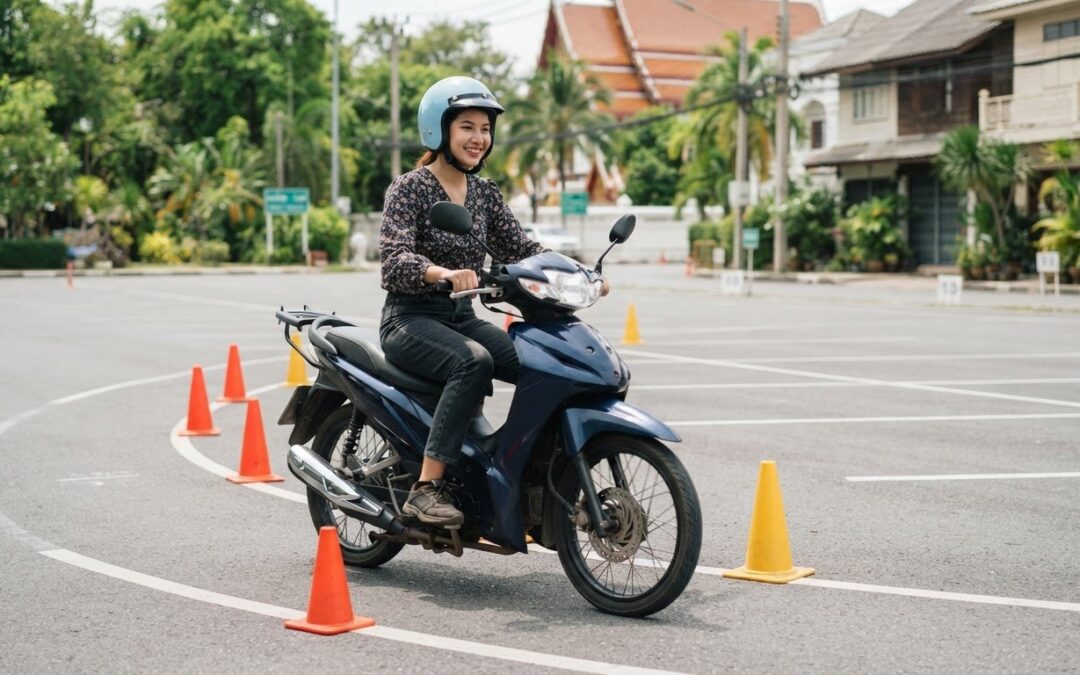
Learning how to drive a semi-automatic scooter starts with understanding its controls and practising at a manageable pace. If you’re unsure when to shift, worried about stalling at low speed, or confused about how this scooter differs from an automatic, focus first on the gear rhythm. Smooth, deliberate inputs matter more than speed.
This guide covers how to prepare, move off, change gears, slow down, turn, and stop. You’ll also learn how to choose a suitable place to practise and what to master before riding in traffic. In Thailand, make sure you have the correct motorcycle licence before riding: a foreign licence must cover motorcycles and be accompanied by a valid International Driving Permit showing the motorcycle category, or you’ll need a Thai motorcycle licence. Wear a helmet, take your time, and get comfortable with the basics before adding traffic.
Key Takeaways
- Learn how a semi-automatic scooter differs from a twist-and-go model, so you know what to expect from its controls.
- Understand how the gear selector, throttle, and brakes work together to help you ride with smoother control.
- Follow a practical first-ride sequence to move off, change gears, slow down, and stop in a safe, open area.
- Correct common beginner habits, including abrupt throttle use, rushed shifts, and braking too late.
- Build confidence step by step with how to drive a semi-automatic scooter practice, from stationary controls to wider turns and more complex riding.
What Is a Semi-Automatic Scooter, and How Is It Different?
A semi-automatic scooter is a geared motorcycle that generally lets you change gears without operating a hand clutch lever. You use the throttle to control engine power and a foot-operated selector to choose gears. You still need to coordinate those actions as you ride, but there’s no hand clutch lever to operate as there is on a conventional manual motorcycle.
The word “scooter” can be confusing. Many familiar twist-and-go scooters are fully automatic: the transmission selects the gearing for you, so you don’t shift gears while riding. A semi-automatic still requires you to select gears yourself. For an overview of how this type of transmission works, see What is a Semi-Automatic Transmission?
Semi-automatic vs. automatic vs. manual: what changes for the rider?
The main difference is what your hands and feet do. On a fully automatic scooter, you operate the throttle and brakes while the transmission handles gear changes. On a semi-automatic, you add gear selection with a foot control, but generally don’t operate a clutch lever. On a conventional manual bike, you select gears and coordinate a hand-operated clutch as well. Gear patterns and operating sequences vary by model, so don’t assume one bike works exactly like another.
Identify the controls before you start
Before starting the engine, sit on the scooter while it is stable and identify each control by sight and feel. Layouts vary, so use the owner’s manual as your guide. Keep the engine off while you get familiar with the controls.
- Throttle: Usually a twist grip, it controls engine power. Learn how it moves and returns without revving the engine.
- Front and rear brakes: These slow or stop the scooter. Identify which lever or pedal operates each brake. Their positions aren’t universal.
- Ignition: This switches the electrical system and, depending on the scooter, enables the engine to start. Follow the model’s instructions.
- Gear selector: Often operated by foot, it changes the selected gear. Check the manual to understand its pattern and operation instead of guessing.
Practise reaching each control while stationary. Don’t start riding until you can identify the throttle, both brakes, ignition, and gear selector without confusion. Knowing where each control is makes the first steps easier, but the scooter’s manual remains the authority for its specific controls and operating instructions.
How the Gears, Throttle, and Brakes Work Together
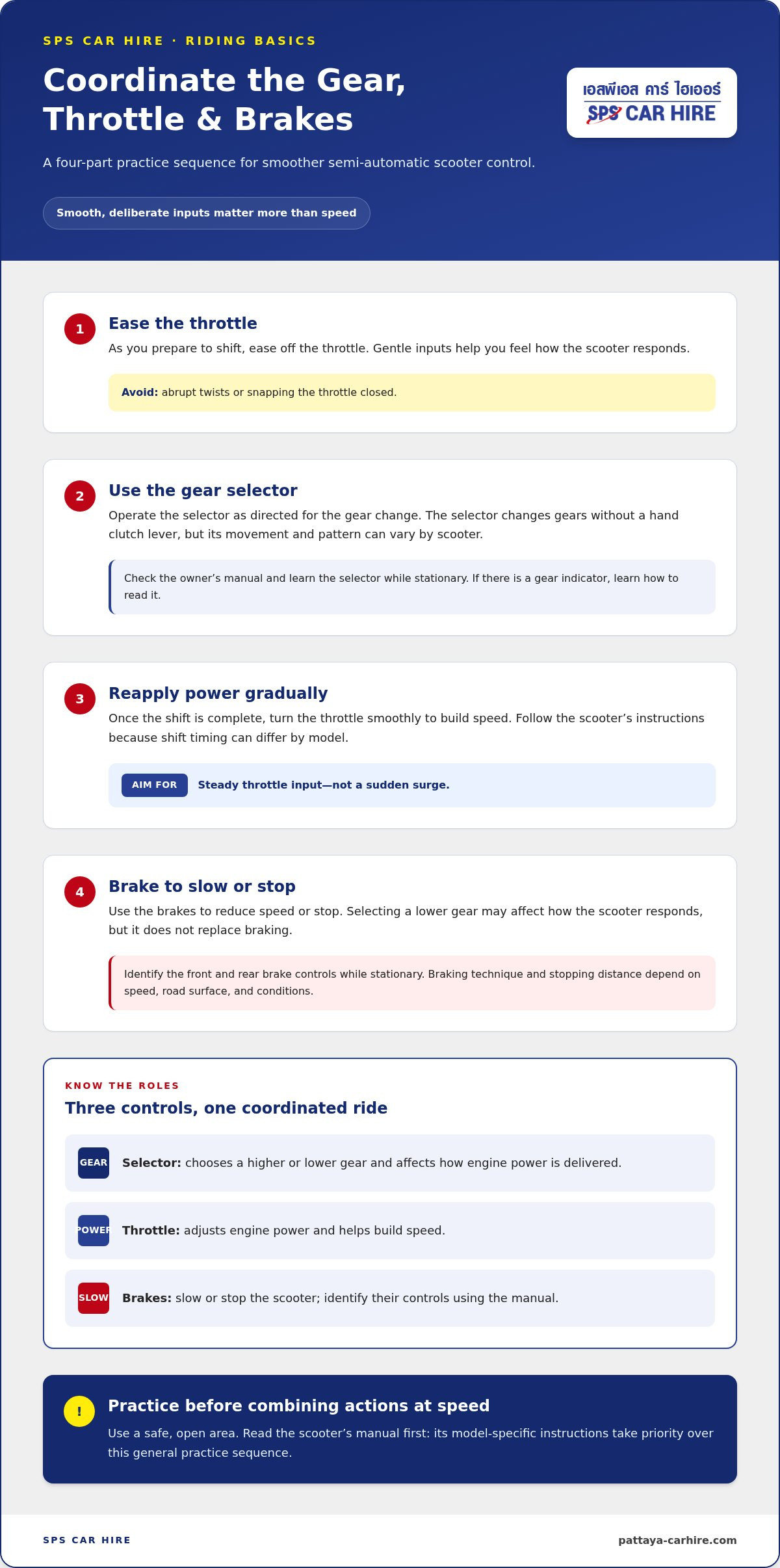
Think of the controls as a team: the gear affects how engine power is delivered, the throttle asks for more or less power, and the brakes reduce speed. Smooth riding comes from coordinating them rather than making sudden inputs. The exact response depends on the scooter, so use its manual for model-specific instructions. Treat any general sequence as a starting point, not a universal rule.
| Control | Rider input | Purpose |
|---|---|---|
| Transmission | Changes gear through the selector | Matches the engine’s power delivery to the riding situation |
| Gear selector | Operated by foot on many models | Selects a higher or lower gear |
| Throttle | Turn the grip gradually | Adjusts engine power and helps build speed |
| Brakes | Apply the controls identified in the manual | Slows or stops the scooter |
What does the foot-operated gear selector do?
The selector changes the transmission gear without requiring you to operate a hand clutch lever. Its positions and movement can vary. Some scooters use a pattern where you press or lift a foot control to select gears, but don’t assume a familiar pattern applies to your bike. Before riding, check the manual and identify the selector’s action while stationary. If the scooter has a gear indicator, learn how to read it.
How throttle and brakes affect control
Use the throttle gently to build speed. On many semi-automatic models, a gear change involves easing off the throttle as you operate the selector, then applying power smoothly again. Follow the scooter’s instructions, since timing can differ. Avoid abrupt twists or snapping the throttle closed. Steady inputs make it easier to feel how the bike responds.
Before moving, identify and practise the front and rear brake controls while the scooter is stationary, following the manual. Learn where each control is and how it moves. Braking technique and stopping distance depend on factors such as speed, road surface, and conditions. Don’t rely on a fixed distance or assume one input suits every situation. The NHTSA Motorcycle Safety Guidelines also offer general guidance on motorcycle safety and responsible riding.
Use this basic coordination sequence only as a practice aid, not as a substitute for the scooter’s instructions:
- Ease the throttle as you prepare to shift.
- Use the selector as directed for the gear change.
- Reapply the throttle gradually once the shift is complete.
- To slow or stop, use the brakes. Selecting a lower gear may affect how the scooter responds, but it doesn’t replace braking.
Practise these actions in a safe, open area before combining them at speed. When you’re ready to ride a motorbike, explore motorbike rental options from SPS Car Hire. The company offers motorbike rentals, but the riding instructions for your specific scooter always take priority.
How to Ride a Semi-Automatic Scooter: A Step-by-Step First Ride
Your first practice session should focus on control, not speed. Choose a level, open area away from traffic, pedestrians, parked vehicles, and other obstacles. Read the scooter’s manual before starting. Its instructions take priority, especially for the starting procedure, gear pattern, and when to shift. Practise one action at a time, then combine them at a gentle pace.
Before moving off: prepare the scooter and practice area
Wear a correctly fitted helmet and other suitable protective equipment. Check that the scooter is stable, you can reach the controls comfortably, and the practice area is clear. With the engine off, locate and rehearse the gear selector and both brake controls. This lets you learn their movement without also managing throttle or motion.
Move off, change gears, slow down, and stop
Use this sequence as a practice framework, not a substitute for the scooter’s manual. Gear positions and operating steps vary, so don’t rely on a pattern learned from another bike.
- Prepare. Put on your protective equipment, settle into a balanced position, and make sure the scooter and practice space are ready. Keep the front wheel pointed in the direction you intend to travel.
- Start as instructed. Follow the model’s starting procedure. Before moving, confirm the selected starting gear using the method described in its manual. If the gear position is unclear, stop and check rather than guessing.
- Move off gently. Keep your attention on the space ahead and apply only a small, smooth amount of throttle. Let the scooter begin moving without rushing. If it feels unsettled, use the brakes to stop, then pause and reset.
- Practise a shift. Once you’re moving steadily in the open area, ease off the throttle and operate the selector as the manual directs. The foot movement and timing are model-specific. Reapply power gradually after the change, and practise at a pace that leaves you time to respond.
- Slow down. Roll off the throttle and use the brakes to reduce speed. Don’t rely on selecting a lower gear to stop the scooter. Gearing doesn’t replace braking. Leave room to slow smoothly, and adjust your actions to the surface and conditions.
- Stop and reset. Brake in a controlled way until the scooter is fully stopped, then follow the manual’s instructions for the selector and engine. Check your balance and readiness before another attempt.
Repeat the sequence until each action feels familiar. If coordinating the selector with the throttle still feels awkward, practise those controls separately while stationary before trying again. Build up gradually, and end the session if you feel rushed, tired, or unsure. Aim to make each start, shift, and stop deliberate before adding more complex riding conditions.
Common Beginner Mistakes: Shifting, Braking, and Turning
Small, rushed inputs can make a new rider feel less in control. A sudden throttle twist may deliver power more sharply than intended, while a hurried shift can interrupt smooth progress. Braking late leaves less room to respond, and turning before reducing speed can make the scooter harder to manage. Don’t try to force your way through a mistake. Slow down the practice, separate the actions, and repeat them calmly in a controlled area.
Why rushed gear changes and abrupt throttle cause trouble
Every scooter responds in its own way, so a gear change that feels smooth on one may feel different on another. Rushing the selector or adding throttle abruptly can make the bike’s response less predictable and shake a beginner’s confidence. Practise one shift at a time at a manageable pace, following the manual. Focus on a deliberate selector movement and a gradual return to the throttle rather than trying to shift quickly.
- Mistake: Twisting the throttle sharply. A fast input can make acceleration feel sudden. Rehearse turning the grip gently and steadily, then easing it back without snapping it closed.
- Mistake: Rushing a gear change. Trying to shift before you’re ready can disrupt your progress. Practise the selector movement separately while stationary, then work on one shift at a time when the scooter is moving slowly in a clear practice space.
- Mistake: Looking down at the selector for too long. This takes your attention away from the path ahead. Learn the control while stopped and use the model’s gear indicator, if fitted, rather than staring at your feet as you ride.
- Mistake: Braking suddenly or relying on just one brake. Abruptly grabbing a control can unsettle the scooter. Practise smooth braking with the controls as described in the manual, learning how each brake responds before riding in more demanding conditions.
- Mistake: Entering a turn too quickly or staring at the front wheel. Reduce speed before the turn, then look along the path you intend to take. Practise wide turns at a comfortable pace, without aiming for a fixed speed that may not suit the space or surface.
Braking and cornering mistakes to avoid
Braking and turning require different kinds of attention, so practise them separately before combining them. First rehearse smooth stops on a straight, clear path. Then practise wide turns at a comfortable pace, keeping your eyes directed along your intended route. As you improve, combine the skills by slowing before a turn and maintaining calm, measured control through it. Avoid grabbing the brakes suddenly mid-turn. If you feel uncertain, stop safely and reset.
There’s no benefit in pushing through when the controls feel confusing or your balance feels unsettled. Bring the scooter to a safe stop, take a breath, and return to a simpler drill. Learning how to drive a semi-automatic scooter is about building repeatable control, not proving how quickly you can progress. When you’re ready to ride a motorbike, explore motorbike rental options from SPS Car Hire.
Build Confidence Before Riding on Public Roads
Confidence comes from repeating simple skills in a sensible order, not from jumping straight into traffic. Begin in a suitable, clear practice area away from vehicles and obstacles, and follow the scooter’s operating instructions throughout. Practise only where you’re permitted to ride. If you’re learning in Thailand, remember that traffic keeps to the left and understand the road rules before going onto public roads.
A gradual practice plan for new riders
Start with the scooter stationary and the engine off. Familiarise yourself with the controls and practise reaching them without looking away for long. Then add one skill at a time, returning to an easier drill whenever an action feels rushed or uncertain.
- Get comfortable while stationary. Learn the selector pattern and brake controls from the manual. Follow the model’s instructions before starting the engine.
- Practise slow starts and stops. Focus on moving off gently, keeping a steady line, and stopping smoothly. Repeat until you can do both without feeling hurried.
- Add wide turns. Practise turns separately, looking along the path you intend to take and keeping your movements calm.
- Combine skills gradually. Once starts, stops, shifts, and turns feel controlled on their own, join them in the practice area. Add complexity only when you can stay relaxed and attentive.
Keep each session focused. Tiredness, frustration, or feeling unsettled can make it harder to respond thoughtfully, so pause or stop rather than pushing through. If you remain unsure about operating the scooter, get further instruction before practising more or riding on public roads.
Know when you are ready to progress
Use this checklist as a practical confidence check, not a guarantee that every road situation will be easy. You should be able to:
- Start and move off deliberately, without abrupt throttle inputs.
- Change gears calmly by following the scooter’s specific instructions.
- Slow down and stop clearly using the brakes, without relying on a gear change to stop.
- Complete wide turns while looking along your intended path and maintaining control.
- Stay composed enough to notice what’s around you and make decisions without rushing.
If any item still feels inconsistent, keep practising in a suitable area or seek more instruction. Before riding publicly in Thailand, check that you meet the applicable licensing requirements: a foreign rider needs a Thai motorcycle licence or a home-country motorcycle licence accompanied by a valid International Driving Permit that includes the motorcycle category. A car-only licence is not sufficient. Wear a helmet and follow the scooter’s manual and local road rules.
When you’re ready to consider a hired scooter, read the budget scooter rental guide. The riding skills in this article apply to the specific scooter you use, so review its instructions rather than assuming every rental model is semi-automatic.
Take Your Next Ride One Step at a Time
Learning how to drive a semi-automatic scooter is a process, not a test of how quickly you can get on the road. Keep practising in a safe, suitable area until operating the scooter feels calm and deliberate, and follow the manual for the bike you’re using. Before riding on public roads in Thailand, make sure you meet the applicable licensing requirements and understand the road rules.
SPS Car Hire offers motorbike rentals, including new or nearly new Yamaha Nuovo and Honda Mio motorbikes. These are rental options, not a claim that any particular model is semi-automatic. Learn the controls of the specific bike you ride before setting off.
Explore motorbike rental options from SPS Car Hire as you plan your next ride. Build your skills at your own pace, trust steady practice, and ride only when you feel ready.
Frequently Asked Questions
Is a semi-automatic scooter easy for a beginner to ride?
It can be manageable for a beginner who learns the controls gradually, but it still takes practice. You’ll need to coordinate throttle, gear selection, and braking, and each scooter may respond differently. Before setting off, make sure you understand that model’s selector pattern and starting procedure. If you’re struggling to balance or focus on the controls, pause and get more instruction rather than trying to learn in traffic.
Can you ride a semi-automatic scooter without changing gears?
Usually, you shouldn’t plan to ride without changing gears. A semi-automatic requires the rider to select gears, unlike a twist-and-go scooter, and the appropriate gear can depend on speed and riding conditions. Staying in one gear may make the scooter respond poorly or feel less controlled as conditions change. Follow the owner’s manual for when and how to shift, and don’t assume the same gear will suit every situation.
How do you change gears on a semi-automatic scooter?
Use the foot selector according to the scooter’s manual, since its pattern and shifting procedure aren’t universal. As a general principle, ease off the throttle while making the shift, then apply power smoothly once the change is complete, if the manual instructs this. Practise a single shift at a time in a clear area. Don’t look down for an extended time or copy another scooter’s gear sequence without checking yours.
What gear should you use when stopping on a semi-automatic scooter?
There isn’t one gear that applies to every scooter or stop. Use the brakes to slow and bring the bike to a stop. A lower gear doesn’t replace braking. As you approach a stop, follow the manual’s instructions for downshifting and what to do with the selector once stationary. Before setting off again, confirm the starting gear as directed, especially if you’re unsure which position you selected.
Can a semi-automatic scooter stall?
Yes, a semi-automatic scooter can stall. Removing the hand-operated clutch lever doesn’t mean the engine can’t stop unexpectedly. A stall may happen if the scooter is handled outside its operating range, such as slowing too much in a gear that doesn’t suit the situation, though details vary by model. If it stalls, come to a safe stop, keep the scooter stable, and follow the manual’s restart procedure.
Should you use both brakes on a semi-automatic scooter?
Use the front and rear brakes as the scooter’s manual directs, and practise their operation before riding. Applying only one brake may not be appropriate for every stop, while grabbing either control suddenly can unsettle the bike. Learn how each brake feels at a gentle pace in a safe area. The amount of braking needed depends on speed, surface, and conditions, so avoid relying on a fixed stopping distance.
How should you practise riding a semi-automatic scooter for the first time?
Begin in a level, open practice area where riding is permitted, with a correctly fitted helmet and no traffic or obstacles nearby. With the scooter stationary, familiarise yourself with its controls and manual. Practise starting, moving slowly, and stopping before adding shifts or turns. If you’re learning how to drive a semi-automatic scooter, build up one skill at a time and stop if you feel tired, rushed, or unsure.
 -
 -
 -
 -
 -
 -
 -