

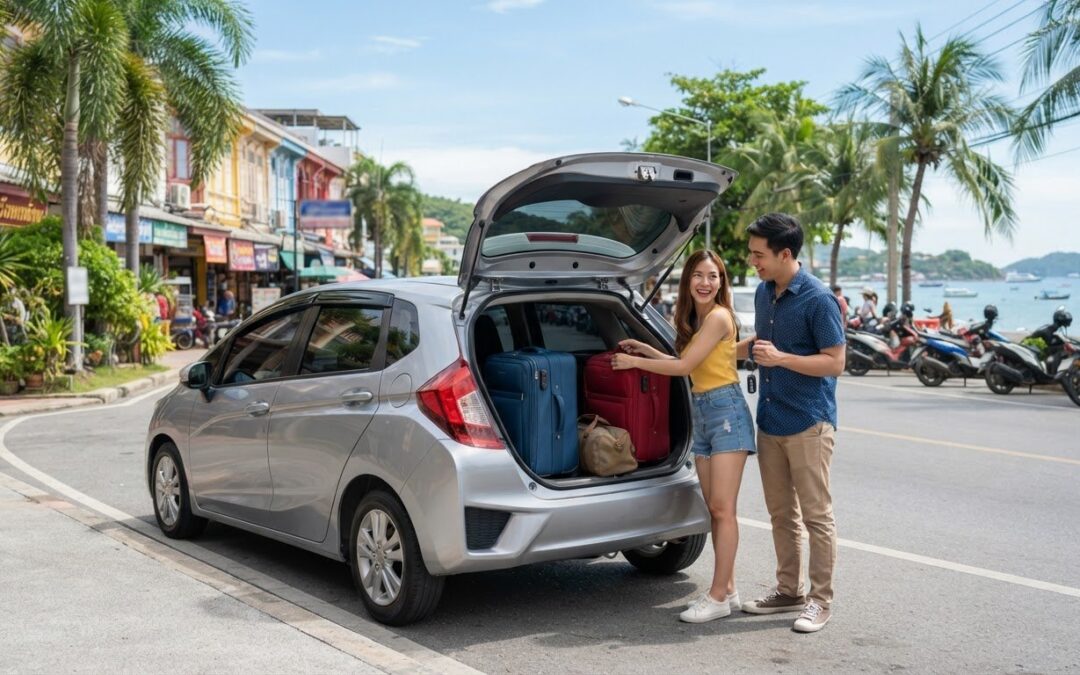
Could a smaller rental make your Thailand trip easier, or leave passengers and bags short of space? Small car hire can be a practical, budget-conscious way to travel independently, but the right choice depends on who is travelling, what you are carrying and how you plan to use the vehicle.
A compact car may suit everyday journeys or a short getaway with a light load. More passengers, bulky luggage or long stretches of driving can make a roomier vehicle a better fit. Start by matching the vehicle to the fullest, most demanding part of your itinerary, then review the rental terms so you know what to expect before collecting the keys.
This guide covers passenger and luggage space, compares rental categories and explains what to check before a self-drive trip. It also offers practical steps for matching a rental period to your plans and budget. SPS Car Hire provides budget-friendly self-drive rentals, with short- and long-term options.
Key Takeaways
- Make a passenger-and-bag inventory to decide whether small car hire fits your trip.
- Consider the size and shape of your luggage, not just the number of bags.
- Compare small cars, larger cars and trucks according to the space and practical use your plans require.
- Before setting off, review the rental terms, prepare your documents, inspect the vehicle and record any existing marks.
- Match the rental period to your plans and compare the terms to find a budget-friendly self-drive option with SPS Car Hire.
Small Car Hire: When Does a Compact Rental Make Sense?
Small car hire means renting a compact vehicle for self-drive travel. A smaller vehicle can be easier to manoeuvre and park, and may suit everyday journeys with a light load. But size alone does not determine whether it is right for your trip. Passenger comfort, luggage, route and expected driving conditions all matter.
Think beyond the vehicle’s category. A car that feels manageable for a short trip with one companion may be cramped once you add several bags, child seats or a longer drive. Tight parking can make a compact vehicle convenient, while more passengers or a luggage-heavy itinerary may call for a different balance of space and comfort.
A small group with modest luggage and straightforward plans is often a good fit for a compact rental. Use that as a starting point, then check it against the full itinerary, not just the first journey.
What counts as a small hire car?
Rental categories vary between companies and markets, so “small” is best understood as a general description of size and everyday use, not a promise of a particular model. A compact vehicle typically prioritises a manageable footprint over generous passenger or cargo room. The subcompact car article provides context on one vehicle classification, although rental labels may differ.
For your decision, focus on practical fit: how many people will ride, whether you can load your bags comfortably, and how everyone will feel during the journey. Don’t assume a category name guarantees a specific amount of space.
Who is most likely to benefit from a compact rental?
Solo travellers and couples may find a smaller vehicle convenient when they have modest luggage and a simple itinerary. Short everyday journeys, such as trips between accommodation and planned activities, may not require much cargo space. With fewer passengers, there is also more room to keep bags accessible without crowding the cabin.
Passenger count is only part of the picture. A couple with bulky cases, sports equipment or several days’ supplies may need more space than a small group carrying day bags. Longer drives can also make seating comfort and room for personal items more important.
Before comparing categories, sketch out the whole trip:
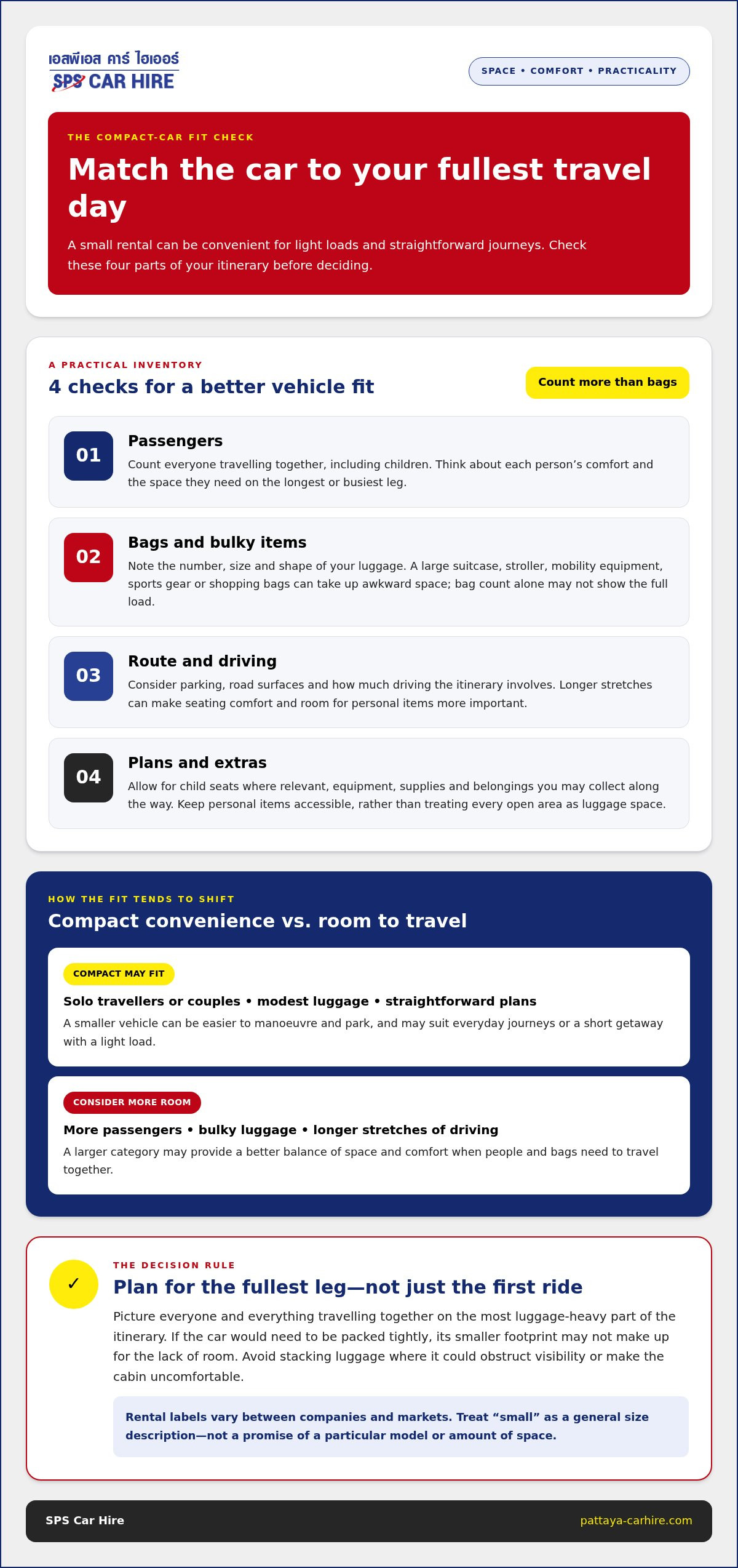
- Passengers: Count everyone travelling together, including children.
- Bags: Consider the number, size and shape of each item, not only the total count.
- Route: Think about parking, road surfaces and how much driving the itinerary involves.
- Plans: Allow for shopping, equipment or extra belongings you may carry during the trip.
If the car would need to be packed tightly for every leg, its smaller footprint may not make up for the lack of room. Choose a size that works for the busiest, most luggage-heavy part of your itinerary. Matching the vehicle to the whole journey makes it easier to identify a practical self-drive option.
How to Judge Space, Comfort, and Practicality Before Hiring
Start with your actual travel load, not the category label. Write down everyone who will ride, the bags and equipment they will bring, and how you will use the vehicle throughout the trip. This quick inventory helps you judge when a compact rental may be comfortable and when limited space could become a daily frustration.
Count adults and children, then note items that take up awkward space, such as a large suitcase, folded stroller, mobility equipment or shopping bags collected along the way. Include child seats in your planning where relevant, without assuming a particular rental includes one. Leave space for personal items you will want close at hand rather than treating every open area as luggage capacity.
Choose a vehicle by matching the passenger count, the shape and number of bags, and the length of your trip. A car that works for a light day out may be less suitable when everyone and their luggage must travel together for several days.
Will a small car fit your passengers and luggage?
Small car hire may suit a group with a manageable load, but passenger numbers alone do not tell you whether everyone will travel comfortably. Consider how much room each person needs and whether bulky bags will compete for shared space. A few soft bags may be easier to arrange than rigid cases, while unusually shaped equipment can be difficult to fit. Think through the fullest journey, not just the leg with the least luggage.
For a practical check, group your items by type and identify which ones must travel on every leg. If your plans depend on carrying mobility equipment, a stroller or other bulky items, consider their actual shape rather than estimating by bag count. Don’t plan to stack luggage where it could obstruct visibility or make the cabin uncomfortable.
How trip length and driving plans affect comfort
An occasional short journey places different demands on a vehicle than frequent or extended driving days. For longer stretches, consider whether everyone can sit comfortably, get in and out easily, and keep necessary personal items accessible. If passengers need more room or the itinerary involves substantial driving, a larger category may be a better fit than a compact option.
Your route matters too. Regular stops, repeated loading and unloading, and changing plans can make access and storage more important than they first appear. Think about the least convenient part of the trip, such as moving everyone and their bags after a full day, then decide whether a compact vehicle still feels practical. The U.S. federal rental car policy generally directs federal travellers toward compact cars, with exceptions for needs such as passenger or luggage space. This is U.S. guidance, not a Thailand rental rule, but it illustrates why trip requirements can justify choosing a different size.
Once you have set your space and comfort priorities, compare self-drive options against the complete itinerary. Choose a vehicle and rental period that work for your plans, rather than deciding by category alone.
Small Car Hire Compared With Larger Rental Options
The smallest vehicle is not automatically the best-value choice. A compact car may be easier to handle and practical for light travel, but if it cannot comfortably carry your group and belongings, a larger category may suit the trip better. Compare how each option works across the whole itinerary, including possible changes of plan, rather than choosing on size alone.
| Category | Typical use | Space considerations |
|---|---|---|
| Small car | Everyday journeys and trips with a lighter load | Less room for passengers and luggage than larger categories; compact dimensions may be convenient for parking. |
| Larger car | Journeys where passenger comfort or flexibility matters | More room may help with additional passengers, bags, or changing plans, though the vehicle takes up more space. |
| Truck | Moving tasks or carrying bulky loads | Better suited to carrying needs than passenger-focused travel; consider whether the load is the priority. |
Small car or larger car: which suits your group?
Small car hire can suit a light travel load, while a larger car may offer useful breathing room for passengers and belongings. The difference becomes clearer when plans are flexible: an extra passenger, an unplanned purchase or a change in itinerary can make additional space valuable. More room can also help you keep personal items accessible instead of rearranging luggage at every stop.
There is no universal winner. Consider how often you will carry everyone together, how much comfort matters on the longest drive, and whether your plans may expand. Fuel use varies with the vehicle and how it is driven, so don’t assume the smallest category guarantees lower overall costs. Rental terms and the needs of the trip matter too. Compare the full terms and practical fit before choosing.
If you are weighing self-drive against other ways to get around, consider how often you will travel, how much flexibility you need and whether you will make several stops. Those details can help you decide which transport option fits your plans.
When a truck is more practical than a small rental car
Consider a truck when the main task is carrying a bulky load or handling a move, rather than transporting passengers on a typical trip. Think about what you need to move and whether a passenger-focused car would require awkward packing or multiple journeys. Base the decision on the load, not on the assumption that one category suits every purpose.
For an extended utility-vehicle need, consider how long the task will take and what carrying needs must be met throughout. For ordinary travel, compare passenger comfort, luggage room, route and rental duration before choosing a category. The right fit is the one that handles the actual task without adding space or capability your plans do not call for.
What to Check Before Starting a Self-Drive Rental
A few careful checks before departure can make a self-drive rental easier to manage. Read the agreement, prepare the required documents, inspect the vehicle and understand how and where it must be returned. For small car hire in Thailand, use the rental agreement and current official guidance as reference points, since document requirements and conditions can vary.
Follow this sequence before setting off:
- Review the rental terms. Read the driver eligibility conditions, permitted use, rental period and any responsibilities that apply during the hire. Make sure you understand the agreement’s conditions and restrictions.
- Prepare your documents. Check the current document requirements for your circumstances and have the required items ready before collection. Requirements can depend on current rules and the rental conditions.
- Inspect the vehicle. Walk around the car and look for visible marks, scratches, dents or other concerns. Familiarise yourself with the controls you will need and note the fuel level before departure.
- Understand the return process. Review the return instructions in your agreement, including the expected return time and condition. Keep the instructions accessible so you can plan the final part of the rental.
Documents and rental terms to understand
Before collection, read the agreement closely instead of assuming every rental has the same conditions. Check who is permitted to drive, what use is allowed and what the return instructions require. Prepare documents according to current official guidance and the specific rental conditions. If a clause is unclear, make sure you understand it before accepting the vehicle and driving.
Inspect the car and understand insurance
Take your time during the walk-around. Photograph existing marks clearly from more than one angle, and record their location and appearance through the agreed inspection process before driving away. Include the interior if you notice visible damage there. Make sure concerns are documented rather than relying on memory after the trip.
Inside the vehicle, familiarise yourself with essential controls before entering traffic. Check and note the fuel level so you can compare it with the return instructions later. A calm inspection is more useful than rushing through collection and discovering an issue once you are on the road.
Read the insurance terms carefully. Review what the agreement says about coverage, exclusions and your responsibilities if the vehicle is damaged. Don’t assume a general description explains every detail. Understand how the terms apply to your trip before accepting the rental.
Ready to arrange practical self-drive transport? Explore SPS Car Hire’s self-drive rental options and choose a rental period that fits your plans.
Arrange Budget-Friendly Self-Drive Car Hire With SPS Car Hire
A rental that fits your plans should work for the people, belongings and journeys you actually have, not just look like the simplest category on a booking page. Before choosing, bring together the practical decisions from this guide: vehicle size, passenger and luggage needs, trip length, driving plans and rental terms. This gives you a clear basis for comparing self-drive options without making assumptions about a vehicle’s capacity or cost.
SPS Car Hire provides budget-friendly self-drive car rentals, with short- and long-term options. The right choice depends on how long you need the vehicle and what you will ask it to do. A compact option may suit a lighter load and straightforward plans; a larger car or truck may be more appropriate when passenger comfort or carrying needs take priority. Aim for a sensible match, not the smallest category at any cost.
Choose a rental period that fits your plans
Short-term car hire can suit a defined trip or a brief period of independent travel. If you need a vehicle for an extended stretch, a long-term rental option may fit better than arranging separate short hires. Think through the dates you expect to need the vehicle, then compare the rental period and terms with your itinerary. SPS Car Hire offers both short- and long-term car rental options, so you can plan around different trip durations.
Before settling on a category and rental length, make a quick final review:
- People: Account for everyone travelling together, including any comfort needs on longer drives.
- Belongings: Consider how your bags and other items will fit, especially on the fullest travel day.
- Purpose: Decide whether the vehicle is mainly for passenger journeys or carrying bulky items.
- Duration: Align the rental period with your planned dates and read the terms that apply.
Make the next step simple
Once those details are clear, you can compare self-drive options with a better sense of what suits your trip. SPS Car Hire offers best-price guarantees for rentals, alongside budget-friendly car and truck hire. Review the rental details in light of your travel needs, and choose the option that fits the journey rather than relying on category labels alone.
Explore SPS Car Hire self-drive car hire and take the next step toward convenient, independent travel.
Make Your Next Journey Easier to Plan
The right rental choice should make the trip feel simpler before you set off. Picture an ordinary day on the road: where you will go, what you will carry and how much flexibility you want if plans change. That final check can help you choose a vehicle that supports the trip instead of becoming another detail to work around. The goal is not to choose the smallest option by default, but to select small car hire that matches the people travelling and the way you expect to use it.
Think of this decision as part of shaping the pace of your time away. A clear plan at the start leaves more attention for the places, people and activities you came to enjoy. When you are ready to plan independent travel, explore SPS Car Hire’s self-drive options and choose a rental period that works for your journey.
Explore SPS self-drive car hire and set your plans in motion with confidence.
Frequently Asked Questions
Is a small car a good choice for a self-drive trip in Thailand?
It can be, if the vehicle suits your group and the roads on your planned route. A compact car may work well for everyday journeys and lighter travel, while extended driving, rough surfaces or frequent stops can make comfort and clearance more important. Consider the full itinerary, including how often you will drive and where you will park, rather than judging suitability by the first day alone.
Can a small hire car fit four passengers and their luggage?
It depends on the vehicle’s actual interior and luggage space, as well as the size of your bags. Four people travelling with small day bags have different needs from four people carrying rigid suitcases for a longer stay. Don’t rely on passenger count alone or assume all luggage will fit securely. Compare your group’s belongings with the vehicle details, and consider a roomier category if the load leaves little flexibility.
What should I check before renting a small car?
Read the agreement for driver eligibility, permitted use, insurance terms, exclusions and return instructions. Check which documents apply to your circumstances under current rules and the rental conditions. At collection, inspect the interior and exterior, make sure you understand the essential controls, and note the fuel level. Photograph visible damage clearly and make sure concerns are recorded before departure, so you have a useful reference if questions arise later.
Is a small rental car always cheaper to run?
No. Running costs depend on more than vehicle size, including driving conditions, distance, traffic and how the vehicle is used. A smaller car may be practical for lighter travel, but it does not guarantee lower overall costs. Compare the rental terms and consider whether the vehicle can handle your trip comfortably. Choosing too little space could create inconvenience, while a larger vehicle may make better sense for passengers or equipment.
How much does small car hire cost?
There is no single fixed price for small car hire. The total can vary with rental dates, duration, vehicle category and the agreement’s terms. For a useful comparison, look at the full rental total rather than focusing on a headline rate, and note what the agreement says about insurance, fuel, deposits and return conditions. SPS Car Hire offers best-price guarantees for rentals; compare the rental details with your plans.
Do I need an International Driving Permit to rent a car in Thailand?
Whether you need an International Driving Permit depends on your licence and the rules that apply to your situation. Requirements can change, so don’t rely on advice intended for another country or assume a familiar licence is sufficient. Before travelling, check current Thai government guidance and the rental agreement’s document requirements. Prepare the relevant original documents, and make sure their details match the driver who will use the vehicle.
Should I choose a small car or a truck for luggage and equipment?
Choose according to whether your priority is carrying passengers or transporting a bulky load. A small car may suit personal bags alongside a group, but large equipment, boxes or items for a move may call for a truck rental. Think about the load’s shape and how often you will need access to it. If passengers and cargo both need substantial room, compare the practical trade-offs before selecting a category.
 -
- -
- -
- -
- -
- -
- -
-