


A rental shop handing over a scooter doesn’t prove your licence authorises you to ride it. If you’re searching for a driving license for scooter rental Thailand, remember that being allowed to rent and being legally qualified to ride are different things. A car-only licence won’t cover a scooter, and missing motorcycle entitlement or permit documents could create problems if you’re stopped or involved in a crash.
Online advice can be confusing, especially when rental counters don’t always ask to see every document. This guide explains what tourists generally need to ride legally, why a valid motorcycle entitlement matters alongside an International Driving Permit, and how a longer stay can affect licensing requirements. It also covers what to check before setting off and why an invalid licence may put insurance coverage at risk. Use these checks to make a safer, more informed choice about renting a motorbike or choosing another way to travel.
Key Takeaways
- Before choosing a driving license for scooter rental Thailand, check that your motorcycle entitlement covers the vehicle you plan to ride.
- Carry your valid home-country licence and the required International Driving Permit; the permit supports your licence rather than replacing it.
- Compare rental requirements with your insurance policy wording. A rental shop’s approval doesn’t determine whether you’re legally authorised or insured.
- Before setting off, verify your documents, licence categories, and relevant policy terms. If anything is unclear, choose another way to travel until you have confirmed your eligibility.
Thailand Scooter Rental: What License Do You Need?
To ride a rented scooter legally in Thailand, you need valid motorcycle authorisation for the vehicle and the required supporting documents. A rental shop handing over the keys doesn’t replace the correct licence. Tourists generally need a valid home-country licence with motorcycle entitlement and a valid International Driving Permit (IDP).
These documents serve different purposes. Your home licence is the driving licence issued by your country. Your motorcycle entitlement is the category or endorsement authorising you to ride a motorcycle. An IDP accompanies your licence and presents its information for use abroad; it doesn’t create motorcycle permission that your home licence doesn’t provide.
Thailand’s licensing framework, summarised in the Driving license in Thailand overview, concerns legal authorisation to drive, not a rental shop’s decision to release a vehicle. In short, rental acceptance is permission from a business to take its vehicle, while legal authorisation depends on holding the documents required to ride on Thai roads. Treat these as separate checks.
When checking a driving license for scooter rental Thailand, start with the motorcycle category on your licence, then make sure your IDP reflects the same entitlement. Licence labels and rules can vary by country. Before travelling, confirm through an official Thai authority that your specific category is accepted for motorcycle use in Thailand.
Does a car driving licence let you ride a scooter?
No. Don’t assume a car-only entitlement covers a scooter. Check the category printed on your home licence and look for explicit motorcycle authorisation. Tourists generally need full motorcycle entitlement, commonly Category A, alongside an IDP; a car-only Category B licence isn’t enough. Restricted A1 or A2 entitlements may not qualify, so verify your exact category and any applicable exceptions with an authoritative source.
Engine size isn’t an automatic workaround. Thailand does not provide a small-engine exemption for two-wheeled motorised vehicles. If your licence category is restricted, don’t infer that a smaller scooter is legally covered. Check your entitlement, not just the vehicle’s appearance or engine size.
Why rental-shop practice is not proof of legal permission
A rental transaction confirms only that the shop has agreed to rent you a vehicle under its own process. It doesn’t certify that your documents meet Thai road-use requirements. An informal document check can’t change what your licence authorises, and a shop might accept documents without examining every category. Don’t treat that acceptance as legal approval.
Before deciding to ride, check that:
- Your home licence is valid and explicitly includes motorcycle entitlement.
- Your IDP is valid and corresponds to your motorcycle-authorised licence.
- You’ve verified your licence category and permit requirements with an official source if the wording is unclear.
If any part of the check is uncertain, pause before riding. Rental convenience doesn’t replace the required authorisation.
International Driving Permit for Thailand: match it to your motorcycle licence
An International Driving Permit (IDP) is not a standalone licence. It accompanies your valid home-country driving licence and doesn’t add motorcycle permission if your original licence covers cars only. For scooter riding, check that your home licence includes motorcycle entitlement and that the IDP reflects it. The documents should support the same vehicle category, not contradict each other.
Your home licence must authorise motorcycle riding, and your IDP must reflect that entitlement. Neither document makes up for a missing motorcycle category on the other. Thailand recognises IDPs issued under both the 1949 Geneva Convention and the 1968 Vienna Convention. For official Thai licensing information, consult the Thailand Department of Land Transport, and verify permit recognition with the relevant issuing authority before travelling.
What should your International Driving Permit show?
Check the vehicle categories recorded in the IDP and compare them with the motorcycle category on your underlying licence. An IDP accompanies a national licence; it isn’t a separate “international driving licence,” and a translated copy of your licence isn’t automatically an IDP. The applicable convention and category markings can depend on the documents issued in your country, so verify both before relying on them.
A 1949-format IDP is valid for one year, while a 1968-format IDP can be valid for up to three years. Check the actual expiry date on your permit. UK licence holders are advised to obtain a 1968 IDP. A permit’s potential longer validity doesn’t mean it remains usable after the underlying licence expires.
Prepare your licence documents before travelling
Apply through the authorised IDP issuer in your home country. Allow time to review its application steps, required documents, and processing arrangements. Check the dates on both documents and make sure they’ll remain valid throughout your planned riding period. If your licence has a restricted motorcycle category or unfamiliar code, confirm how it is treated with the issuing authority or relevant Thai authority before setting off.
Unless official guidance clearly says otherwise, plan to carry the physical IDP and original home-country licence together. Don’t assume a phone photograph, scan, or digital copy will be accepted in place of required documents. Keep the documents accessible while riding, and check that the names and details are consistent across them.
- Home licence: valid for the planned trip and expressly includes motorcycle entitlement.
- IDP: issued by an authorised body, valid on the travel dates, and showing matching motorcycle coverage.
- Permit convention: recognised for use in Thailand and appropriate to your issuing country; check current guidance before departure.
Once your documents match and your eligibility is clear, SPS Car Hire’s budget-friendly motorbike rentals provide a self-drive option. Having the paperwork ready makes it easier to assess whether that option suits your plans.
Licence, scooter class, and insurance: resolve the common misunderstandings
A successful rental doesn’t prove you’re licensed to ride, and neither a rental transaction nor a licence alone confirms that insurance will cover a particular incident. Check three things separately: whether your licence authorises you to ride, whether the rental shop agrees to rent you a vehicle, and what the relevant insurance policy covers.
| Check | What it tells you | What it doesn’t prove |
|---|---|---|
| Licence entitlement | Whether your licence documents authorise you to ride the vehicle under applicable rules. | That a rental shop will accept the documents or that an insurer will cover a claim. |
| Rental-shop acceptance | Whether the shop agrees to rent you its vehicle under its rental process. | That you’re legally authorised to ride or meet an insurance policy’s conditions. |
| Insurance terms | How the policy applies to the vehicle, rider, and circumstances of an incident. | That every loss or claim will be covered. |
This distinction matters when researching a driving license for scooter rental Thailand. Read the rental agreement and relevant insurance documents separately. A key handover isn’t a legal or insurance decision.
Do scooter engine size and vehicle class change the requirement?
“Scooter” is an everyday label, not necessarily the legal classification that determines what licence you need. Thailand’s guidance makes no small-engine exemption for two-wheeled motorised vehicles: riders need proper motorcycle authorisation. Don’t infer eligibility from a scooter’s appearance or assumed engine size. If the vehicle category or your licence entitlement is unclear, verify it with an authoritative Thai source before riding.
Could an invalid licence affect an insurance claim?
It could create a coverage problem, but no blanket outcome can be promised. The insurer’s decision depends on the policy wording and the facts of the incident. Before renting, check provisions about valid licences, authorised riders, vehicle type or class, and exclusions. Review the rental agreement separately for its terms on damage and responsibility.
Keep these risks distinct:
- Legal rules determine whether you’re authorised to ride and what consequences may apply if you aren’t.
- Rental terms set the agreement between you and the vehicle owner, including the responsibilities described in the contract.
- Travel or rental insurance responds according to its own coverage, exclusions, and claim requirements.
For example, a shop might rent a scooter even if your documents don’t show motorcycle entitlement. That doesn’t make the ride lawful or determine whether an insurer would cover medical expenses or damage after a crash. Similarly, holding a motorcycle licence doesn’t mean every policy applies to every scooter or circumstance. Read the actual documents and resolve uncertainty before setting off.
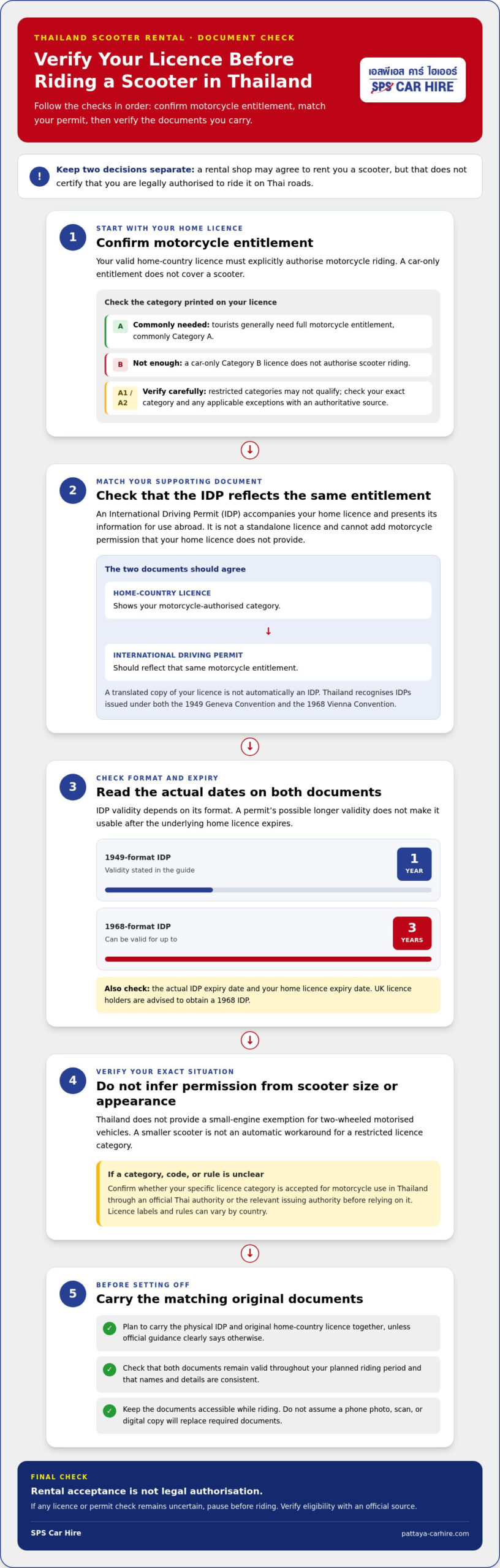
Before scooter rental in Thailand: a licence and document checklist
A short check before collecting a scooter can prevent confusion at the rental counter and help you decide whether to ride. Work through these five checks in order. Keep your documents ready, but remember that a rental agreement and an insurance policy answer different questions from whether you’re legally authorised to ride.
Five checks to complete before collecting a scooter
- 1. Read your home licence category. Confirm it’s valid and explicitly includes motorcycle entitlement. A car-only category doesn’t establish permission to ride a scooter. If category codes or restrictions are unclear, verify their meaning with the licensing authority that issued your licence and the relevant Thai authority.
- 2. Match the IDP to that entitlement. If an International Driving Permit is required for your circumstances, check that it’s valid for your travel dates and shows motorcycle coverage consistent with your home licence. An IDP doesn’t add an entitlement missing from the original licence.
- 3. Prepare the original documents. Carry your original home licence and IDP together where required. Check that names, categories, and validity dates are legible and consistent. Don’t rely on a photo or digital copy unless an official source confirms it’s accepted for your situation.
- 4. Read the rental agreement. Understand the conditions for the named rider, vehicle use, damage, and responsibility. The shop’s willingness to rent the scooter doesn’t establish that you’re legally qualified to ride it.
- 5. Review insurance wording. Check relevant exclusions and requirements, including licence validity, authorised riders, and vehicle class. Don’t assume the rental paperwork provides travel-insurance coverage or that holding a licence guarantees a claim will be paid.
Include the rental arrangements in your planning, but don’t treat them as a substitute for verifying your licence eligibility. The key decision is whether your documents clearly authorise you to ride the vehicle.
What if your documents do not clearly authorise motorcycle riding?
Pause. If the wording, category, or permit requirements leave you uncertain, don’t ride until you’ve verified your authorisation with an official source. A rental shop’s approval can’t resolve ambiguity in your licence or determine how authorities will assess it.
If you can’t establish that you’re eligible, choose another transport option rather than taking a chance. Car rental or taxis may be alternatives for getting around. Once your documents clearly support motorcycle riding and you’ve reviewed the relevant terms, you can make an informed choice about motorbike rental. Eligible riders can choose SPS Car Hire’s budget-friendly motorbike rentals as a self-drive option.
Choose a motorbike rental only after confirming your licence eligibility
Make the rental decision in the right order: confirm that you’re legally authorised to ride, then decide whether a motorbike suits your trip. Tourists generally need a valid home-country licence with motorcycle entitlement and the required valid International Driving Permit. If either document is missing, expired, restricted, or unclear, treat that as a no-go until you’ve checked the requirements with an authoritative source.
A rental shop’s willingness to provide a motorbike doesn’t change what your licence permits. Renting successfully isn’t a workaround for missing motorcycle authorisation, and it doesn’t determine whether an insurance policy will respond to a claim. Keep the questions separate: eligibility depends on your licence documents, rental is a contract, and insurance depends on the policy wording and circumstances.
When does renting a motorbike make sense?
A motorbike can be a convenient self-drive choice if you’re legally authorised, comfortable riding, and its flexibility suits your plans. Convenience alone isn’t a reason to proceed. Consider whether your documents clearly cover the motorcycle category, whether you understand the rental terms, and whether your policy conditions fit the intended use. If the paperwork leaves room for doubt, choose another transport option.
Base your decision on both licence readiness and your transport needs. If your documents are valid and match, you can weigh the practical benefits of renting a motorbike. If you have only a car licence, an unclear category, or an expired permit, resolve the issue before considering a ride. Don’t let a convenient rental process rush the decision.
Your next steps for a smoother rental decision
Before collecting a vehicle, check the motorcycle category on your home licence, make sure your IDP is valid and matches that entitlement, and review the rental agreement and relevant insurance wording. If a category or requirement isn’t clear, verify it with an official authority before setting off. This sequence helps you assess the rental on practical terms without overlooking eligibility.
- Go: Your licence clearly authorises motorcycle riding, required supporting documents are valid, and you’ve reviewed the relevant rental and policy terms.
- No-go: Your entitlement is missing or uncertain, your supporting documents don’t match, or you haven’t established the applicable requirements.
If riding isn’t right for your documents or plans, choose another transport option. If you’re eligible and ready to ride, SPS Car Hire’s budget-friendly motorbike rentals provide a self-drive option.
Make your transport choice with confidence
Your travel plans don’t need to depend on a scooter. Let your document readiness guide the decision: if your driving license for scooter rental Thailand situation is clear and you’re comfortable riding, a motorbike can be one self-drive option. If anything remains uncertain, choosing another way to get around is a sensible plan, not a setback.
SPS Car Hire offers budget-friendly self-drive vehicle rentals, including motorbikes. Choose an option that fits your plans and eligibility rather than letting convenience push you into a decision before you’re ready.
Explore budget-friendly motorbike rental options and plan your next step with confidence.
Frequently Asked Questions
Can I rent a scooter in Thailand with only a car driving licence?
You may find a rental shop willing to rent to you, but a car-only licence doesn’t authorise you to ride a scooter. The key is the entitlement printed on your licence, not whether the rental transaction goes ahead. If your document has unfamiliar category codes, check their meaning with the licensing authority that issued it and confirm how the entitlement applies in Thailand before riding.
Do I need an International Driving Permit to ride a scooter in Thailand?
Tourists generally need an International Driving Permit alongside a valid home-country licence with motorcycle entitlement. The IDP should be valid for your stay and issued under a convention Thailand recognises. Prepare both documents before travelling rather than relying on the rental shop to decide whether you can ride. If you’ll be residing in Thailand long term, check the Thai licence requirements that apply to your status.
Does my International Driving Permit need a motorcycle category for Thailand?
Yes. The permit should reflect motorcycle entitlement, and your underlying home licence must also authorise motorcycle riding. An IDP showing motorcycle coverage can’t make a car-only home licence sufficient. Compare the categories on both documents, including any restrictions, and don’t rely on a generic translation or a permit that only reflects your car entitlement. If category wording is unclear, seek an official interpretation before riding.
Is a UK CBT certificate valid for riding a scooter in Thailand?
Don’t assume a UK Compulsory Basic Training certificate is enough. CBT is not the same as holding a full motorcycle licence, and guidance for riding in Thailand requires full motorcycle entitlement rather than relying on a restricted qualification. Check your actual UK licence categories and current Thai requirements with the relevant authorities. If your documents don’t clearly establish full motorcycle authorisation, don’t ride a rented scooter.
Can I use a digital International Driving Permit when renting a scooter in Thailand?
Don’t count on a digital IDP, phone image, or scan being accepted instead of the required document. Acceptance can depend on the permit issuer and the rules applied by authorities or the rental business. Before departure, check with the authorised IDP issuer and relevant Thai authorities whether your specific digital document is recognised. Carry the original physical permit and home licence if required, and keep them accessible while travelling.
What happens if I ride a rented scooter in Thailand without the correct licence?
You may face a fine, and police can impound the vehicle if you’re unlicensed. The potential fine reported for driving without a valid licence or the correct category is up to ฿10,000; the amount imposed can depend on the circumstances. A rental shop handing over the scooter doesn’t prevent enforcement. Verify your eligibility before riding if your documents are incomplete or unclear.
Does travel insurance cover scooter accidents if I have no motorcycle licence?
Coverage isn’t guaranteed. Missing motorcycle entitlement may conflict with your policy’s licensing conditions or exclusions, and the insurer will assess the wording and circumstances of the claim. Before riding, read the policy sections on motorcycles, licence requirements, authorised riders, and medical expenses. If you can’t confirm that your situation meets the stated conditions, contact your insurer for guidance or choose another transport option rather than assuming a claim will be paid.
 -
- -
- -
- -
- -
- -
- -
-