


Understanding long term car rental cost has become increasingly important as more individuals and businesses weigh the benefits of flexible vehicle access against traditional ownership. In 2026, the economics of renting versus buying have shifted dramatically, with subscription models, extended rental contracts, and comprehensive insurance packages reshaping how we think about transportation expenses. Whether you're planning an extended stay in Pattaya or managing a corporate fleet, knowing the true cost structure of long-term rentals helps you make informed financial decisions that align with your mobility needs.
What Defines Long Term Car Rental
Long term car rental typically refers to agreements spanning 30 days to several years, distinguishing it from daily or weekly rentals. Most rental companies offer significant discounts when you commit to extended periods, with pricing tiers commonly breaking at 30, 90, 180, and 365-day intervals.
The defining characteristics include:
- Flat monthly rates that replace daily calculations
- Included maintenance and roadside assistance in most packages
- Comprehensive insurance coverage as standard
- Flexible terms allowing early termination or extension
- No depreciation risk falling on the renter
Unlike traditional leasing, long term rentals don't require large upfront deposits or credit checks in many markets. According to research published in Transportation, consumers increasingly prefer vehicle subscriptions and extended rentals because included services like insurance and maintenance reduce uncertainty around total costs.
Duration Brackets and Pricing Structures
Rental companies structure their long term car rental cost around distinct duration brackets. A 30-day rental might cost 25-30% less per day than a weekly rate, while a 12-month commitment can reduce daily costs by 50-60% compared to short-term pricing.
| Rental Duration | Typical Daily Rate Reduction | Common Use Cases |
|---|---|---|
| 30-89 days | 25-35% off weekly rate | Extended vacations, temporary relocations |
| 90-179 days | 40-50% off weekly rate | Seasonal workers, insurance replacements |
| 180-364 days | 50-60% off weekly rate | Expatriate assignments, business projects |
| 12+ months | 60-70% off weekly rate | Long-term expats, corporate fleets |
Premium services like those offered by established providers in tourist destinations often include free delivery and pickup, eliminating transportation costs to rental offices. When evaluating options, check if your car rental provider in Pattaya offers these convenience features that reduce hidden costs.

Breaking Down Monthly Rental Costs
The advertised long term car rental cost represents just the baseline. Understanding what's included versus what costs extra determines your true monthly expense.
Base Rental Fees
Monthly base rates in 2026 vary dramatically by vehicle class, location, and season. In markets like Thailand, economy vehicles might rent for $400-600 monthly on long-term contracts, mid-size sedans for $600-900, and SUVs for $900-1,400. These rates typically include:
- Unlimited or high-mileage allowances (3,000-5,000 km/month)
- Basic collision damage waiver
- Third-party liability coverage
- Regular maintenance scheduling
- 24/7 roadside assistance
Peak season surcharges can add 20-40% to base rates in tourist destinations, while off-season discounts offer similar reductions. Some companies lock rates for the entire contract period, protecting against mid-term price increases.
Insurance Components
Insurance forms a substantial portion of long term car rental cost, but the coverage level determines whether you face additional liability. First-class insurance-mandatory for legal rental operations in many jurisdictions-covers:
- Collision damage waiver (CDW) with zero or low deductibles
- Theft protection for the full vehicle value
- Third-party liability meeting legal minimums
- Personal accident insurance for driver and passengers
Budget options may offer basic insurance with high deductibles ($1,000-3,000), requiring renters to purchase supplemental coverage. Premium packages reduce deductibles to zero but add $10-25 daily to costs. Over a year, this difference totals $3,650-9,125-a significant budget consideration.
Fuel Policies and Consumption
Long-term renters face three common fuel policies:
- Full-to-full: Receive vehicle with full tank, return it full (most economical)
- Pre-purchase: Pay upfront for initial tank, return empty (convenient but often overpriced)
- Fuel-inclusive: Daily/weekly fuel allowance built into rate (rare, premium pricing)
Fuel represents a variable cost outside the base long term car rental cost. A mid-size sedan averaging 8 liters/100km driven 1,500 km monthly consumes roughly 120 liters. At 2026 fuel prices ($1.20-1.50/liter in Thailand), monthly fuel costs add $144-180 to your budget. Over 12 months, that's $1,728-2,160-potentially 30-50% of your base rental fee.
Comparing Rental Costs to Ownership
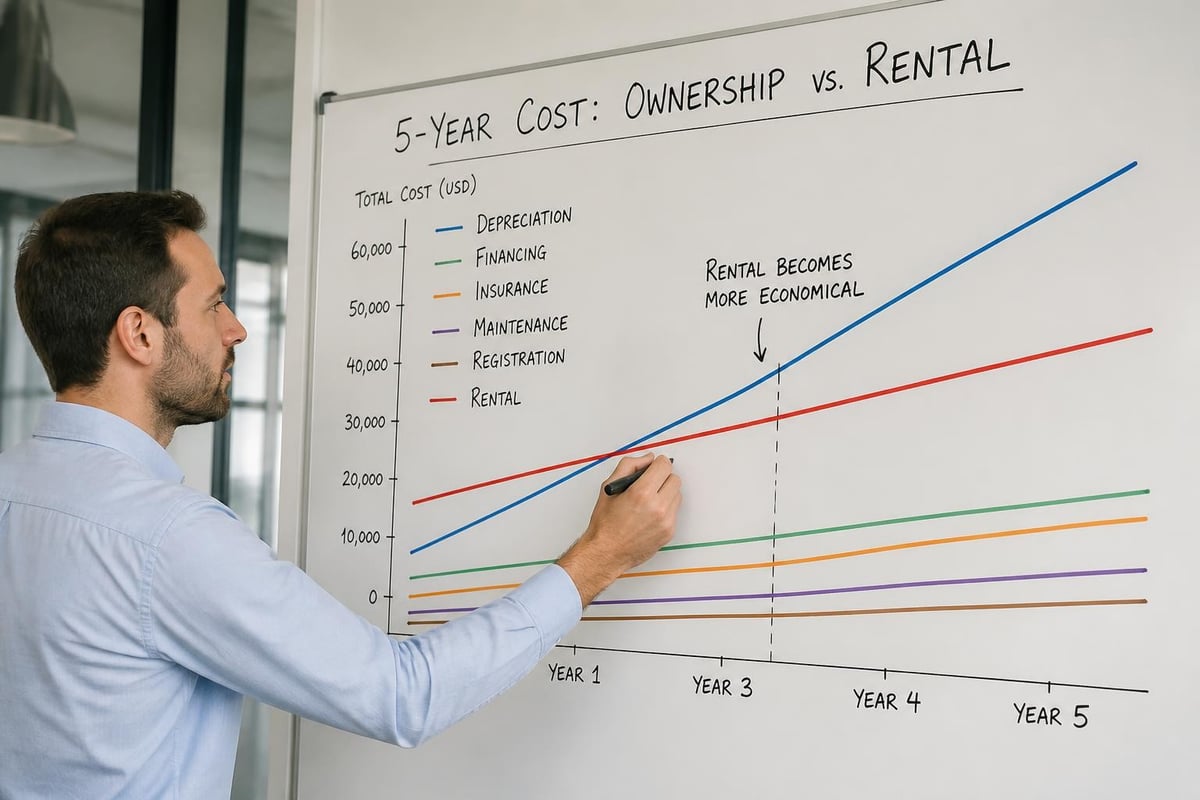
The AAA’s “Your Driving Costs” analysis provides valuable benchmarking data showing that average vehicle ownership costs $12,297 annually (or $1,025 monthly) for sedans driven 15,000 miles. This comprehensive figure includes depreciation, fuel, insurance, maintenance, financing, and registration.
Five-Year Ownership Analysis
Using Kelley Blue Book’s Total Cost of Ownership methodology, we can compare purchasing a $30,000 vehicle versus extended rental:
| Cost Category | 5-Year Ownership | 5-Year Rental (Economy) | 5-Year Rental (Mid-size) |
|---|---|---|---|
| Depreciation | $18,000 | $0 | $0 |
| Financing interest (4.5%) | $3,750 | $0 | $0 |
| Insurance | $7,500 | Included | Included |
| Maintenance | $4,200 | Included | Included |
| Registration/fees | $1,250 | Included | Included |
| Rental fees | $0 | $30,000 | $45,000 |
| Total | $34,700 | $30,000 | $45,000 |
This simplified comparison excludes fuel (identical in both scenarios) and assumes $500 monthly rental for economy, $750 for mid-size vehicles. Depreciation-the largest ownership cost-disappears entirely with long-term rentals, making them competitive for those who don't drive enough to justify ownership.
Business Tax Implications
For business users, long term car rental cost treatment differs significantly from ownership. The IRS guidance in Publication 463 specifies that businesses can deduct actual rental expenses or use standard mileage rates, but not both. In 2026, rental payments are fully deductible as ordinary business expenses without depreciation schedules or Section 179 limitations.
Owned vehicles require:
- Depreciation over 5-6 years using MACRS
- Records separating personal from business use
- Interest deduction limits on auto loans
Rental agreements simplify bookkeeping with single monthly invoices fully attributable to business use, potentially offering superior tax efficiency for high-tax-bracket businesses.
Hidden Costs and Fee Structures
Advertised long term car rental cost rarely tells the complete story. Scrutinizing contract fine print reveals additional expenses that can inflate total costs by 15-40%.
Common Additional Charges
- Young driver surcharges ($10-25/day for drivers under 25)
- Additional driver fees ($5-15/day per extra authorized driver)
- Cross-border travel permits ($50-200 per trip)
- GPS and child seat rentals ($5-10/day each)
- Airport pickup/delivery fees ($25-75 per transaction)
- Excess mileage charges ($0.15-0.30 per km over allowance)
A 12-month rental with just GPS ($7/day) and one additional driver ($10/day) adds $6,205 annually-more than 100% increase on a $500 monthly base rate. Negotiating inclusions upfront dramatically improves cost predictability.
Early Termination and Extension Penalties
Long-term contracts lock favorable rates but limit flexibility. Terminating a 12-month agreement after six months typically incurs:
- Repricing of consumed months at short-term rates (potentially doubling costs)
- Flat cancellation fees ($200-500)
- Loss of discounts and promotions applied to full-term bookings
Conversely, extending contracts often requires renegotiation at current market rates, which may exceed original pricing by 10-30% in high-demand periods. Month-to-month agreements after initial terms offer flexibility but sacrifice 15-25% in rate discounts.
Seasonal and Geographic Variations
Long term car rental cost fluctuates significantly based on location and timing. Tourist destinations like Pattaya experience 40-60% rate increases during November-February peak season versus June-September low season.
Regional Pricing Patterns
Market dynamics create substantial geographic cost differences:
- Tourist hubs: Premium pricing year-round with seasonal spikes ($600-1,200/month mid-size)
- Business districts: Stable corporate rates with weekday surcharges ($500-900/month)
- Suburban/rural areas: Lower base rates but limited vehicle selection ($350-700/month)
- Airport locations: Convenience premiums of 15-25% over city branches
Expatriate housing providers like Swissôtel Living Jakarta Mega Kuningan often negotiate corporate rates with rental companies for residents, securing 10-20% discounts through volume agreements. If you're relocating for business, check whether your accommodation includes vehicle rental partnerships.
Currency and International Considerations
International renters face exchange rate risks on long-term contracts. A 12-month agreement paid monthly in local currency protects against currency fluctuations, while prepaid annual contracts (often discounted 5-10%) lock exchange rates but reduce flexibility.
Credit card foreign transaction fees (1-3%) add to costs unless using cards with fee waivers. Wire transfer payments may incur $25-50 fees per transaction, making monthly credit card payments (despite fees) more economical than bank transfers.
Vehicle Class and Feature Impact
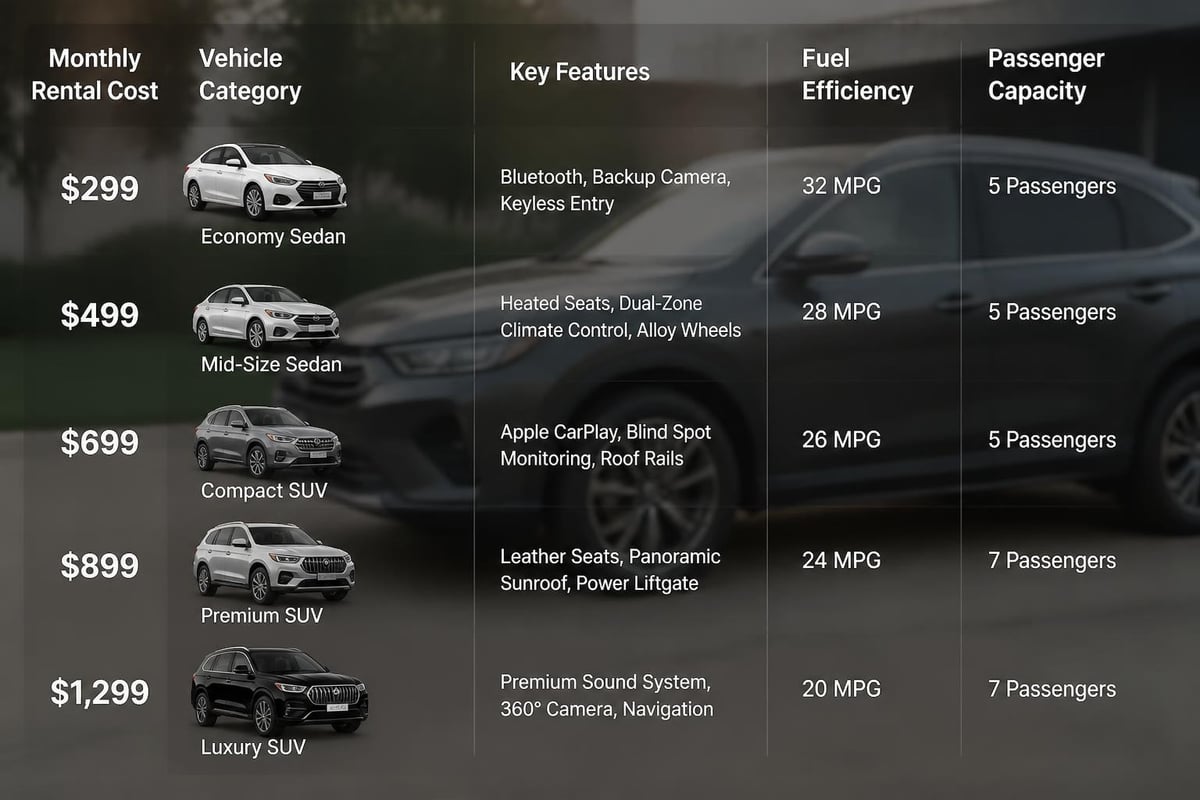
The vehicle you select fundamentally shapes long term car rental cost. Economy sedans typically cost 40-60% less monthly than full-size SUVs, but payload, passenger capacity, and feature differences justify premiums for specific use cases.
Economy versus Premium Tiers
| Vehicle Class | Monthly Range (2026) | Typical Features | Best For |
|---|---|---|---|
| Economy sedan | $400-600 | Manual, basic AC, 40 MPG | Solo travelers, city driving |
| Compact SUV | $550-800 | Automatic, upgraded interior | Small families, mixed terrain |
| Mid-size sedan | $600-900 | Premium audio, safety tech | Business professionals |
| Full-size SUV | $900-1,400 | 7-passenger, 4WD, luxury features | Large families, off-road needs |
| Luxury/performance | $1,500-3,000 | Premium brands, advanced tech | Executive travel, special occasions |
Stepping up one class increases monthly costs by $150-300 but may deliver substantial value through improved comfort, safety features, and capability. Calculate the cost per additional benefit rather than focusing solely on base price differences.
Electric and Hybrid Options
The International Energy Agency’s Global EV Outlook 2024 documents rapid EV total cost of ownership improvements as battery costs decline and charging infrastructure expands. Long term car rental cost for EVs in 2026 shows interesting patterns:
- Rental premiums: EVs cost 10-25% more monthly than equivalent gasoline vehicles
- Fuel savings: Electricity costs 50-70% less than gasoline per kilometer
- Maintenance benefits: Fewer moving parts reduce service costs (already included in rentals)
A $700/month EV versus $600 gasoline vehicle adds $1,200 annually in rental costs but saves approximately $900-1,200 in fuel, reaching near parity. Renters with home charging access maximize savings, while those depending on public charging face convenience trade-offs.
Corporate and Business Long-Term Rental
Businesses approach long term car rental cost differently than individuals, prioritizing fleet flexibility, tax efficiency, and administrative simplification over absolute lowest rates.
Fleet Management Benefits
Corporate long-term rental agreements offer:
- Predictable monthly expenses replacing capital outlays
- Scalability to add or reduce vehicles as headcount changes
- Outsourced maintenance freeing internal resources
- Reduced insurance complexity with blanket commercial coverage
- Newer vehicle fleet without resale logistics
Strategy& automotive research indicates that companies increasingly prefer subscription and long-term rental models over ownership for vehicles outside core business functions (delivery fleets, service vehicles). The flexibility to right-size fleets quarterly justifies 10-15% cost premiums over ownership in dynamic businesses.
Volume Discounts and Negotiation
Multi-vehicle agreements unlock substantial savings:
- 5-10 vehicles: 10-15% off standard long-term rates
- 11-25 vehicles: 15-25% discounts plus priority service
- 26+ vehicles: Custom pricing, dedicated account management
Businesses can leverage these discounts by consolidating rental needs. Three departments each renting 4 vehicles individually pay full rates; pooling into a 12-vehicle agreement saves $8,000-15,000 annually.
When Long-Term Rental Makes Financial Sense
Determining whether long term car rental cost delivers value versus alternatives requires analyzing your specific circumstances across multiple dimensions.
Ideal Scenarios for Long-Term Rental
Short-to-medium term needs (3-24 months)
Temporary assignments, sabbaticals, extended travel, or project-based work make ownership impractical. Rental eliminates disposal hassles and depreciation risk.
Low annual mileage (under 15,000 km)
Ownership costs spread over fewer kilometers increase per-kilometer costs dramatically. Consumer Reports’ leasing analysis shows that low-mileage drivers benefit most from usage-based models.
Desire for newer vehicles
Rental fleets turn over every 1-3 years, guaranteeing modern safety features, reliability, and efficiency without long-term commitments.
Business tax advantages
Companies in high tax brackets maximize deductions through fully deductible rental expenses versus depreciation schedules.
Avoidance of maintenance uncertainty
Included maintenance eliminates surprise repair costs that plague older owned vehicles, particularly important for those without mechanical knowledge.
For residents and visitors in Thailand's Eastern Seaboard region, finding comprehensive car rental options in Pattaya with transparent pricing and full insurance coverage simplifies the decision process.
When Ownership Proves More Economical
Long-term needs (5+ years)
Ownership becomes increasingly cost-effective as depreciation slows in years 4-6 and rental payments accumulate without building equity.
High annual mileage (over 25,000 km)
Excess mileage charges in rental agreements (or limited high-mileage plans) make ownership with its unlimited usage more economical.
Specific vehicle requirements
Custom modifications, specialized equipment, or rare vehicle types may be unavailable or prohibitively expensive in rental fleets.
Strong creditworthiness enabling low financing rates
Buyers securing 0-2% financing reduce the interest cost advantage of rentals, especially when manufacturer incentives apply.
Negotiating Better Long-Term Rates
Long term car rental cost negotiation succeeds when you understand provider cost structures and competitive positioning. Rental companies face high fixed costs (fleet acquisition, insurance, facilities) and variable costs (maintenance, depreciation) that create negotiation opportunities.
Timing and Seasonal Leverage
Book during off-peak periods when fleet utilization drops below 70%. Providers prefer locking lower rates over idle inventory, creating 15-25% negotiation room in low seasons.
Commit to longer terms. Each duration jump (30→90→180→365 days) unlocks new discount tiers. Proposing 13 months instead of 12 may trigger annual rate application to the full term.
Prepay when possible. Full advance payment reduces administrative costs and collection risks, justifying 5-10% discounts. Ensure contracts include proportional refunds for early termination before prepaying.
Bundling and Value-Adds
Rather than demanding lower headline rates, request included services that add value without significant provider cost:
- GPS and child seats (provider cost: $2-3/day; retail: $7-10/day)
- Additional drivers (administrative cost: minimal; retail: $10-15/day)
- Extended mileage allowances (marginal cost: maintenance only; retail: $0.20-0.30/km)
- Free delivery/pickup within reasonable radius
- Flexible cancellation terms (24-48 hour notice instead of 7-day requirements)
These concessions improve your total value by 10-20% without requiring rate reductions that impact provider profitability. Many businesses find this approach to long term car rental cost optimization more successful than aggressive price negotiations alone. Companies like SPS Car Hire that include first-class insurance and free delivery as standard offerings demonstrate this value-focused approach.
Insurance and Liability Considerations
Insurance represents 20-35% of long term car rental cost, making coverage understanding essential for both financial planning and risk management.
Coverage Tiers and Deductibles
Most long-term agreements offer three insurance levels:
Basic coverage
Meets legal minimums with high deductibles ($1,500-3,000 for damage, $500-1,000 for theft). Monthly savings of $300-500 annually versus premium coverage.
Standard coverage
Moderate deductibles ($500-1,000 for damage, $250-500 for theft). Balances cost and protection for most renters.
Premium/zero-deductible coverage
Eliminates out-of-pocket costs for covered incidents. Annual premium increase of $1,200-3,000 versus basic coverage.
For business use or areas with high accident rates, premium coverage provides budget certainty. Personal renters with emergency funds may accept basic coverage, self-insuring the deductible gap.
Third-Party Liability Limits
Standard rental agreements in Thailand and many markets include minimum legal liability coverage (often $50,000-100,000 for property damage, $25,000-50,000 per person for injury). These limits may prove inadequate in serious accidents involving multiple vehicles or injuries.
Supplemental liability insurance (SLI) increases limits to $1,000,000 or more for $5-15 daily, or $1,825-5,475 annually. High-net-worth individuals and businesses face asset exposure if limits prove insufficient, making SLI a prudent investment despite increasing long term car rental cost by 10-20%.
Maintenance and Service Inclusions
Included maintenance represents significant value in long-term rental agreements, typically worth $800-1,500 annually for sedans, $1,200-2,500 for SUVs based on manufacturer service schedules.
What's Typically Covered
Standard long-term rental maintenance includes:
- Oil changes and fluid top-ups every 5,000-10,000 km
- Tire rotation and balancing at recommended intervals
- Brake inspections and pad replacement when needed
- Air filter replacement following manufacturer schedules
- Windshield wiper replacements as required
- Battery testing and replacement if failing
- 24/7 roadside assistance including towing, jump-starts, tire changes
Providers schedule maintenance proactively based on mileage tracking systems, often arranging loaner vehicles during service to minimize disruption. This convenience eliminates the research, scheduling, and oversight required for owned vehicle maintenance.
Renter Responsibilities and Damage
Despite comprehensive coverage, renters bear responsibility for:
- Fuel level maintenance appropriate to policy
- Interior cleanliness beyond normal wear
- Reporting damage within specified timeframes (24-48 hours)
- Negligent damage (operating with known mechanical issues, off-road use in non-approved vehicles)
Unreported damage discovered at contract end may face partial or full deductible charges even under premium coverage. Documenting vehicle condition with photos at pickup and regularly throughout long-term use protects against disputed charges that inflate effective long term car rental cost.
Alternative Mobility Models
Traditional long-term rental competes with emerging mobility solutions that reshape cost-benefit calculations in 2026.
Car Subscription Services
All-inclusive monthly subscriptions bundle vehicle access, insurance, maintenance, and flexibility to switch vehicles into single fees typically 20-40% above standard long-term rental rates. The premium purchases:
- Vehicle swapping monthly or quarterly (sedan to SUV seasonally)
- Insurance flexibility covering multiple drivers without surcharges
- Fully digital management via smartphone apps
- Ultra-flexible terms with 30-day minimum commitments
For users whose needs fluctuate-professionals requiring SUVs for family weekends and sedans for business weeks-subscriptions' higher monthly cost may prove more economical than renting two vehicles or repeatedly switching traditional rentals with associated fees and logistics.
Ride-Sharing and Mixed Strategies
The Transportation research on consumer preferences demonstrates that many urban professionals optimize costs by combining long-term rental for primary transportation with ride-sharing for secondary needs (airport transfers, evening entertainment with alcohol consumption).
Break-even analysis: If long term car rental cost equals $700 monthly and you could eliminate 60% of usage through ride-sharing averaging $15 per trip, you'd need fewer than 28 trips monthly (0.9 trips daily) to justify rental elimination. Most people require transportation more frequently, but secondary vehicle needs often prove more economical through ride-sharing than second vehicle rental.
Documentation and Contract Essentials
Protecting yourself from unexpected costs requires thorough contract review before committing to long-term rental agreements.
Critical Contract Terms
Mileage allowances and overage charges
Verify monthly kilometer limits (commonly 1,500-5,000 km) and per-kilometer charges beyond limits ($0.15-0.30). Calculate expected usage conservatively; exceeding allowances by 1,000 km monthly adds $1,800-3,600 annually.
Fuel policy specifics
Confirm whether "full-to-full" means exactly full or accepts slight variations. Some providers charge $5-10 per liter below full at inflated rates versus market prices.
Permitted usage and territories
Standard agreements restrict off-road use, racing, and commercial applications (ride-sharing, delivery). Cross-border travel often requires advance notification and permits ($50-200 per trip). Violations may void insurance, leaving you personally liable for damages.
Early termination and extension clauses
Understand repricing methodology if you end contracts early. Some providers pro-rate at original rates; others recalculate consumed months at short-term prices. Extension terms should specify whether original rates continue or require renegotiation.
Insurance deductibles and exclusions
Confirm coverage excludes damage from unlisted drivers, intoxication, or gross negligence that could leave you liable despite premium coverage.
International License and Age Requirements
Long-term renters must meet licensing requirements throughout contract duration. International Driving Permits (IDP) valid for tourist rentals may not suffice for 6+ month agreements in some jurisdictions, requiring local license conversion.
Age surcharges for drivers under 25 ($10-25 daily) add $3,650-9,125 annually to long term car rental cost, potentially exceeding the base rate for economy vehicles. Some providers waive surcharges after 90-day contracts, creating negotiation opportunities.
Understanding long term car rental cost requires analyzing base rates, insurance levels, hidden fees, and comparing total expenses against ownership alternatives. Whether you need temporary transportation in Pattaya or flexible business fleet solutions, transparent pricing and comprehensive coverage determine true value. SPS Car Hire delivers competitive long-term rates with full first-class insurance and free delivery throughout Pattaya, ensuring you get reliable transportation without hidden costs. Contact us today to discuss customized long-term rental packages that match your specific needs and budget.
 -
- -
- -
- -
- -
- -
- -
-